

On this page
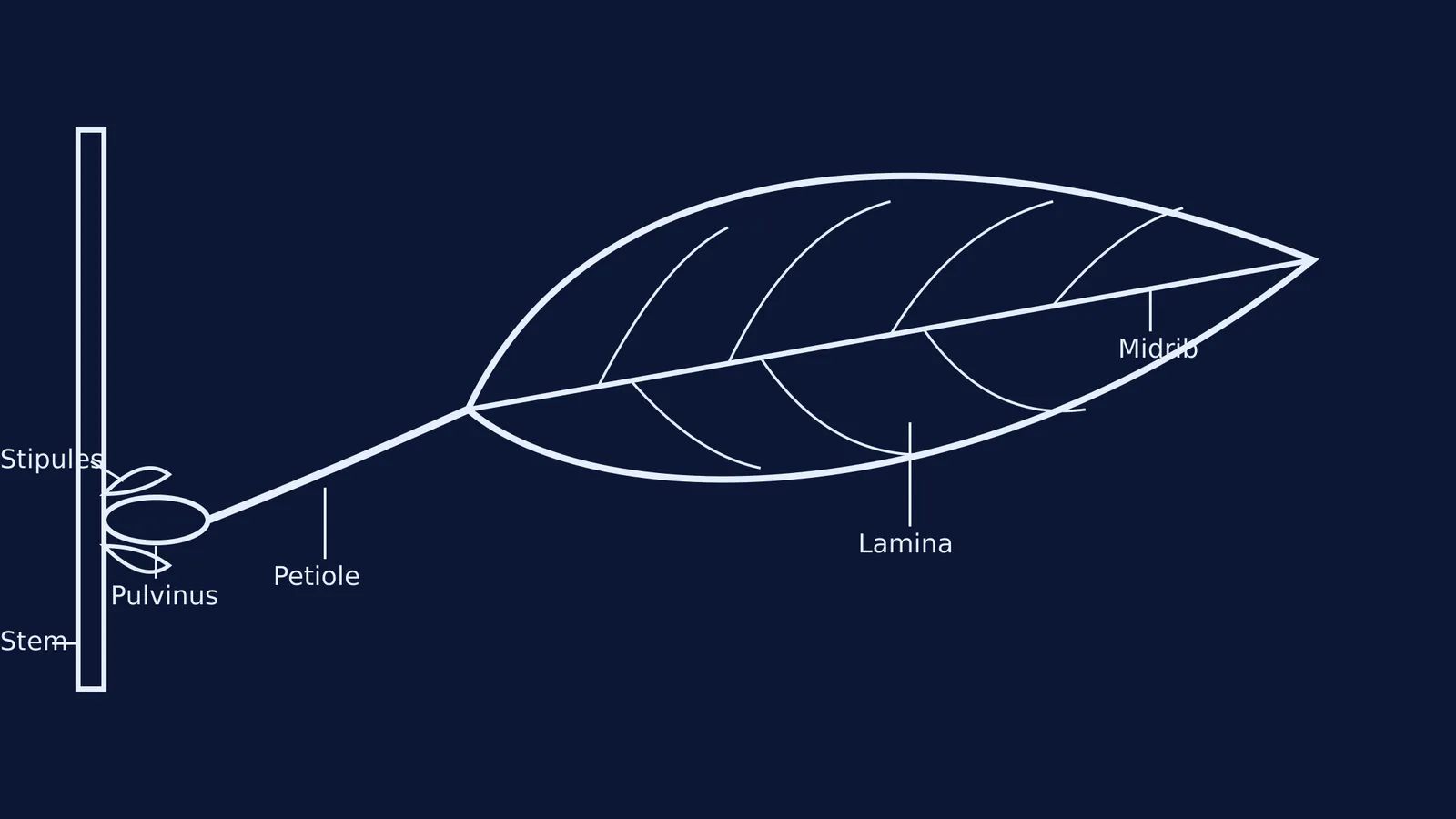
A leaf is the primary photosynthetic engine of a plant, but it is not just a simple green sheet attached to a branch. According to the NCERT Class 11 Biology syllabus, a typical leaf consists of three main parts: the leaf base, the petiole, and the lamina. Each of these parts has a distinct biological role, from anchoring the leaf securely to the stem to maximising the absorption of sunlight.
Understanding plant morphology involves looking closely at how these three structures adapt across different species. When you are learning biological terminology, breaking a complex organ down into its structural components is the best way to remember how it functions. For a deeper dive into biological structures, you can explore the Fermi Concept Library, which covers every concept in physics, chemistry, biology, mathematics and computing.
What is the leaf base and pulvinus?
The leaf base is the lowermost part of the leaf, acting as the structural anchor that attaches the entire organ to the stem at a specific point called a node. The way a leaf base attaches can vary significantly depending on the type of plant.
In some leguminous plants, such as beans and peas (family Fabaceae), the leaf base becomes distinctly swollen and fleshy. This swollen structure is known as a pulvinus. The pulvinus acts as a biological hinge, allowing the leaf to move in response to light, temperature, or touch.
This movement is driven by rapid changes in water pressure (turgor) within the cells of the pulvinus. A 2014 study published in *Scientific Reports* demonstrated that the pulvinus of *Mimosa pudica* (the sensitive plant) uses a bendable xylem bundle and an expandable epidermis to fold its leaves in just 1 to 2 seconds after being touched (DOI: 10.1038/srep06466). While the collapse is nearly instantaneous, the plant actively pumps ions and water back into the pulvinus to reopen the leaf, a recovery process that can take up to 30 minutes.
What are stipules?
In many dicotyledonous plants, the leaf base bears two small, lateral, leaf-like appendages known as stipules. When a leaf has stipules, it is described as stipulate; if they are absent, the leaf is exstipulate.
The primary function of stipules is to protect the young leaf while it is still developing in the bud stage. Once the leaf matures and unfurls, the stipules often fall off, though in some plants like the pea, they enlarge and become photosynthetic, assisting the main leaf blade in producing food.
If you are exploring how plant parts adapt to different environments, reviewing our guide on stem modifications: tendrils, thorns, rhizomes and more will give you a clearer picture of how these structural changes evolve.
What is the function of the petiole?
The petiole is the cylindrical stalk that connects the leaf blade to the stem. Its main job is to hold the leaf blade out to the light, ensuring that the photosynthetic surface is not shaded by other leaves on the same plant. Leaves that possess a petiole are called petiolate, while leaves that attach directly to the stem without one are called sessile.
Beyond simply holding the leaf up, a long, thin, and flexible petiole allows the leaf blade to flutter in the wind. This fluttering motion is not accidental; it provides a vital cooling effect for the plant and constantly brings a supply of fresh air to the leaf surface, which aids in the rapid exchange of carbon dioxide and oxygen.
What does the lamina do?
The lamina, or leaf blade, is the broad, flat, and expanded green part of the leaf. It is the primary site for photosynthesis, gaseous exchange, and transpiration (water loss).
To support this large surface area, the lamina is traversed by a network of veins. The most prominent vein usually runs straight down the middle of the lamina and is called the midrib. Lateral veins and smaller veinlets branch out from this central channel. These veins have two crucial roles: they act as a rigid skeleton that provides mechanical support to the soft tissue of the leaf, and they serve as the plumbing system, transporting water and dissolved minerals in, and carrying synthesized food out to the rest of the plant.
The arrangement of these veins—known as venation—is a key diagnostic tool in botany. Dicots typically exhibit reticulate (net-like) venation, whereas monocots usually display parallel venation. You can read more about identifying plant structures in our guide to the morphology of flowering plants: how to read a floral formula. Furthermore, if you are looking at the internal cellular layout of these veins under a microscope, our breakdown of the anatomy of flowering plants: identify any T.S. in four questions will show you what to look for.
How can you revise leaf morphology?
When preparing for a biology exam, use this simple checklist to describe any leaf you study:
Attachment: Is it petiolate or sessile?
Base: Is there a pulvinus, or does it form a sheath?
Appendages: Are stipules present (stipulate) or absent (exstipulate)?
Lamina: What is the shape of the apex and margin, and is the venation reticulate or parallel?
Walking through these four structural questions will ensure you never miss a defining feature when analysing plant specimens.


