On this page
You have a beaker of brown, sludgy ferric hydroxide at the bottom. You add a few drops of ferric chloride, shake, and the sludge turns into a dark reddish-brown liquid that no longer settles. The precipitate was broken back into colloid-sized particles, and the reason is one ion sitting on their surface.
What is peptization?
Peptization is the process in which a freshly prepared precipitate is converted into a colloidal solution by adding a suitable electrolyte, according to the theory page on preparing sols in IIIT Hyderabad's Colloid and Surface Chemistry Virtual Lab. The electrolyte is called the peptizing agent. It adsorbs onto the surface of the tiny particles in the precipitate and keeps them suspended by electrostatic repulsion.
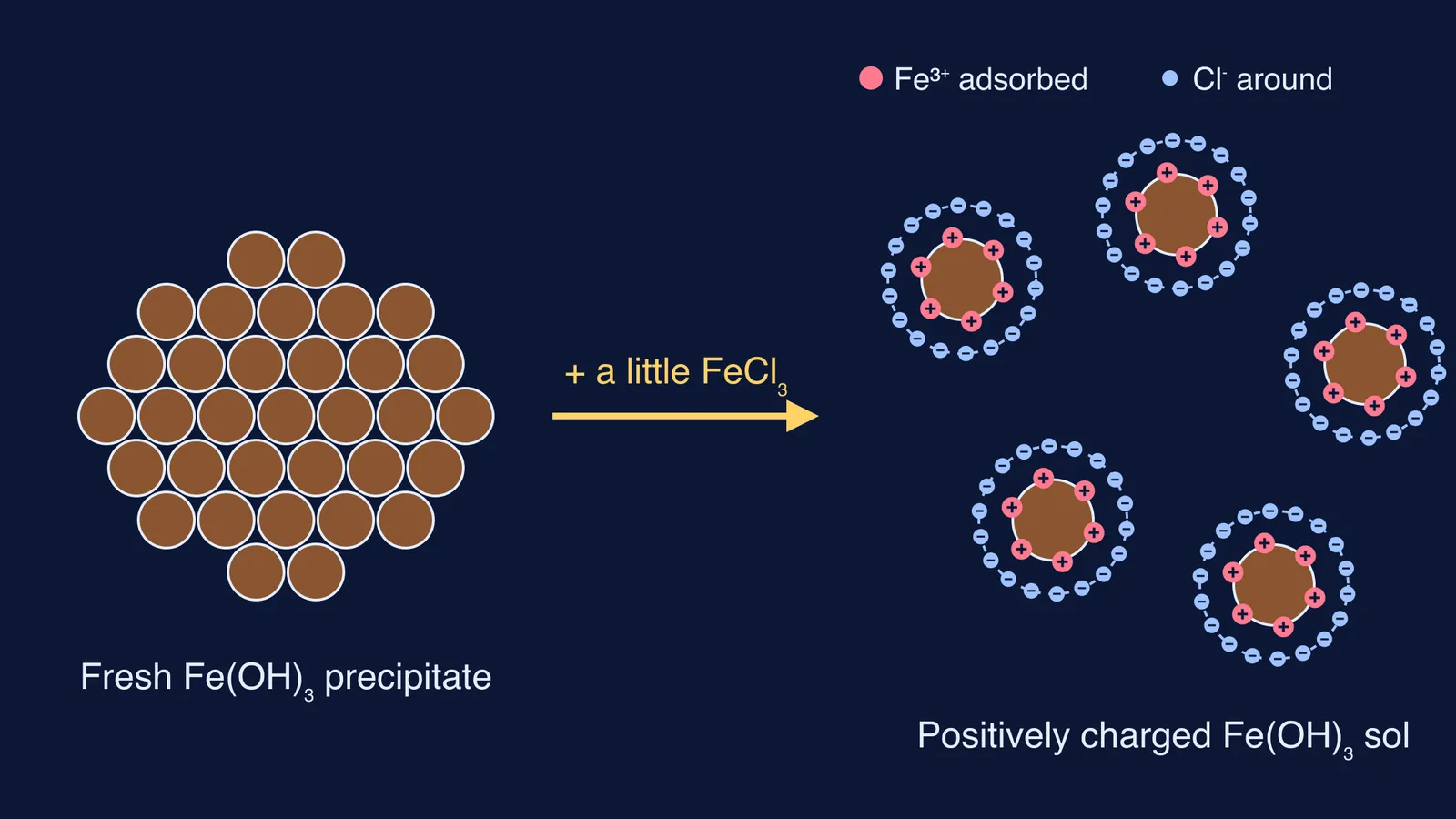
The same page gives the classic example: when freshly prepared ferric hydroxide precipitate is shaken with a small quantity of FeCl3 solution, a dark reddish-brown colloidal solution of Fe(OH)3 forms.
Peptization is the reverse of flocculation, which is why it is also called deflocculation, as the Wikipedia entry on peptization notes. Flocculation clumps colloidal particles into a precipitate; peptization takes the clump apart again.
Why does a little FeCl3 turn fresh Fe(OH)3 into a sol?
Think of the precipitate as many tiny Fe(OH)3 particles stuck together, with no charge to keep them apart. FeCl3 in water gives Fe3+ and Cl- ions, and the Fe(OH)3 surface picks up Fe3+, the ion it shares with the solid: the common ion.
Fe3+ ions adsorb on the surface of each Fe(OH)3 particle.
Every particle now carries a positive charge.
Cl- ions gather loosely in the liquid around each particle, balancing the charge.
Neighbouring particles, all positive on the outside, repel each other and drift apart.
Each particle is now colloid-sized and stays dispersed: you have a positively charged Fe(OH)3 sol.
Analytical chemists describe the same picture for silver chloride. In Harvey's Analytical Chemistry on LibreTexts/08%3A_Gravimetric_Methods/8.02%3A_Precipitation_Gravimetry), excess Ag+ ions adsorb on AgCl particles to form a positively charged primary adsorption layer, while a secondary layer of oppositely charged ions balances it. Swap AgCl for Fe(OH)3 and Ag+ for Fe3+, and you have peptization by FeCl3.
We go deeper into the sign of that charge in our post on why ferric hydroxide sol is positively charged.
Why only a little electrolyte, and not a lot?
A small amount of FeCl3 gives each particle its charge. A large amount of electrolyte crowds the liquid with ions that shield that charge.
Wikipedia's peptization entry explains that the electrical double layer at the particle surface is compressed by added electrolyte and collapses at high ionic strength. Harvey's text makes the same point from the other side: adding electrolyte thins the secondary layer, the particles get close enough to touch, and the precipitate coagulates.
So the same salt can make a sol or destroy one, depending on how much you add. Which ion destroys a sol fastest is the subject of the Hardy-Schulze rule for coagulation.
Can ferric hydroxide sol ever be negative?
Yes. The charge comes from whichever ion the surface adsorbs, not from Fe(OH)3 itself. By the same logic as the AgCl case, a surface that adsorbs anions turns negative. K. C. Sen, R. B. Ganguly and N. R. Dhar studied the coagulation of both negatively and positively charged ferric hydroxide sols in The Journal of Physical Chemistry in 1924.
Fe(OH)3 sol is a lyophobic sol, so it needs this charge to stay stable. Compare it with starch or gum in our guide to lyophilic vs lyophobic sols.
How do you write the answer for full marks?
A four-line answer for a short question such as "What is peptization? Explain with an example."
Definition: Peptization is the conversion of a freshly prepared precipitate into a colloidal sol by shaking it with a small amount of a suitable electrolyte (the peptizing agent).
Example: Fresh Fe(OH)3 precipitate + a little FeCl3 solution gives a reddish-brown Fe(OH)3 sol.
Mechanism: Fe(OH)3 particles adsorb the common ion Fe3+ and become positively charged; Cl- ions surround them.
Result: Like charges repel, the particles separate and stay dispersed as a sol, written Fe(OH)3/Fe3+.
Before you submit, check these common slips:
Writing "dissolves" instead of "disperses". A sol is not a true solution.
Leaving out "freshly prepared" and "small amount". Both are part of the definition.
Forgetting to name the adsorbed ion. "Charge appears" without saying Fe3+ loses the mechanism mark.
Mixing up peptization with the hydrolysis method, where concentrated FeCl3 is added to hot water. That route forms the sol from FeCl3 itself; peptization breaks up a precipitate you already have.
If adsorption, the double layer or sol types still feel shaky, the Fermi Concept Library has a lesson for every concept in chemistry, each with its place in the map. To practise on real questions, the Fermi Problem Library has worked problems with a step-by-step solver that explains the reasoning rather than printing an answer.
Next time you read "a little FeCl3", ask yourself two things: which ion is common, and what charge does it leave behind.