On this page
An ostrich traded flight for speed on the ground, and the main clue is hidden in its chest. Here is what stops it flying, which birds share its body plan, and a frame for writing this answer in a biology exam.
Why can't an ostrich fly?
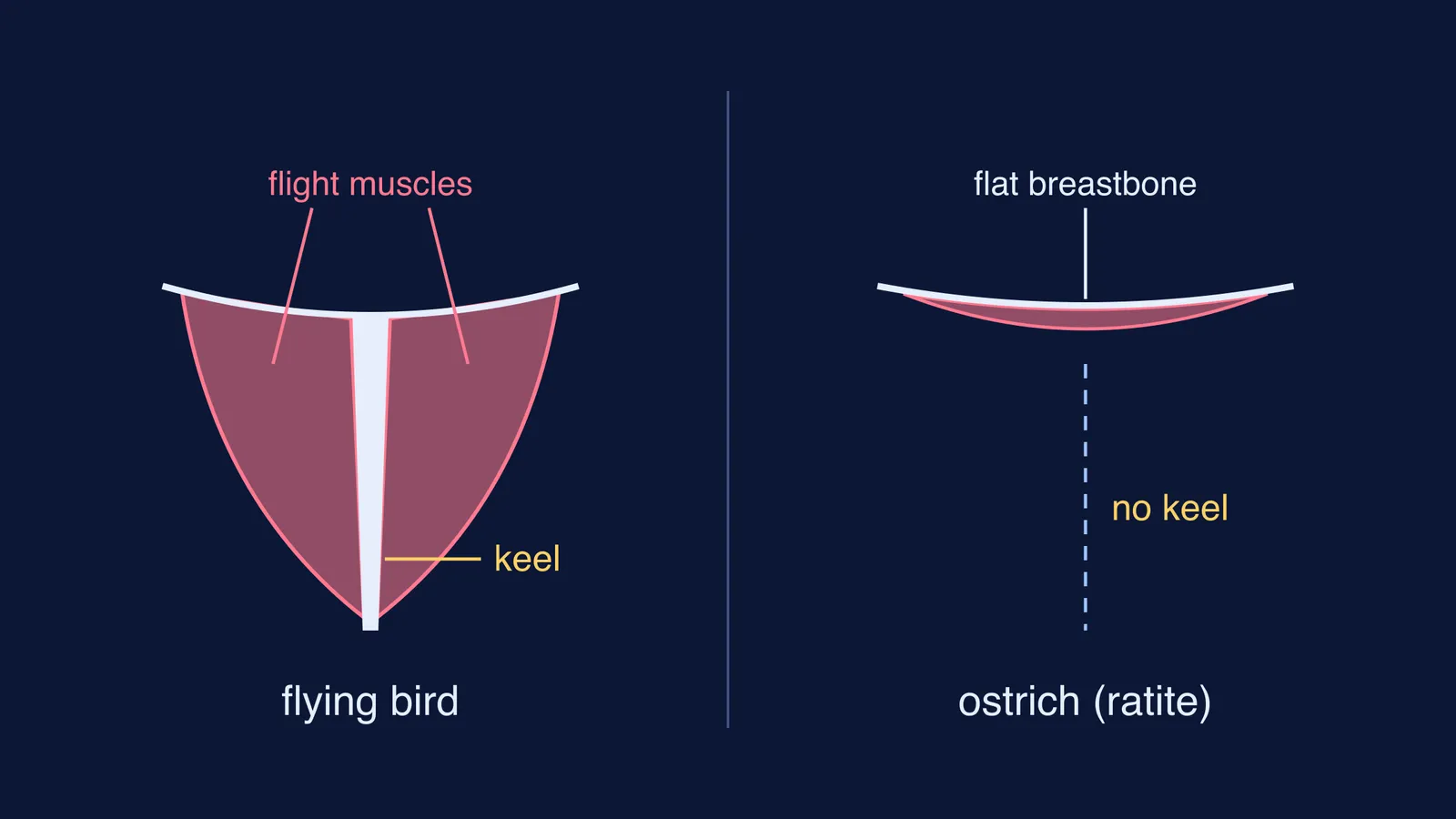
Start with the breastbone, or sternum. In a flying bird the sternum carries a tall ridge called the keel, which anchors the flight muscles, as bird blogger Kate St. John explains. The two main flight muscles are the pectoralis and the supracoracoideus, which Bret Tobalske's 2007 review of bird flight in the Journal of Experimental Biology describes as built for work and power output.
An ostrich has no keel. Ratites have "flat, smooth breastbones that lack a keel to which flight muscles could attach", says the EBSCO Research Starters entry on ostriches and related birds, so their wing muscles are weak and they cannot fly.
Three more features point the same way:
Wings with a different job. Ostriches hold their wings out to balance when they run and use them in courtship displays, says San Diego Zoo Wildlife Alliance.
Soft, loose feathers. In ratites the strands of each feather are not interlocked, so the feathers are soft and billowy rather than a firm surface that can push on air (EBSCO).
A heavy body. An adult male ostrich weighs 100 to 130 kg and stands 2.1 to 2.7 m tall (San Diego Zoo Wildlife Alliance).
What is a ratite, and which birds are ratites?
A ratite is a flightless bird whose breastbone is flat and has no keel (EBSCO). The same source groups the ostrich with the emu, cassowary, rhea and kiwi, and gives their homes:
Ostrich: Africa
Emu: Australia
Cassowary: Australia and New Guinea
Rhea: South America
Kiwi: New Zealand; the smallest ratite, about the size of a chicken
The extinct elephant birds of Madagascar were ratites too, and they hold a surprise.
Did all ratites lose flight just once?
The old story was that ratites split apart as the supercontinent Gondwana broke up. A 2014 study in Science by Kieren Mitchell, Alan Cooper and colleagues sequenced the mitochondrial genomes of two extinct elephant birds. Their closest relatives turned out to be New Zealand's kiwi, not the ostrich of nearby Africa. The authors suggest that ratite ancestors flew to new lands, and that gigantism and flightlessness evolved separately in different lineages after the dinosaurs died out.
A 2019 Science study led by Timothy Sackton and Scott Edwards compared genomes across ratites and tinamous, where flight has been lost repeatedly. The convergence lay in regulatory regions (DNA switches that control genes) tied to flight-related genes, not in protein-coding regions, and these changes influenced limb development. Flightlessness here is convergent: the same trait arising separately in different lineages.
What did the ostrich get in return for its wings?
Legs. Ratites have heavy, strong bones and powerful leg muscles, and run swiftly (EBSCO). San Diego Zoo Wildlife Alliance gives these figures for ostriches:
Sprints in short bursts at up to 70 km/h and holds a steady 50 km/h.
One stride is 3 to 5 m long.
Ostriches are the only birds with just two toes; all other birds have three or more.
Worked example: how many strides a second? Convert the steady speed: 50 km/h × 1000 ÷ 3600 ≈ 13.9 m/s. If one stride covers 4 m, the middle of the 3 to 5 m range, then 13.9 ÷ 4 ≈ 3.5 strides every second. With a 5 m stride it is about 2.8; with 3 m, about 4.6. Long strides let the bird cover ground with fewer steps, the same kind of trade-off you see in how a cheetah's body is built for speed.
If unit conversions like this trip you up, the Fermi Problem Library has worked problems with a step-by-step solver that explains the reasoning rather than printing an answer.
How do you write this answer in a biology exam?
Use this four-point frame for a short or long answer on flightless birds:
Name the group. The ostrich is a ratite, along with the emu, rhea, cassowary and kiwi.
Sternum. Flat, with no keel, so there is no ridge to anchor large flight muscles.
Wings and feathers. Wings are used for balance and display; feather strands are not interlocked.
Legs. Powerful legs with two toes, built for fast running.
For a contrast question, add a line on flying birds: a keeled sternum carrying the pectoralis and supracoracoideus. Then connect to other bird features, such as hollow bones and air sacs, and to evolution topics such as Archaeopteryx, the connecting link between reptiles and birds.
To see where ratites sit among other ideas in animal diversity and evolution, the Fermi Concept Library covers every concept in biology, each with its own lesson and its place in the map.