

On this page
A rocket gains speed by throwing mass out of the back, so its final speed depends on how much of itself it throws away. That idea also explains why orbital launchers shed parts on the way up, from ISRO's four-stage PSLV to NASA's three-stage Saturn V.
What is the formula for the final speed of a rocket?
NASA's Glenn Research Center writes the ideal rocket equation as Δu = V_eq ln(MR), where MR is the mass ratio of the full rocket to the empty one (NASA Glenn, ideal rocket equation). In the notation of your textbook:
v = u ln(m₀/m)
v is the speed gained by burnout (the final speed, from rest)
u is the exhaust speed relative to the rocket
m₀ is the mass at ignition, m the mass at burnout
The same NASA page adds gravity as Δu = V_eq ln(MR) − g₀·t_b, where t_b is the burn time, and its derivation ignores aerodynamic lift and drag. So the ideal equation is an upper limit. For the derivation, see variable-mass rocket problems; for the force side, how thrust depends on relative exhaust speed.
Why does the mass ratio matter so much?
NASA's worked example concludes that 90% of the weight of a rocket going to orbit is propellant, and that the payload is only about 1% of the launch weight (NASA Glenn, ideal rocket equation).
Speed grows with the logarithm of the mass ratio, not with the ratio itself. A rocket that is half propellant has a mass ratio of 2 and reaches 0.69u. A rocket that is 90% propellant has a ratio of 10 and reaches 2.30u. To double that to 4.6u you need a ratio of 100: a rocket that is 99% propellant.
Compare that with orbit. The International Space Station travels at about five miles per second, roughly 8 km/s (NASA, space station facts). With an exhaust speed of 3 km/s (a round number we use throughout), even a mass ratio of 10 gives 3 × ln 10 ≈ 6.9 km/s: short of orbit before gravity and drag take their share.
Why are multi-stage rockets better than single-stage ones?
Empty tanks and engines are dead mass. In NASA's words, "In order to lighten the weight of the vehicle to achieve orbital velocity, most launchers discard a portion of the vehicle in a process called staging" (NASA Glenn, rocket staging). After a drop, the next stage starts with a new, healthier mass ratio, and the speed gains of the stages add up.
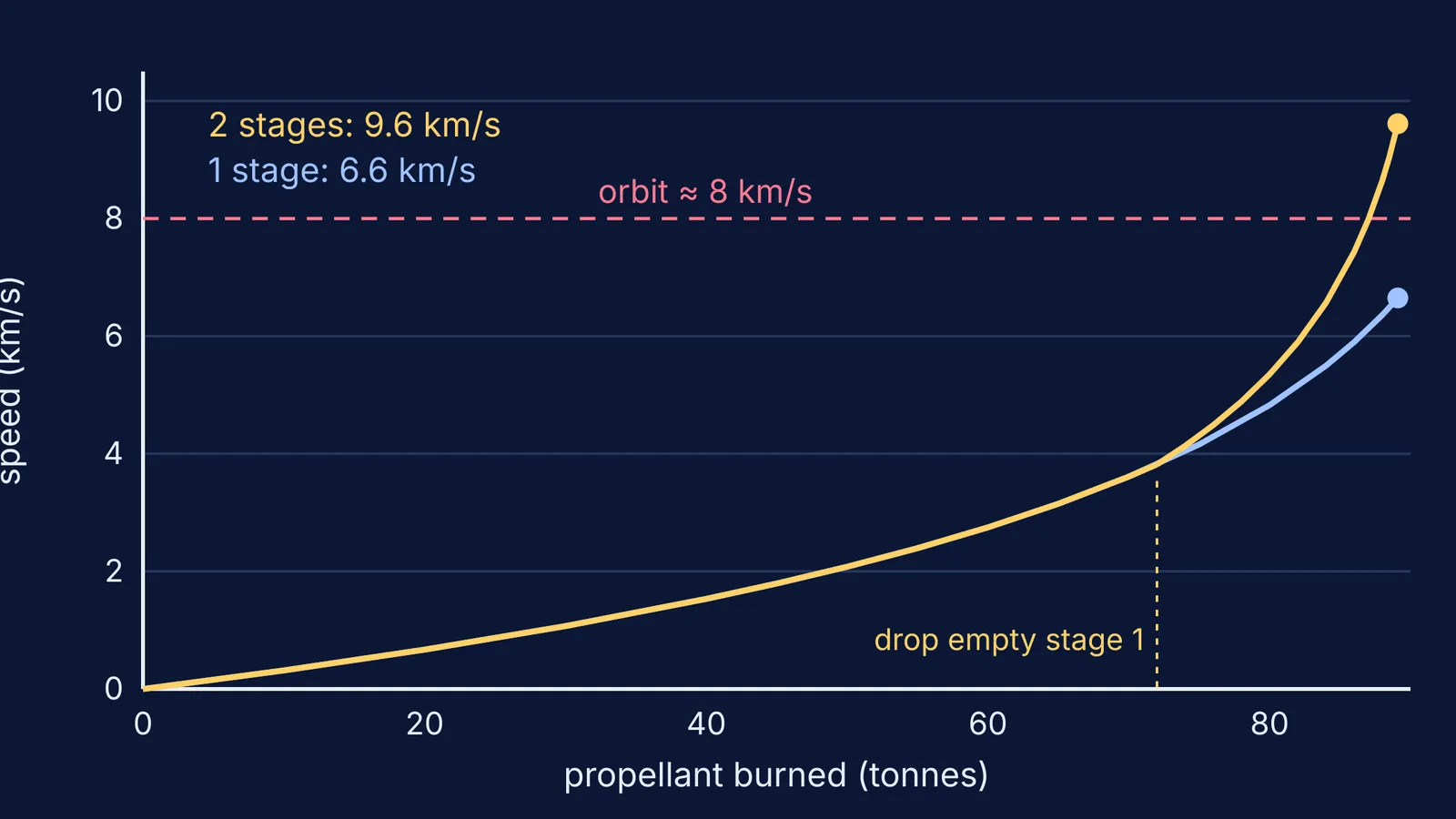
Here is a worked example with everything kept equal: 100 t at launch, a 1 t payload, u = 3 km/s, and tanks plus engines weighing 10% of each stage's fuelled mass. We ignore gravity and drag.
Single stage: the 99 t rocket body is 9.9 t of structure and 89.1 t of propellant.
m₀ = 100 t and m = 100 − 89.1 = 10.9 t, so the mass ratio is 9.17.
v = 3 × ln 9.17 ≈ 6.6 km/s.
Two stages: stage 1 is 80 t (8 t structure, 72 t propellant) and stage 2 is 19 t (1.9 t structure, 17.1 t propellant).
Stage 1 burn: m₀ = 100 t, m = 28 t, ratio 3.57, so v₁ = 3 × ln 3.57 ≈ 3.8 km/s.
Drop the 8 t empty stage. The rocket now weighs 20 t.
Stage 2 burn: m₀ = 20 t, m = 2.9 t, ratio 6.90, so v₂ = 3 × ln 6.90 ≈ 5.8 km/s.
Final speed: 3.8 + 5.8 = 9.6 km/s.
The same 89.1 t of propellant gives 9.6 km/s instead of 6.6 km/s, and only the two-stage rocket clears 8 km/s. The last tonnes of propellant push 9.9 t of empty structure in the single-stage rocket, but only 1.9 t in the two-stage one.
Staging is not free: every extra stage adds engines and separation hardware that must work in flight.
If the stage-by-stage bookkeeping is where you lose marks, the Fermi Problem Library has worked problems with a step-by-step solver that explains the reasoning rather than printing an answer.
How do you solve a rocket mass-ratio question in an exam?
List m₀ and m for every burn separately.
Remove dropped structure after a burn ends and before the next one starts.
Never use one ratio from launch mass to final mass: a drop splits it into separate ratios.
Use ln: ln 2 ≈ 0.693 and ln 10 ≈ 2.303.
Add the stage speeds. If the question includes gravity, subtract g × burn time for each vertical burn.
If logarithms feel shaky, the Fermi Concept Library gives every concept in physics and mathematics its own lesson and its place in the map. For the history, read our profile of Konstantin Tsiolkovsky and the rocket equation.


