On this page
Organising is the chapter where students lose easy marks by mixing up pairs that sound alike: functional and divisional, formal and informal, delegation and decentralisation. Here is what the CBSE syllabus asks, each pair explained, and a revision plan.
What does the CBSE syllabus include in Organising for 2026-27?
The CBSE Business Studies curriculum for 2026-27 lists Organising as Unit 5 of Part A, and Planning and Organising together carry 14 of the 80 theory marks. The same document lists these topics for the unit:
Concept and importance, as a structure and as a process
The steps of the organising process
Functional and divisional structure, with advantages, disadvantages and suitability
Formal and informal organisation, with advantages and disadvantages
Delegation: concept, elements and importance
Decentralisation: concept, importance, and how it differs from delegation
These topics are all covered in Chapter 5 of the NCERT Business Studies Part 1 textbook.
The chapter gives the organising process as four steps: identify and divide the work, group similar jobs into departments (departmentalisation), assign duties, and set up reporting relationships.
What is the difference between functional and divisional structure?
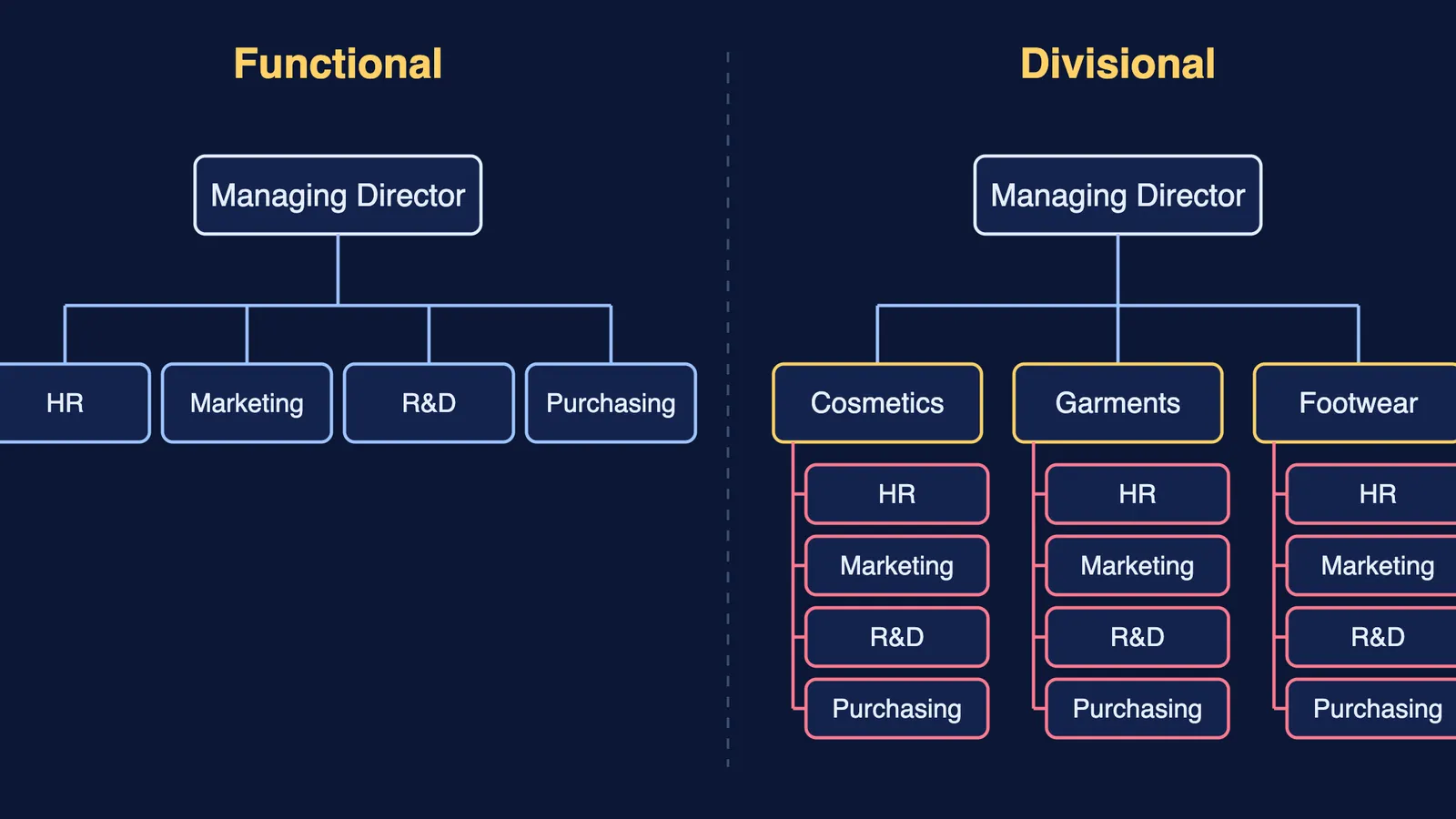
In the NCERT chapter, a functional structure groups jobs of a similar nature into departments such as production, purchase, marketing, accounts and personnel, all reporting to one coordinating head. A divisional structure is built around product lines: each division, such as cosmetics or garments, has its own head and its own functional departments inside it.
The diagram above redraws both of the chapter's example charts. The chapter compares them on six bases:
Formation: functions in one; product lines, each supported by functions, in the other.
Specialisation: functional specialisation versus product specialisation.
Responsibility: hard to pin on one department in a functional set-up; easy to fix on a division head.
Managerial development: harder in functional, easier in divisional because a division head handles every function.
Cost: functional avoids duplication, so it is cheaper; divisional repeats functions in each division, so it costs more.
Coordination: difficult for a multi-product company under functional; easier under divisional.
In case questions, separate product lines with their own profit point to divisional; firm-wide specialist departments point to functional.
How is formal organisation different from informal organisation?
The textbook describes formal organisation as the structure top management deliberately designs, with defined jobs, rules and a chain of command. Informal organisation is the network of social ties that grows by itself when people interact beyond their official roles, such as colleagues who play cricket on Sundays.
Formal organisation makes responsibility easy to fix but can slow decisions, since messages travel through the chain. Informal organisation spreads information fast but can also spread rumours and resist change. Managers are advised to use both.
What are the elements of delegation, and how is decentralisation different?
According to the NCERT chapter, delegation has three elements: authority (the right to command, which flows downward), responsibility (the duty to perform the task, which flows upward) and accountability (being answerable for the result, which also flows upward and cannot be delegated at all). Authority should match responsibility: too much invites misuse, too little leaves the person unable to act.
Decentralisation is delegation extended through every level, so decisions are taken close to where the work happens. The textbook contrasts them:
Delegation is compulsory, because no manager can do everything alone; decentralisation is an optional policy chosen by top management.
Delegation has a narrow scope, between a superior and an immediate subordinate; decentralisation reaches down to the lowest level.
Delegation aims to reduce the manager's burden; decentralisation aims to give subordinates more autonomy.
A worked example: a principal asks the sports teacher to run sports day, with authority to book the ground and pick teams. That is delegation. If the school lets every department head plan and spend their own budget, that is decentralisation. Either way, the principal still answers for the outcome.
How should you revise Organising in one week?
Day 1: Write the four steps of the organising process from memory, then check.
Day 2: Draw functional and divisional charts for a company you know.
Day 3: Write the functional versus divisional comparison on six bases.
Day 4: Do the same for formal versus informal organisation.
Day 5: Learn the three elements of delegation and which way each flows.
Day 6: Write the delegation versus decentralisation differences and try two case questions from the chapter's exercises.
Day 7: Time one short and one long answer, and mark where you mixed up a pair.
Revise it alongside our guide to Fayol's and Taylor's principles of management for Class 12. For case-based practice, see how to ask AI which management principle a case shows, with proof. For Part B, see financial management and capital structure in Class 12. If you also take Mathematics, Fermi's AI tutor can work out what you already know in a topic and build a plan for the session.