On this page
The ocean is huge, so why does it make so little biomass? NCERT's Ecosystem chapter asks you to discuss the reason with your teacher. Here are the numbers, the two limits, and an exam-ready answer.
What does NCERT say about ocean productivity?
The NCERT Class 12 Biology chapter on Ecosystem defines primary production as the biomass produced per unit area over a time period by plants during photosynthesis; its rate is productivity, in g m⁻² yr⁻¹ or (kcal m⁻²) yr⁻¹.
Net primary productivity (NPP) is gross primary productivity minus what plants lose in respiration, written GPP − R = NPP (NCERT). NPP is the biomass available to heterotrophs: herbivores and decomposers.
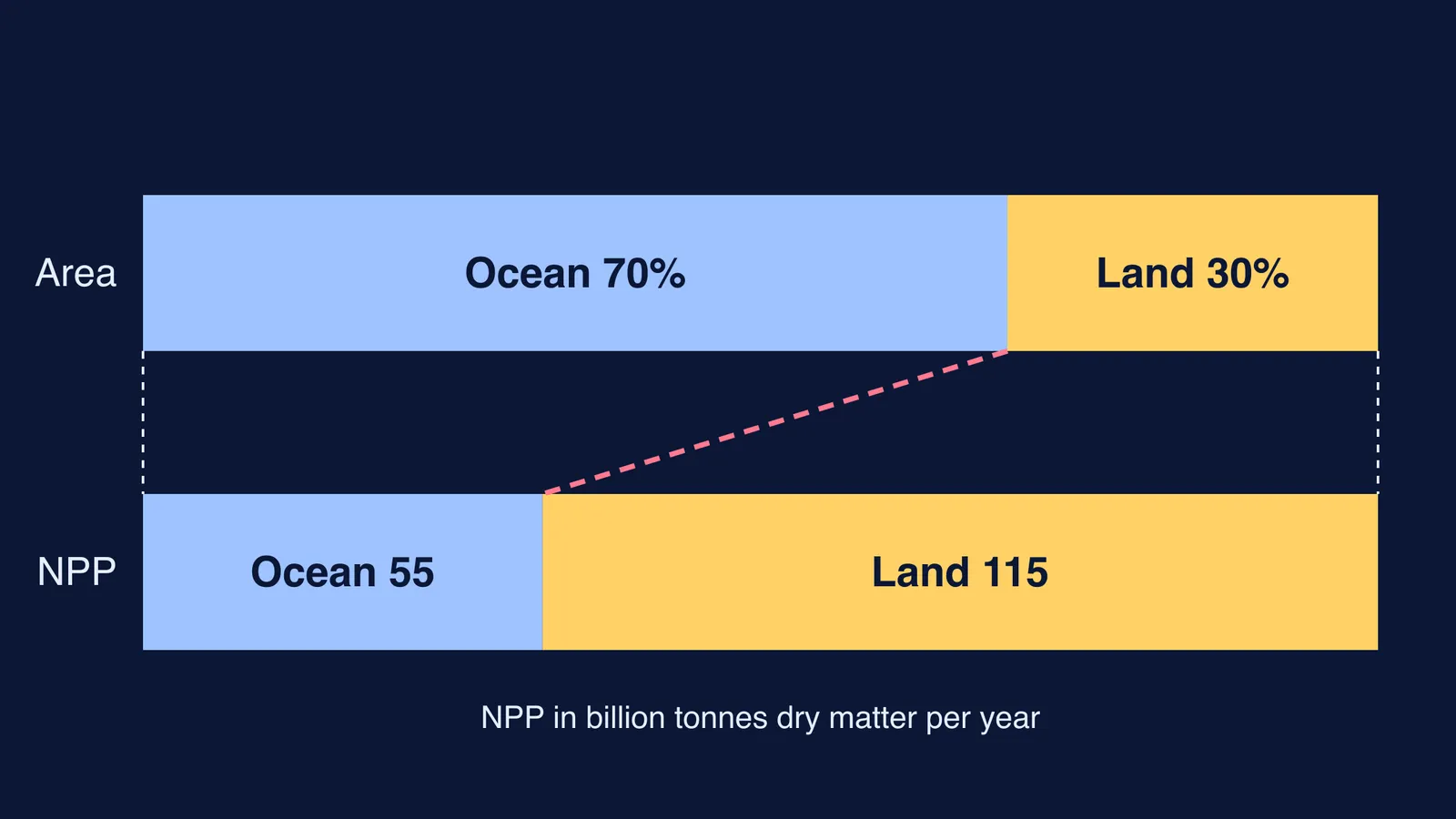
The annual NPP of the whole biosphere is about 170 billion tonnes (dry weight) of organic matter, and the oceans contribute only 55 billion tonnes of it despite covering about 70% of the surface (NCERT). The rest is made on land. Our notes on productivity and decomposition revise GPP and NPP.
How much less productive is the ocean per square metre?
NCERT gives totals, not rates per area, so work it out from the NCERT chapter figures.
Land NPP = 170 − 55 = 115 billion tonnes a year.
Ocean share of NPP = 55 ÷ 170 ≈ 32%, while its share of area is about 70%.
Ocean output per 1% of Earth's surface = 55 ÷ 70 ≈ 0.79 billion tonnes.
Land output per 1% of Earth's surface = 115 ÷ 30 ≈ 3.83 billion tonnes.
Ratio = 3.83 ÷ 0.79 ≈ 4.9.
So, on NCERT's figures, an average patch of land makes roughly five times as much new biomass as an equal patch of ocean. That gap is what needs explaining.
Why is ocean productivity low despite covering 70 percent?
Phytoplankton, the ocean's main producers, need carbon dioxide, sunlight and nutrients such as nitrate, phosphate and silicate, plus trace amounts of iron, according to NASA's Earth Observatory. In much of the open ocean, light and nutrients are found in different places.
The first limit is light. The upper 200 metres of the ocean is the euphotic, or sunlight, zone, and below that depth so little light gets through that photosynthesis is no longer possible, says NOAA's Ocean Service. The average ocean depth is about 3,682 metres (NOAA). So only about 5% of an average water column (200 ÷ 3,682) gets enough light for producers to grow.
The second limit is nutrients. When phytoplankton die, some sink and carry carbon to the deep ocean, and mixing has to bring nutrients back up from deeper waters into the sunlit layers (NASA). About 70% of the ocean is permanently stratified into layers that don't mix well. In subtropical summers, warm, buoyant water sits over cold, dense water, so phytoplankton use up the nutrients and growth falls off until winter storms restart mixing. Iron is so scarce that it limits growth in large areas of the ocean.
Land works differently. Dead leaves are broken down in the same soil where roots grow, and mineralisation releases inorganic nutrients back for plants to use (NCERT). Our post on why energy flows one way but nutrients cycle explains that loop.
Upwelling brings deep, cold, nutrient-rich water to the surface, and those surface waters often have high biological productivity (NOAA). Where light and nutrients finally meet, the ocean is busy.
Does research agree with NCERT's numbers?
Research estimates vary with method and units. A 1998 study in Science by Christopher Field and colleagues, which combined ocean and land models, estimated global NPP at 104.9 petagrams of carbon per year with roughly equal contributions from land and oceans. It found the spread of ocean NPP consistent with primary limitation by light, nutrients and temperature.
This estimate gives the ocean a larger share than NCERT, but it is counted in carbon, not dry weight, so the totals do not compare directly. Either way, the ocean has more than twice land's area, so its productivity per square metre is lower. For board and NEET-UG answers, quote NCERT's figures.
How do you write this answer in an exam?
Use this four-point frame for a 3-mark or 5-mark question, built on the NCERT figures and NASA's phytoplankton explainer:
State the fact: oceans cover about 70% of the surface but make only 55 of 170 billion tonnes of NPP a year.
Light: photosynthesis happens only in the sunlit top layer of water; most of the ocean is dark.
Nutrients: dead organisms sink, and nutrients must be mixed back up from deep water; iron is scarce over large areas.
Mixing: much of the ocean is stratified, except where upwelling or winter mixing brings nutrients up; those zones are productive.
If a term such as stratification or mineralisation still feels shaky, the Fermi Concept Library has a lesson for every concept in biology, each with its place in the map. For numericals like the five-times calculation above, the Fermi Problem Library has a step-by-step solver that explains the reasoning rather than printing an answer. Next, try telling apart standing crop and standing state, which often appear in the same question.