On this page
You are given a glass slab, its thickness and the wavelength of light, and asked how many waves fit inside. Once you notice that the wavelength in glass is not the wavelength you were given, it is a two-line answer. Here is the method, a full 1 mm example, and the follow-up examiners like to add: how many more waves than in air?
How many waves fit in a glass slab?
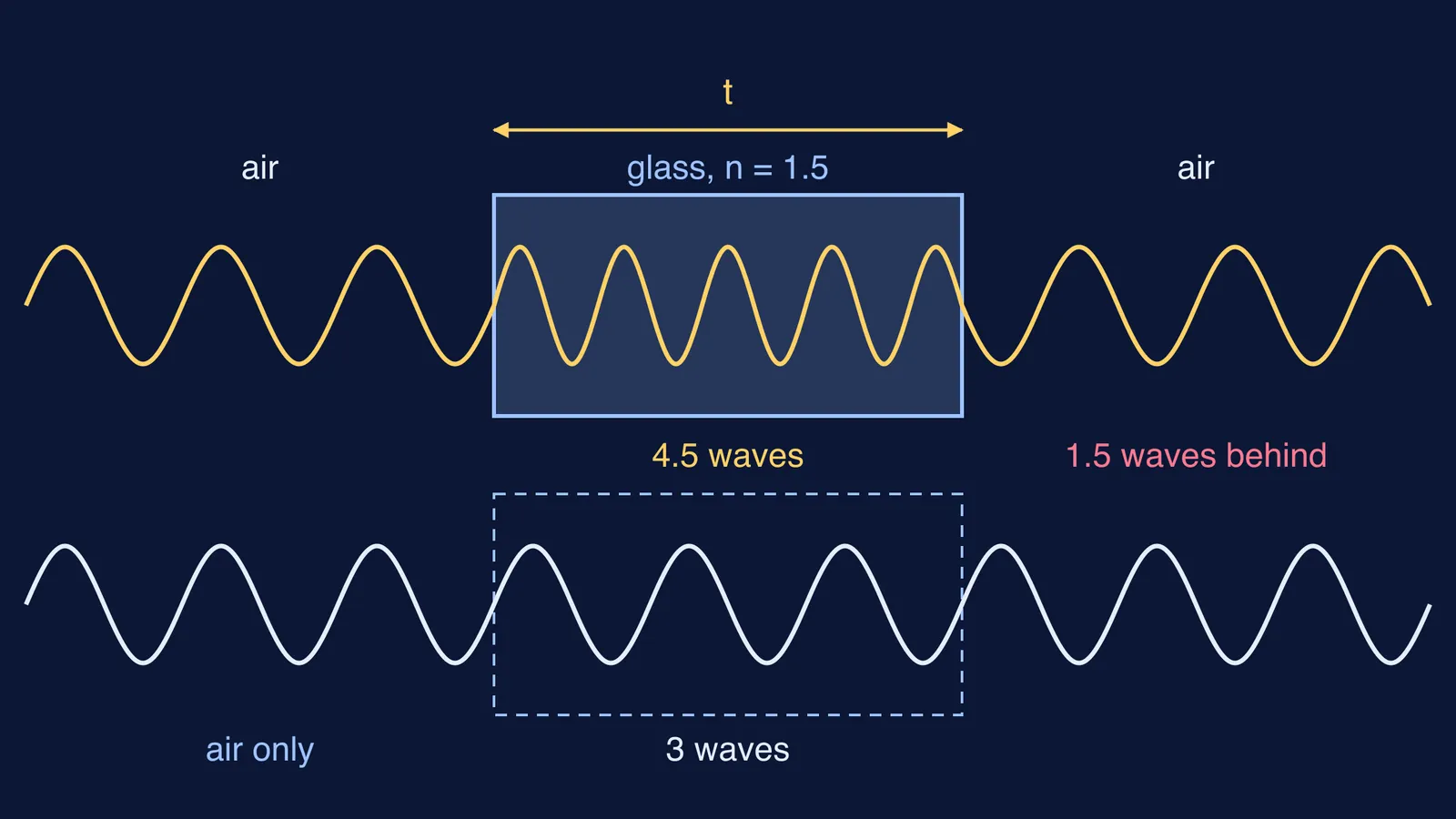
Count waves the way you would count tiles along a floor: length divided by the size of one tile. Here the tile is the wavelength inside the glass, not the one in air.
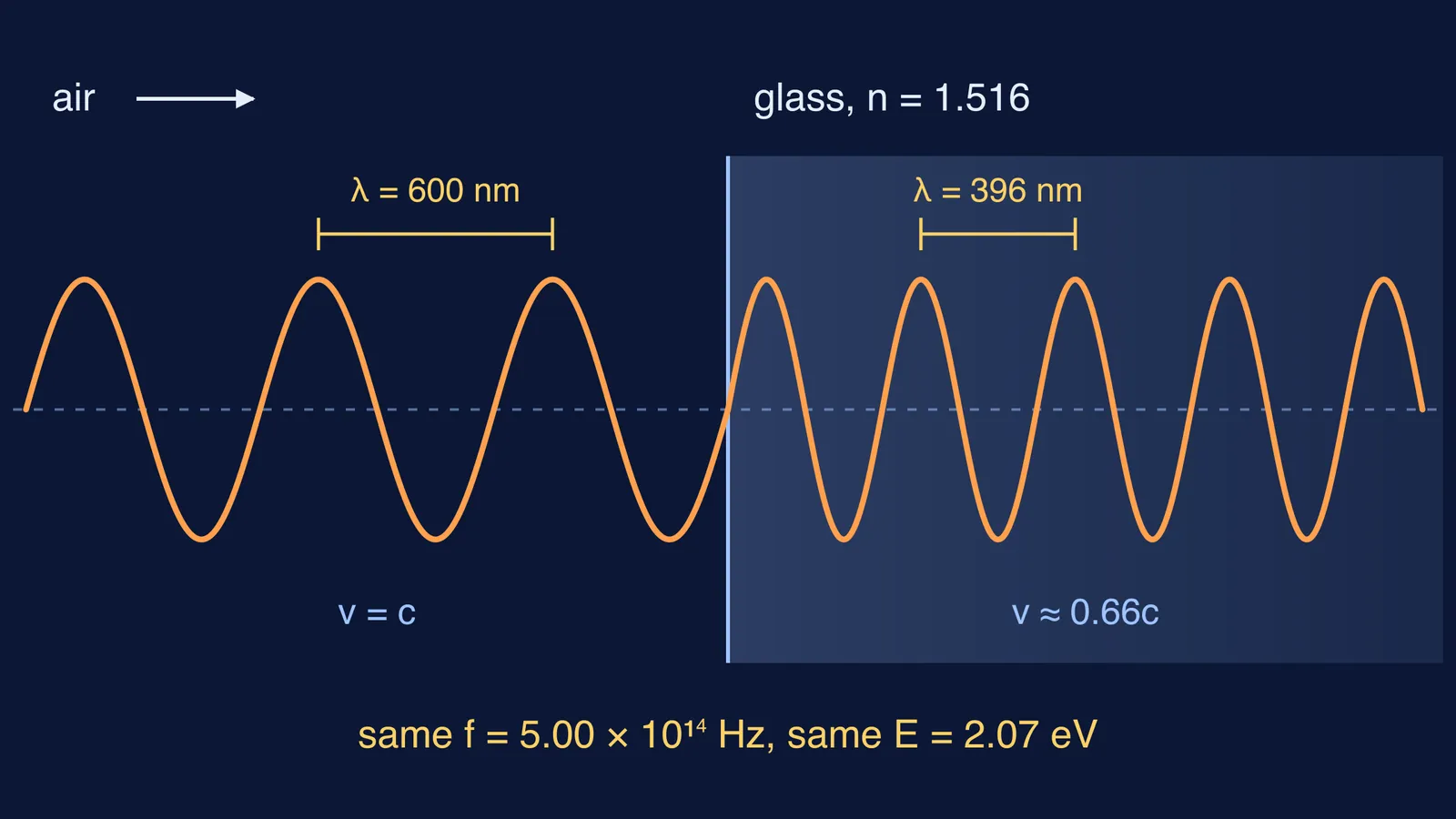
When light goes from a vacuum into a medium, its speed and wavelength change but its frequency stays the same, so the wavelength in the medium is λ/n (OpenStax College Physics 2e, section 27.1). The refractive index is n = c/v, where v is the speed of light in the material (OpenStax College Physics 2e, section 25.3).
So the number of waves in a slab of thickness t is:
N = t / λ_glass = t / (λ/n) = nt / λ
That nt has a name. For a uniform medium, the optical path length is the refractive index times the geometric length (Optical path length, Wikipedia). So counting waves in glass is the same as counting waves along its optical path.
Worked example: how many waves are in 1 mm of glass?
Take t = 1 mm, light of wavelength 600 nm (in vacuum, with air treated as vacuum), and glass with n = 1.5. OpenStax lists crown glass at 1.52 (section 25.3), so 1.5 is the usual round number in problems.
Convert units first: t = 1 mm = 1 × 10⁻³ m, and λ = 600 nm = 6 × 10⁻⁷ m.
Wavelength in glass: λ_glass = 600 nm / 1.5 = 400 nm.
Waves in the glass: N_glass = (1 × 10⁻³) / (4 × 10⁻⁷) = 2,500.
Waves in the same 1 mm of air: N_air = (1 × 10⁻³) / (6 × 10⁻⁷) ≈ 1,666.7, so about 1,667.
The glass holds 2,500 waves where air holds about 1,667. The waves in glass are shorter, so more of them fit.
How many extra waves does glass add compared with air?
Subtract: 2,500 − 1,666.7 ≈ 833 extra waves.
You can also get this in one step. Extra waves = (nt − t) / λ = (n − 1)t / λ. The (n − 1)t part is the optical path difference the glass adds compared with air (Optical path length, Wikipedia): 0.5 × 1 mm = 0.5 mm. Dividing, (0.5 × 10⁻³) / (6 × 10⁻⁷) ≈ 833. Same answer: a quick arithmetic check.
If the question asks for phase, an optical path difference becomes a phase difference through Δφ = (2π/λ) × path difference, with λ the vacuum wavelength. Here that is 2π × 833.3 ≈ 1,667π radians. When the two beams meet, only the leftover third of a wave matters: 833⅓ waves leaves them 120° out of step.
Two variations to test yourself, both using the values in OpenStax section 25.3:
Crown glass, n = 1.52: N_glass = (1.52 × 10⁻³) / (6 × 10⁻⁷) ≈ 2,533, and the extra waves are about 867, from a path difference of 0.52 mm.
Air is not exactly n = 1; OpenStax gives 1.000293. With 600 nm as the vacuum wavelength, N_air ≈ 1,667.2 and the extra waves drop to about 832.8. That is less than half a wave of change, which is why problems tell you to treat air as a vacuum.
What mistakes cost marks on this question?
Dividing by the air wavelength. In glass the wavelength is λ/n (OpenStax section 27.1); t/λ gives the air count, 1,667.
Skipping unit conversion. 1 mm over 600 nm without converting gives 0.0017 instead of about 1,667.
Writing nλ instead of λ/n. If you get fewer waves in glass than in air, stop and check.
Mixing up optical path (nt = 1.5 mm) with path difference ((n − 1)t = 0.5 mm).
Thinking the frequency changes. It does not; only speed and wavelength do.
If you get the right number but are not sure why the method works, the Fermi Problem Library has worked problems with a step-by-step solver that explains the reasoning rather than printing an answer. Wavelength, refractive index and optical path each have their own lesson in the Fermi Concept Library.
Where does this idea show up next?
The same (n − 1)t returns when a thin glass sheet covers one slit in Young's experiment and the fringes shift. Our guide to path difference, phase and phase flips in wave optics takes that next step. Tilt the slab and the ray also moves sideways: see glass slab lateral shift in a simulation, then calculate it. For why light bends on entering glass at all, read when light bends towards the normal, with Snell's law.
Next time you see a slab question, write λ/n before you write anything else.