On this page
In a ray simulation you can change the angle and thickness of a glass slab and watch the emergent ray move as you do. Below: an experiment plan, the formula, and a worked example to check against the screen.
What happens to a ray passing through a glass slab?
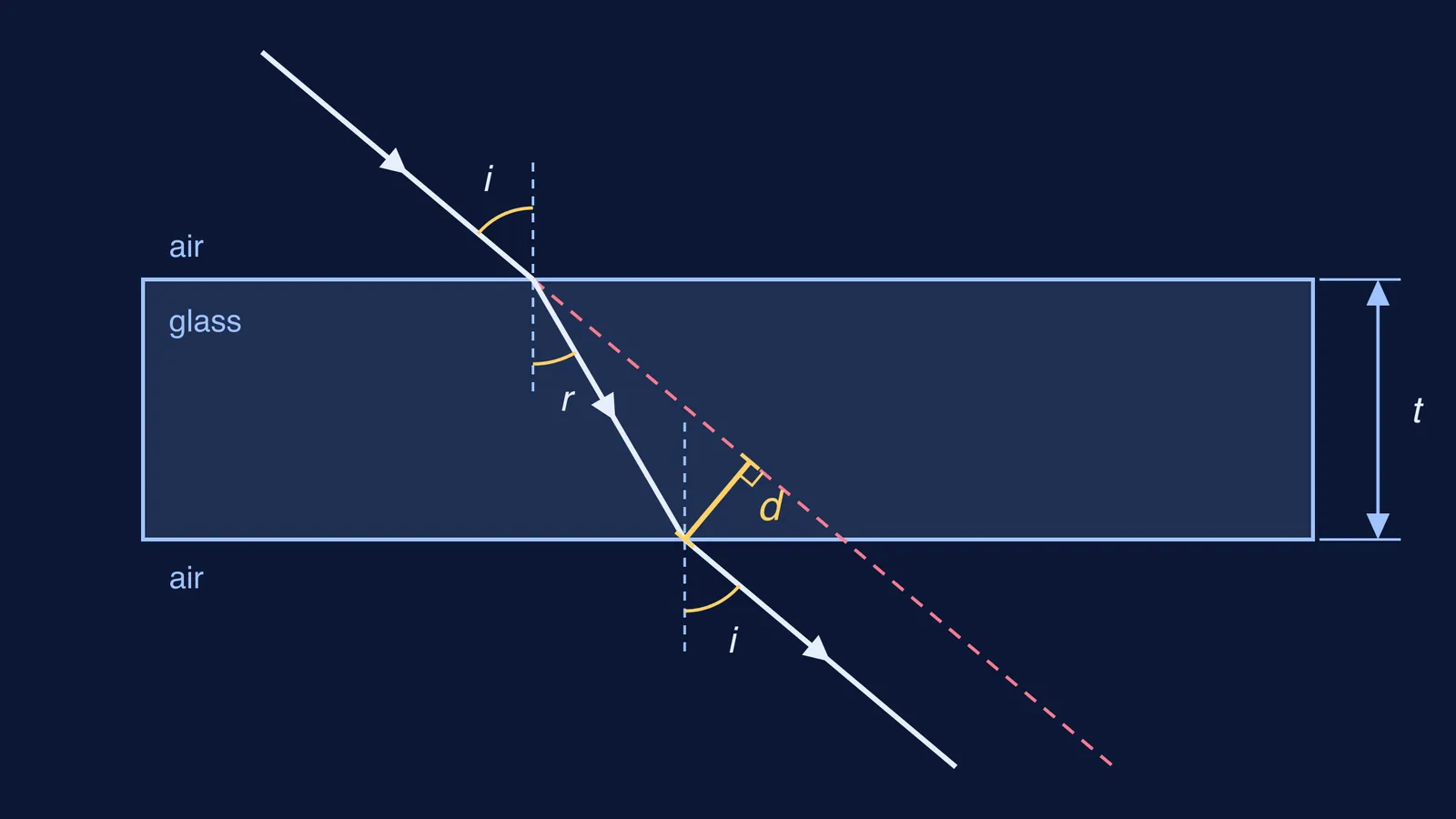
In NCERT's Class 10 science chapter on light, Activity 9.10 traces a ray through a rectangular glass slab with pins, and the textbook notes that the emergent ray is parallel to the incident ray but shifted sideways (NCERT Class 10 Science, Chapter 9). The reason, from the same chapter: the bending at the two parallel faces is equal and opposite, towards the normal going in (air to glass) and away from it going out.
The perpendicular gap between the original line of the ray and the emergent ray is called the lateral shift (or lateral displacement), written d. For the pen-and-paper version, our guide to tracing a ray through a glass slab in the Class 10 practical walks through the pins step by step.
How do angle and thickness change the lateral shift?
Open any ray simulation that lets you place a rectangular glass block in air. Keep the refractive index fixed; the NCERT table lists crown glass at n = 1.52 and water at n = 1.33 (NCERT Class 10 Science, Table 9.3). Run four tests, writing down a prediction before each.
Angle at zero. Send the ray straight in (i = 0). Expect no bending and no shift.
Sweep the angle. Keep thickness fixed and step i through 15°, 30°, 45°, 60° and 75°, measuring the gap each time.
Double the thickness. Fix i at 45° and double the slab. Does the gap double, or grow by more?
Push towards grazing. Take i close to 90° and compare the gap with the thickness.
Switch the material to water and the ray bends less at each face, so the shift shrinks.
How do you calculate the lateral shift?
The derivation takes three lines. Call the point where the ray enters the slab O and the point where it leaves O′.
Inside the slab the ray travels from O to O′. With thickness t and refraction angle r, that path has length OO′ = t / cos r.
The angle between OO′ and the extended incident ray is (i − r), and d is the perpendicular distance from O′ to that line.
So d = OO′ × sin(i − r), which gives d = t sin(i − r) / cos r.
Two results follow. Because d is proportional to t, doubling the thickness doubles the shift at the same angle. And as i approaches 90°, (i − r) approaches (90° − r), so d approaches t: the shift can never be larger than the slab is thick.
Worked example: what is the lateral shift for crown glass at 45°?
Take a crown-glass slab (n = 1.52, from NCERT Table 9.3) that is 5 cm thick, and a ray at i = 45°.
Snell's law: sin r = sin 45° / 1.52 = 0.7071 / 1.52 = 0.4652, so r ≈ 27.7°.
i − r = 45° − 27.7° = 17.3°.
d = 5 × sin 17.3° / cos 27.7° = 5 × 0.297 / 0.885 ≈ 1.68 cm.
Double the slab to 10 cm and d becomes about 3.36 cm, exactly twice. The full sweep for the same slab:
i = 15°: r ≈ 9.8°, d ≈ 0.46 cm
i = 30°: r ≈ 19.2°, d ≈ 0.99 cm
i = 45°: r ≈ 27.7°, d ≈ 1.68 cm
i = 60°: r ≈ 34.7°, d ≈ 2.60 cm
i = 75°: r ≈ 39.5°, d ≈ 3.76 cm
Going from 15° to 30° adds about half a centimetre, but 60° to 75° adds more than a centimetre. Meanwhile r creeps towards about 41.1°, the largest refraction angle crown glass allows (sin r = 1/1.52).
Where do students lose marks on lateral shift?
Writing sin r instead of cos r in the denominator, or dropping it altogether.
Measuring d along the slab surface or along the emergent ray, instead of perpendicular to the two parallel rays.
Mixing up lateral shift with normal shift (apparent depth), which is what you see when you look straight down through the slab.
For exam-style questions, see our post on lateral shift through a glass slab, with formula and worked problems. If Snell's law itself still feels shaky, start by predicting every ray in a Snell's law simulation.
Where can you practise this next?
The Fermi Simulation Lab has interactive simulations for the ideas that are easier to see than to read. When a numerical goes wrong, the Fermi Problem Library has worked problems with a step-by-step solver that explains the reasoning rather than printing an answer.
Your next step: set i to 45°, predict d with the formula, then measure it on screen.