On this page
NH3 and NF3 look like twins. Both have a nitrogen atom with three bonds and one lone pair, so VSEPR theory gives both the same trigonal pyramidal shape. Yet their bond angles are not the same, and the question "why is the bond angle of NF3 smaller than NH3?" turns up again and again in Class 11 tests and JEE Main practice sets.
What are the bond angles of NH3 and NF3?
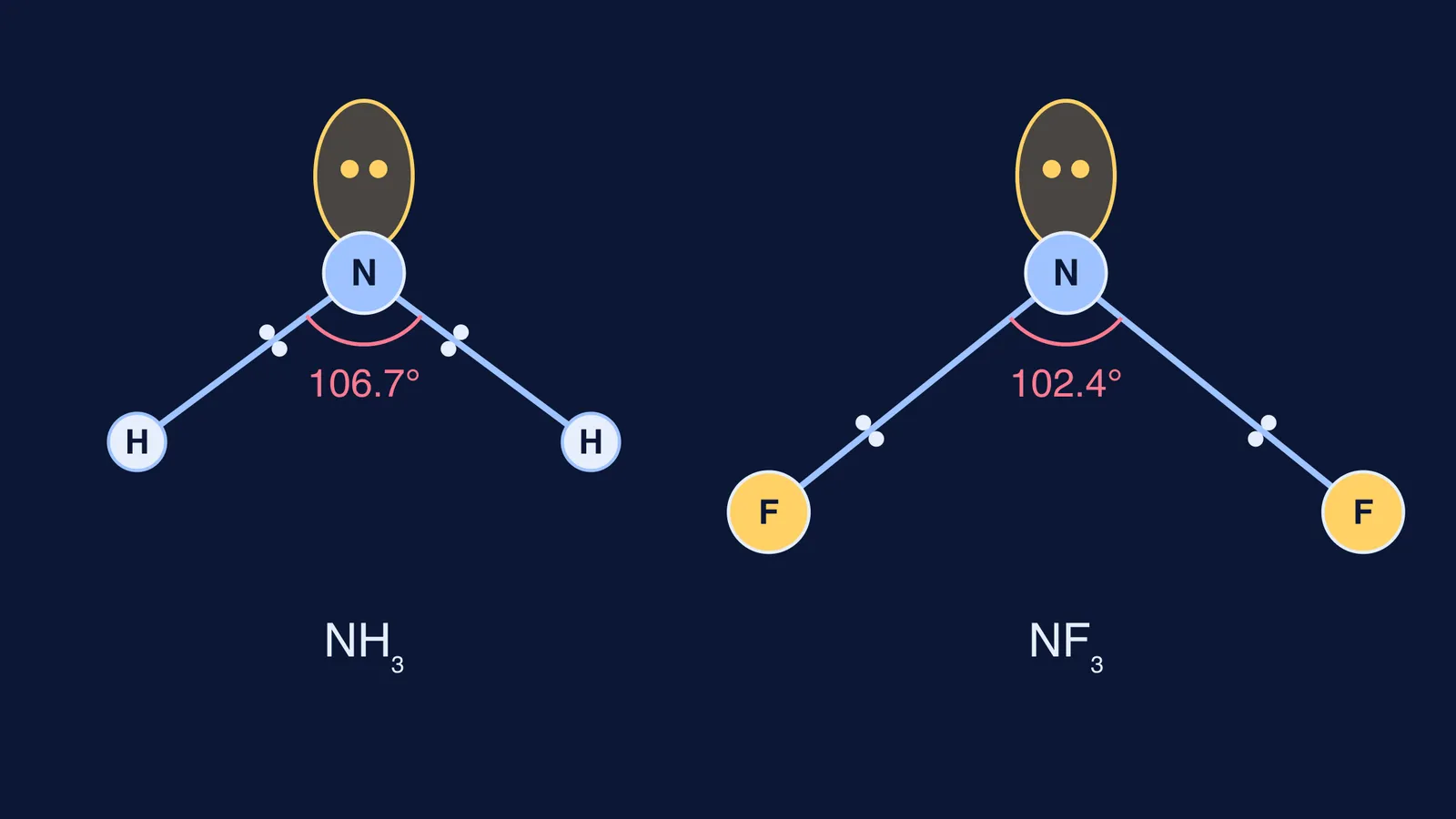
The measured H–N–H angle in ammonia is 106.67°, with an N–H bond length of 1.012 Å (NIST CCCBDB, NH3). Textbooks often round this to 107°.
The measured F–N–F angle in nitrogen trifluoride is 102.37°, with an N–F bond length of 1.365 Å (NIST CCCBDB, NF3).
Both are below the 109.5° of a perfect tetrahedron, because a lone pair repels bonding pairs more strongly than bonding pairs repel each other. If that part is still shaky, our post on why lone pair repulsion shrinks the angles in CH4, NH3 and H2O builds it up step by step. The puzzle here is the extra 4° or so that NF3 loses.
Why is the bond angle of NF3 smaller than NH3?
VSEPR theory, developed by R. J. Gillespie and R. S. Nyholm from 1957 (Quarterly Reviews, Chemical Society), includes a rule that covers this case. An NPTEL chemical bonding lecture states it plainly: "Repulsion between bond pairs decreases as the electronegativity of the atom bound to the central atom increases" (NPTEL, Module 2, Lecture 7).
Now put in the numbers. On the Pauling scale, hydrogen is 2.20, nitrogen is 3.04 and fluorine is 3.98 (electronegativity data)).
In NH3, nitrogen (3.04) is more electronegative than hydrogen (2.20), so each bonding pair is pulled towards nitrogen. Three bonding pairs crowded near nitrogen push each other apart strongly.
In NF3, fluorine (3.98) is more electronegative than nitrogen (3.04), so each bonding pair is pulled out towards fluorine. The pairs sit further from nitrogen and from each other, so they repel less.
The lone pair stays on nitrogen in both. In NF3, with weaker bond pair–bond pair repulsion to resist it, the lone pair–bond pair repulsion wins by more and squeezes the bonds closer: about 102° instead of about 107°.
The same electron shift explains a second NH3–NF3 favourite, the dipole moment. See why NH3 has a higher dipole moment than NF3.
How do you write this answer in an exam?
A full answer needs four links in the chain, ending with the measured angles from NIST's CCCBDB. Here is a version short enough to write from memory:
Both NH3 and NF3 have sp3 nitrogen with three bond pairs and one lone pair, so both are pyramidal.
Fluorine is more electronegative than nitrogen, while hydrogen is less electronegative, so in NF3 the bonding pairs are drawn away from nitrogen and in NH3 they are drawn towards it.
Bonding pairs further from the central atom repel each other less, so bond pair–bond pair repulsion is weaker in NF3.
The lone pair–bond pair repulsion therefore compresses the angle more: NF3 is about 102°, NH3 about 107°.
Before you move on, check your answer against this list:
Did you compare each ligand with nitrogen, not just fluorine with hydrogen?
Did you say which way the bonding pair shifts in each molecule?
Did you name the repulsion that changes (bond pair–bond pair), not just "repulsion"?
Did you finish with the two angles?
If you want more questions of this kind with each step explained, the Fermi Problem Library has worked problems with a step-by-step solver that explains the reasoning rather than printing an answer.
Does a more electronegative atom always give a smaller bond angle?
No, and this is where students who memorise the rule get caught. Nitrogen trichloride has a Cl–N–Cl angle of 107.78° (NIST CCCBDB, NCl3), slightly larger than ammonia's 106.67°, even though chlorine (3.16) is more electronegative than hydrogen (2.20) (electronegativity data)).
The usual explanation is that chlorine's electronegativity is very close to nitrogen's, so the bonding pairs barely shift outwards, and chlorine atoms are far bigger than hydrogen atoms, so size starts to matter. The electronegativity rule works best when the ligands differ strongly in electronegativity and size is not the main factor, as with F against H.
Hybridisation gives a second way to see the same result: nitrogen puts more p-character into bonds to fluorine, which narrows the angle between them. Bent's rule and how to use it to predict bond angles covers that next step. If VSEPR still feels shaky, look it up in the Fermi Concept Library, where each concept has its own lesson, then come back and try the four-line answer from memory.