

On this page
Nature and significance of management is the first chapter of Class 12 Business Studies, and it sets up the vocabulary for every chapter after it. Get it clear and the later chapters on planning, staffing and controlling become much easier to write about.
What does the CBSE syllabus include for this chapter?
The official CBSE Business Studies curriculum for 2026-27 lists five topics in Unit 1: the concept, objectives and importance of management; management as a science, art and profession; the levels of management; the five functions; and the concept and importance of coordination. Unit 1 shares 16 of the 80 theory marks with Unit 2 (principles of management) and Unit 3 (business environment).
The same document gives 30% of the theory marks to applying ideas to new situations, so case questions matter.
Fayol and Taylor belong to Unit 2, covered in our guide to principles of management for Class 12.
What is management, and how is efficiency different from effectiveness?
The NCERT textbook, chapter 1, describes management as a process of getting things done so that goals are reached both effectively and efficiently. Effectiveness means finishing the task and reaching the goal. Efficiency means doing it at the lowest cost in resources. A factory that meets its target but wastes material is effective, not efficient.
NCERT gives seven features of management:
Goal-oriented: it exists to reach stated objectives.
All-pervasive: a school, a hospital and a petrol pump all need it.
Multidimensional: it manages work, people and operations.
Continuous: its functions repeat without a break.
A group activity: many people work towards one goal.
Dynamic: it adapts as the environment changes.
Intangible: you cannot see it, only its results.
Its objectives are organisational (survival, profit, growth), social (benefits for society) and personal (employees' pay and growth). It matters because it helps reach group goals, raises efficiency, builds an organisation that can change, helps people meet personal goals and develops society.
Is management an art, a science or a profession?
Art: art needs theoretical knowledge, personal application and creative practice. Management has all three, so it is an art.
Science: science needs a systematic body of knowledge, principles tested by experiment and universal validity. Management has the first, but its principles deal with human behaviour, so they cannot be tested exactly and must be adapted to each situation. It is an inexact science.
Profession: a profession has a defined body of knowledge, restricted entry, a professional association, a code of conduct and a service motive. Management meets only the first fully. No degree is required to be a manager, unlike a chartered accountant, and associations such as the AIMA are neither compulsory nor backed by law.
What do the three levels of management do?
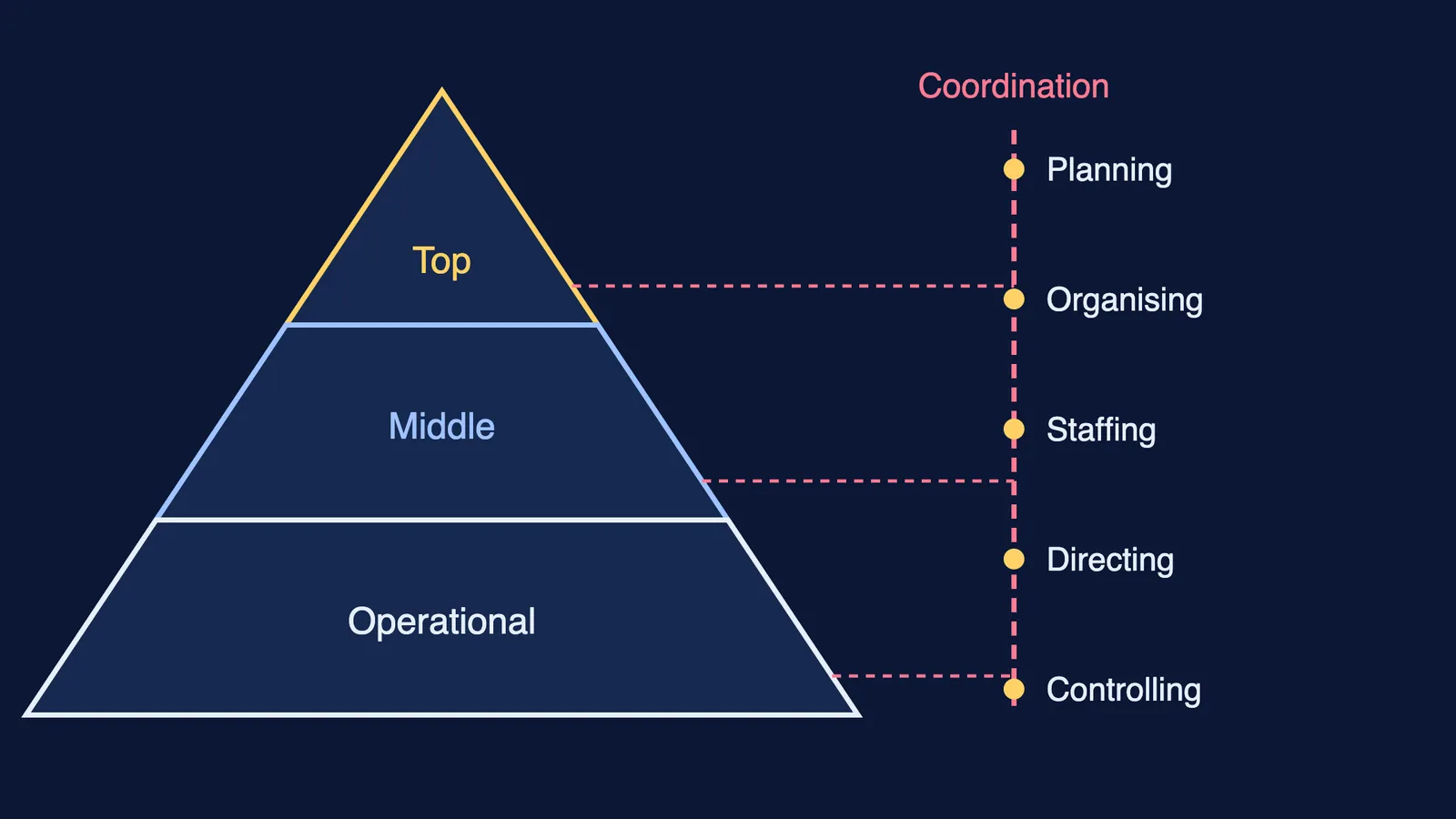
Top management (chairperson, CEO, functional heads) sets overall goals and strategy and answers for the whole organisation.
Middle management (division and department heads) interprets top-level policies, staffs and motivates the department, and works with other departments.
Supervisory or operational management (supervisors and foremen) directs workers and looks after quality, waste and safety.
Why is coordination called the essence of management?
The five functions are planning (deciding in advance), organising (grouping tasks, assigning authority), staffing (finding the right people), directing (leading and motivating) and controlling (checking performance against standards). Coordination is not a sixth function. NCERT calls it the essence of management because it runs through all five, like a thread through a garland.
Coordination integrates group effort, ensures unity of action, is continuous, all-pervasive and deliberate, and is every manager's job. It matters more as organisations grow, split into departments and rely on specialists. NCERT's example is the Mumbai dabbawallas, whose chain of tiffin handovers works only because each step fits the next.
A worked case: how to tag a board question
Meera runs a cloud kitchen in Pune. She decides to launch a festive thali in October (planning). She sets up separate prep, cooking and delivery teams with team leads (organising) and hires two extra cooks (staffing). The delivery lead briefs riders every morning (directing). When orders arrive late, she compares delivery times with her target and changes the routes (controlling). The kitchen's schedule matches the sales team's promotion dates (coordination).
When you answer a case like this:
Underline the action in each sentence and match it to one function.
Quote that line in your answer.
Name the level of the person doing it: Meera is top, a team lead is middle, a supervisor on the floor is operational.
For "art or science" questions, name the feature the case shows.
For Part B, the marketing mix and the four Ps and financial markets and SEBI reward the same habit of tagging each line of a case. If you are unsure where to start revising, Fermi's AI tutor can work out what you already know and build a plan for the session.


