On this page
In plant breeding long answers, NCERT's example of mutation breeding is mung bean. The older NCERT Class 12 chapter, Strategies for Enhancement in Food Production, puts it in one line: "In mung bean, resistance to yellow mosaic virus and powdery mildew were induced by mutations" (NCERT Class 12 Biology, Chapter 9, 2020-21 edition). Below: what sits behind that line, and a five-step flow chart for the exam.
Check first: in the 2026-27 NCERT reprint, Chapter 9 is Biotechnology: Principles and Processes (current NCERT Chapter 9), so confirm your syllabus still lists this topic.
What is mutation breeding?
NCERT defines mutation as "the process by which genetic variations are created through changes in the base sequence within genes", which creates a trait not found in the parent (NCERT, 2020-21 edition). Mutation breeding means inducing those changes artificially "through use of chemicals or radiations (like gamma radiations)", then selecting the plants with the useful trait and using them in breeding (same source).
The agents that cause these changes are called mutagens. The Bhabha Atomic Research Centre lists UV rays, beta rays, gamma rays, X-rays, fast neutrons, thermal neutrons, electron beams and ion beams among the physical mutagens available for mutagenesis programmes (BARC, Trombay Crop Varieties). Chemical mutagens such as ethyl methanesulfonate (EMS) do the same job (Anuragi et al., 2022). For the history, read how Hermann Muller showed that X-rays make genes mutate, and Charlotte Auerbach showed that chemicals can do it too.
The key idea for your answer: a gamma ray does not aim at a resistance gene. Breeders treat many seeds, grow them, then search for the few useful plants. The skill is in the screening.
Why does mung bean need yellow mosaic virus resistance?
A 2020 review in Frontiers in Plant Science says yellow mosaic disease of pulses, mung bean included, is caused by four distinct begomoviruses, including mungbean yellow mosaic virus (MYMV) and mungbean yellow mosaic India virus (MYMIV) (Mishra et al., 2020). It reaches the mung bean crop through the whitefly *Bemisia tabaci*. The same review puts crop yield loss between 10 and 100%, depending on the mung bean variety and the stage at which the crop is infected.
How are resistant plants screened?
Anuragi, Yadav and Sheoran treated two mung bean varieties that were sensitive to MYMIV with different doses of gamma rays and EMS, then checked the offspring for resistance in the second and third mutant generations, called M2 and M3 (International Journal of Radiation Biology, 2022). In M3, 64 mutants looked resistant. DNA markers linked to the disease confirmed only 22 of them as truly resistant. Two resistant mutants, M-37 and M-104, gave a little more seed than the controls, and the authors wrote they could be released as a variety after further validation.
Notice the funnel: many treated seeds, 64 plants that look resistant, 22 that pass a second test, two worth taking forward.
NCERT lists the steps of conventional breeding for disease resistance as "screening germplasm for resistance sources, hybridisation of selected parents, selection and evaluation of the hybrids and testing and release of new varieties" (NCERT, 2020-21 edition). Mutation breeding helps when no good resistance source exists: you create the variation yourself. Anuragi and colleagues call lack of genetic variability "the biggest bottleneck" for other breeding tools (2022 study). For the general sequence, see our guide to the steps of plant breeding and NCERT's disease-resistant varieties.
Which Indian mung bean varieties came from BARC's mutation work?
BARC says its blend of mutation and recombination breeding has led to the release of 62 crop varieties in 12 crops, mung bean among them (BARC, Trombay Crop Varieties). Three mung bean entries from that bulletin:
TARM-1 (1997, RUM-5 x TPM-1): resistant to powdery mildew, tolerant to yellow mosaic virus disease.
TMB-37 (2005, Kopergaon x TARM-2): moderately resistant to yellow mosaic virus.
TJM-3 (2007, Kopergaon x TARM-1): resistant to powdery mildew, yellow mosaic virus and Rhizoctonia root-rot.
Look at the pedigrees: the two later varieties cross a TARM line with the established variety Kopergaon. Mutation and hybridisation work together.
How do you write the five-step flow chart in a long answer?
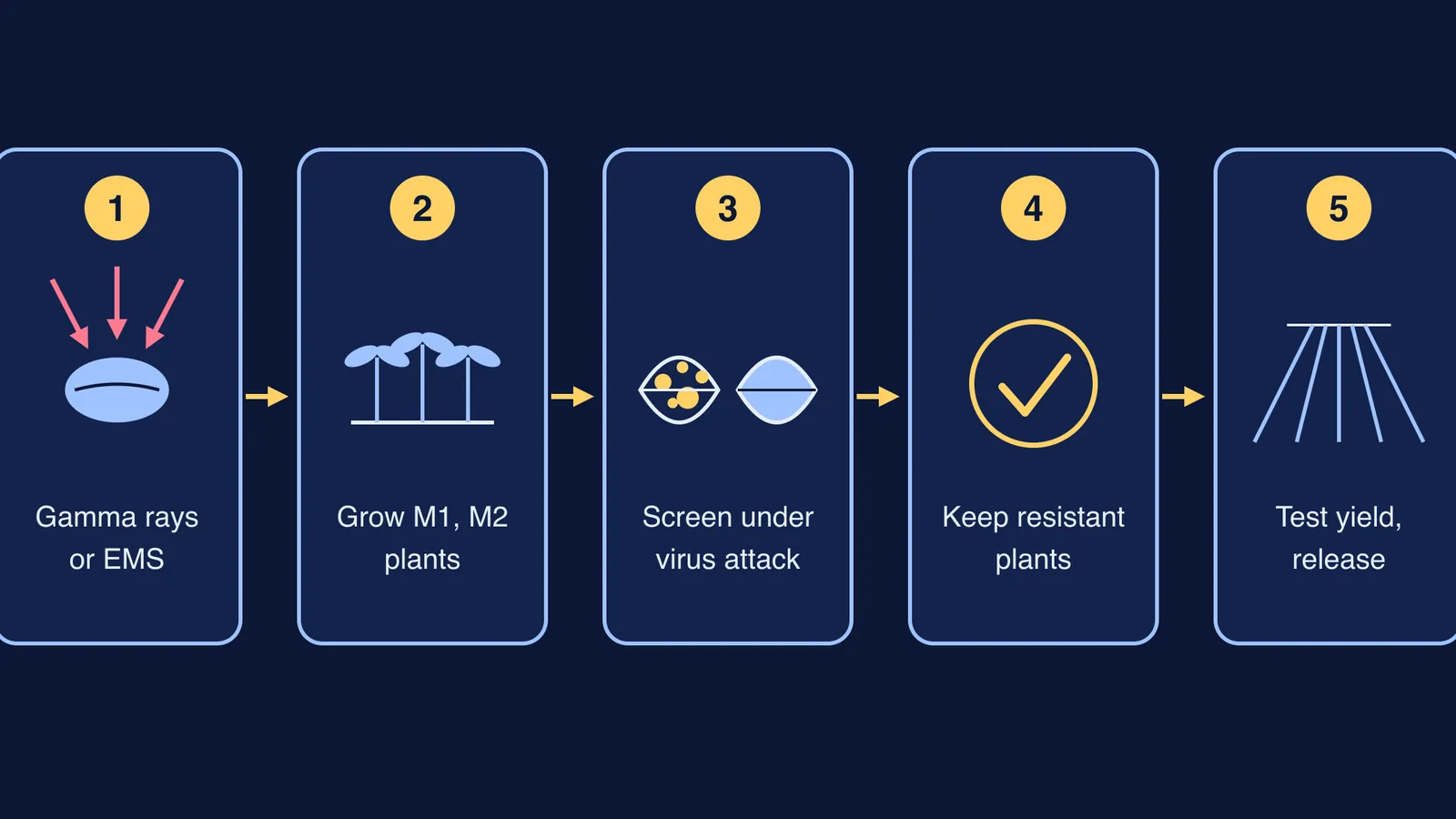
Draw these as boxes joined by arrows, then write one line under each:
Induce mutations: treat seeds of a good variety that lacks resistance (for example, a high-yielding mung bean that gets yellow mosaic virus) with gamma rays or a chemical mutagen such as EMS.
Grow the M1 and M2 generations from the treated seed.
Screen the plants under disease pressure.
Keep the plants that stay healthy and confirm their resistance in the next generation, for example with DNA markers.
Test yield in trials, then release the variety or use it as a parent in hybridisation.
End with NCERT's mung bean example.
If the jump from a base-sequence change to a resistant crop still feels shaky, the Fermi Concept Library has a lesson for every concept in biology, each with its place in the map. The Fermi Problem Library has worked problems with a step-by-step solver that explains the reasoning.
Tonight, draw the flow chart once from memory and check it against the five steps above.