On this page
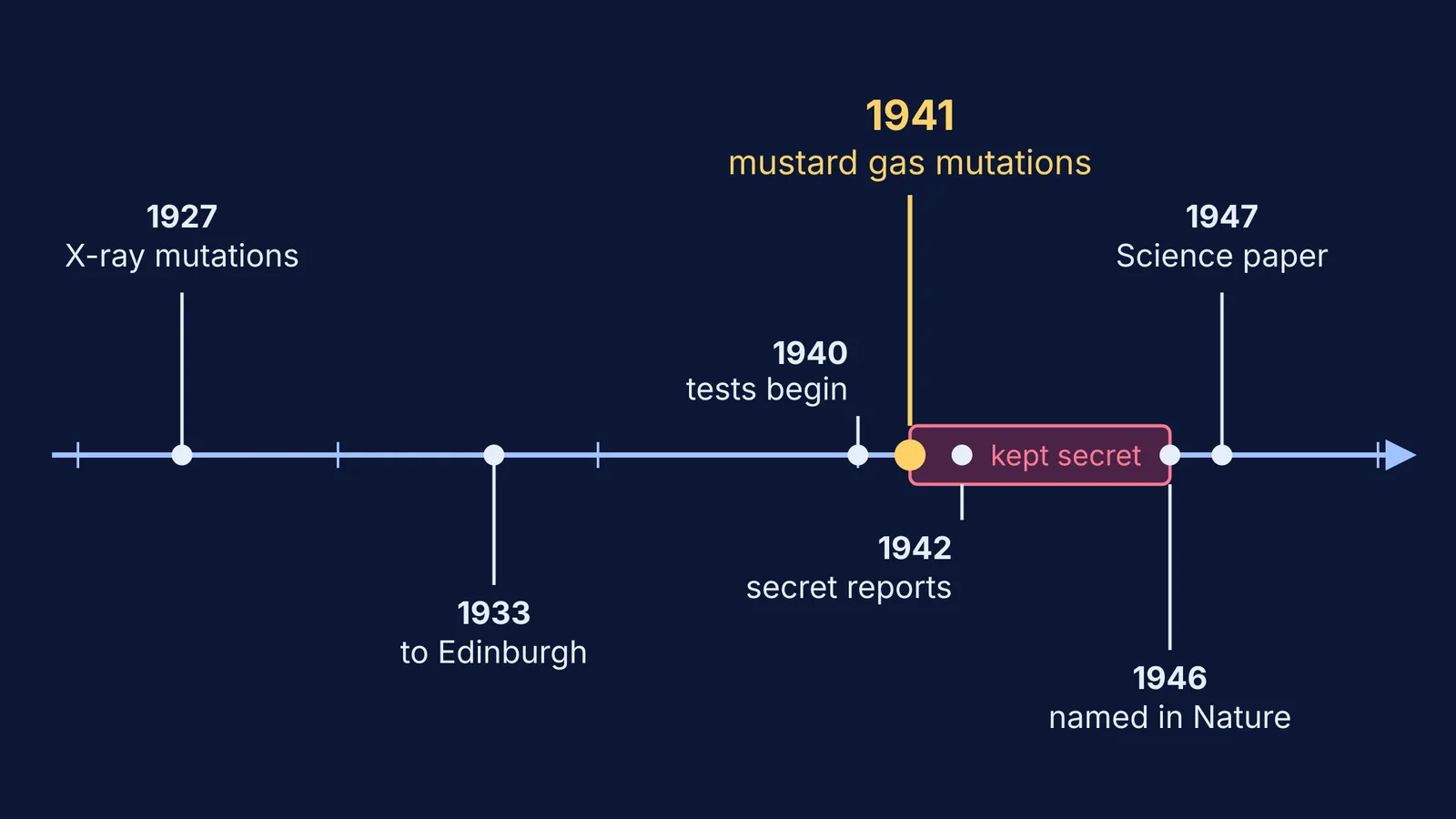
By 1941, scientists knew that X-rays could make genes mutate. Then, in a wartime laboratory in Edinburgh, Charlotte Auerbach showed that fruit flies exposed to mustard gas passed new mutations on to their offspring. Her Royal Society memoir says she was known above all for this discovery in 1941 that gene mutations can be artificially induced by treatment of Drosophila flies with a chemical substance, mustard gas.
Who was Charlotte Auerbach?
Auerbach was born on 14 May 1899 and died on 17 March 1994, according to the dates in her Royal Society biographical memoir. She was born into a Jewish family in Krefeld, Germany, and earned a PhD in Edinburgh in 1935 for work on fruit flies, says a chapter on chemical mutagenesis by J. M. Leitão.
In 1933, after Nazi anti-Jewish laws cost her a science teaching post, she left Berlin for Britain and settled at Edinburgh's Institute of Animal Genetics, the University of Edinburgh's archive blog records. Hermann J. Muller, who worked there in the late 1930s, had a profound effect on her; Leitão writes that he encouraged her to test chemicals. Muller had shown in 1927 that X-rays cause mutations, in Artificial Transmutation of the Gene; read more in our post on Hermann Muller and the X-rays that made genes mutate.
How did Auerbach show mustard gas causes mutations?
In 1940 Auerbach began working with the pharmacologist J. M. Robson on the effects of mustard gas, according to Leitão's account, which draws on Geoffrey Beale's 1993 history of the discovery. According to Auerbach, the pharmacologist A. J. Clark suggested testing it, having noticed that the long-lasting effects of mustard gas resembled those of X-rays. Robson and his collaborators carried out most of the treatments; Auerbach did the genetic analysis, using Muller's ClB method for spotting lethal mutations on the X chromosome.
The 1942 reports described sex-linked lethals, plus inversions and translocations, where chromosomes break and rejoin the wrong way. In a 1946 paper, Auerbach and Robson wrote that mustard gas had been found in 1941 to produce mutations and chromosome rearrangements comparable to those caused by X-rays.
Worked example: how a hidden lethal mutation shows up
A lethal mutation kills the fly that inherits it, so you cannot see it directly. The trick is to count who is missing.
A treated male passes his single X chromosome to every daughter.
Each daughter's sons get one of her two X chromosomes.
If the father's X carries a lethal mutation, every son who inherits it dies before reaching adulthood, so one whole class of sons is missing.
Compare with untreated males. Far more missing classes after treatment means the treatment causes mutations.
The ClB stock adds marker genes so the father's X is easy to track; the logic is the same.
Why was the mustard gas discovery kept secret?
Mustard gas was a chemical weapon, so the War Office commissioned the work and kept it confidential; reports went to the Ministry of Supply in 1942 and 1943, the Edinburgh archive blog notes. In the reports, mustard gas was coded as substance "H", Leitão writes.
The gas was named in a letter, Chemical Production of Mutations, published in Nature on 9 March 1946. A fuller paper, The Chemical Production of Mutations, appeared in Science in March 1947. The work won Auerbach the Royal Society of Edinburgh's Keith Prize, the university archive notes.
Why does Auerbach's discovery still matter?
A mutagen is "a chemical or physical agent capable of inducing changes in DNA called mutations", in the words of the US National Human Genome Research Institute glossary. Auerbach's experiments put chemicals on that list. A paper in Genetics describes her mustard gas work as "the first demonstration of chemical mutagenesis".
The same glossary lists tobacco products among known mutagens. Safety testing still asks the question Auerbach answered: does this chemical damage genes? To see what mutations do to a protein, read our guide to point and frameshift mutations. To see how cells fight back, read about Aziz Sancar and how cells repair damaged DNA.
How should you revise mutagens for a biology exam?
Check that you can:
Define a mutagen, with one physical example (X-rays) and one chemical example (mustard gas).
Name who showed each: Muller for X-rays in 1927, Auerbach for mustard gas in 1941.
Explain how a lethal X-linked mutation is detected, using the missing-sons logic.
Say why a control group is needed.
Tell a point mutation from a chromosome rearrangement such as an inversion.
If the chain from DNA to mutation to protein feels loose, the Fermi Concept Library gives every biology concept its own lesson and its place in the map. For X-linked crosses, the Fermi Problem Library has worked problems with a step-by-step solver that explains the reasoning rather than printing an answer.
Next time you read "chemical mutagen", picture a refugee scientist in wartime Edinburgh counting the sons that never appeared.