On this page
Ocean water never sits still. Wind ripples it, the Moon and Sun raise and lower it once or twice a day, and currents carry heat from the equator towards the poles. Here are the definitions, causes and effects examiners ask about.
Is movements of ocean water still in the Class 11 syllabus?
Yes. The CBSE Geography curriculum for 2026-27 lists Movements of Ocean Water as Chapter 13 of Fundamentals of Physical Geography, under Unit V, Water (Oceans), with waves, tides and currents as its content (CBSE Geography curriculum 2026-27). Unit V carries 4 marks, shared with Chapter 12. The map list names seven cold currents (Humboldt, California, Falkland, Canaries, West Australian, Oyashio, Labrador) and five warm ones (Alaska, Brazilian, Agulhas, Kuroshio, Gulf Stream).
The NCERT chapter, a 2026-27 reprint, splits the movements into horizontal (waves and currents) and vertical (tides, upwelling and sinking water). It builds on the distribution of oceans and continents in Class 11.
What are ocean waves and what causes them?
Waves transmit energy, not water, across the ocean (NOAA Ocean Service). Most come from friction between wind and the sea surface. Storms also push up storm surges and undersea earthquakes set off tsunamis, the same page says. Surges are not regular like tides (NCERT); see what a storm surge is.
NOAA adds that the passing energy moves water in a circular motion. The NCERT chapter says waves slow down near the beach because of friction with the sea floor, and break when the depth of water is less than half the wavelength.
Learn these terms as a set:
Crest and trough: the highest and lowest points of a wave.
Wave height: the vertical distance from trough to crest; amplitude is half of it.
Wavelength: the horizontal distance between two crests.
Wave period: the time between two crests passing a fixed point.
Wave frequency: the number of waves passing a point in one second.
What causes tides, and what are spring and neap tides?
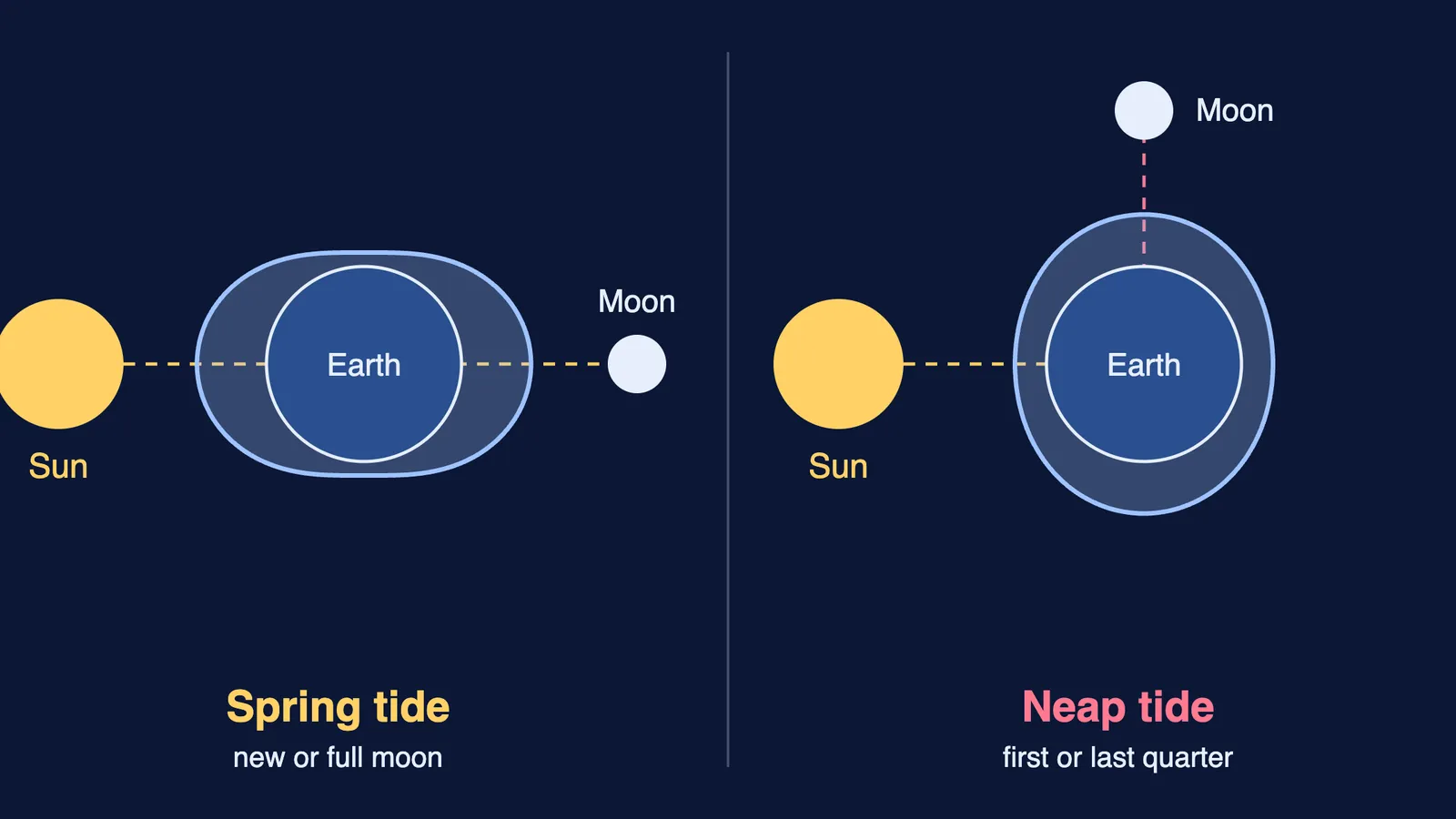
A tide is the regular rise and fall of sea level, once or twice a day, caused mainly by the pull of the Moon and the Sun. Solar tides are about half as large as lunar tides (NOAA tides tutorial). Gravity and the opposing centrifugal effect raise two bulges, one facing the Moon and one on the far side.
Spring tides come at new and full moon, when the Sun, Moon and Earth line up and their pulls add. Neap tides come about a week later, when the Sun and Moon sit at right angles and partly cancel, so the range is smaller (NOAA). "Spring" has nothing to do with the season (NOAA).
By frequency, NCERT lists semi-diurnal (two highs and two lows a day), diurnal (one of each) and mixed (highs of unequal height) tides. Falling water is the ebb; rising water is the flow or flood.
Those timings follow NOAA's lunar day, which lasts about 24 hours 50 minutes. That is why tide tables shift later each day.
If the two bulges confuse you, the Fermi Simulation Lab has interactive simulations for ideas that are easier to see than to read.
How do ocean currents form and how do they affect climate?
Ocean currents are steady flows of water along a set path. NCERT lists four primary forces: heating by the Sun, wind, gravity and the Coriolis force. Surface currents in the open ocean are driven by a complex global wind system (NOAA currents tutorial). NCERT adds that the Coriolis force turns moving water to the right in the Northern Hemisphere and to the left in the Southern, building large circular currents called gyres.
Deep currents are driven by differences in density, set by temperature and salinity. Near the poles, sea ice forms, the salt is left behind, and the saltier, denser water sinks (NOAA).
The effects, from the NCERT chapter:
Cool waters along west coasts in tropical and subtropical latitudes leave those coasts cool, foggy and generally dry.
Warm currents along east coasts in tropical and subtropical latitudes bring warm, rainy climates.
Warm water off west coasts in middle and higher latitudes gives cool summers and mild winters, as in north-west Europe.
Where warm and cold currents mix, oxygen is replenished and plankton grow, so the world's best fishing grounds lie mainly in these zones.
Where the monsoon is strong, NCERT notes, monsoon winds steer the currents. Those same seasonal winds once carried sailing ships, as our piece on how ancient traders used monsoon winds explains.
How should you revise this chapter in three days?
Day 1, waves: write the wave terms from memory, then draw and label one wave.
Day 2, tides: draw Sun, Earth and Moon twice, lined up and at right angles, and say which gives a spring tide and why.
Day 3, currents: mark the twelve map currents on an outline map, then write a 150-word answer on the causes of currents using the four primary forces.
If the Coriolis force still feels shaky, the Fermi Concept Library gives each concept its own lesson.