

On this page
Cyclone warnings cover wind, rain and storm surge. The surge is often the deadliest. A paper on storm surge modelling for the Bay of Bengal and Arabian Sea by S. K. Dube and colleagues in Natural Hazards (2009) notes that about 300,000 lives were lost in the November 1970 cyclone that hit what is now Bangladesh, and 140,000 in the April 1991 Chittagong cyclone. It says these and most of the world's greatest cyclone disasters have been directly attributed to storm surges.
What is a storm surge, exactly?
The US National Hurricane Center defines storm surge as "an abnormal water level rise generated by a storm over and above the predicted astronomical tide" (NOAA National Hurricane Center).
The storm tide is the total water level you see: surge plus normal tide (NOAA National Hurricane Center).
A surge is not a single giant wave or a tsunami. It is a broad dome of raised sea that comes ashore with the cyclone.
How do wind and low pressure raise the sea?
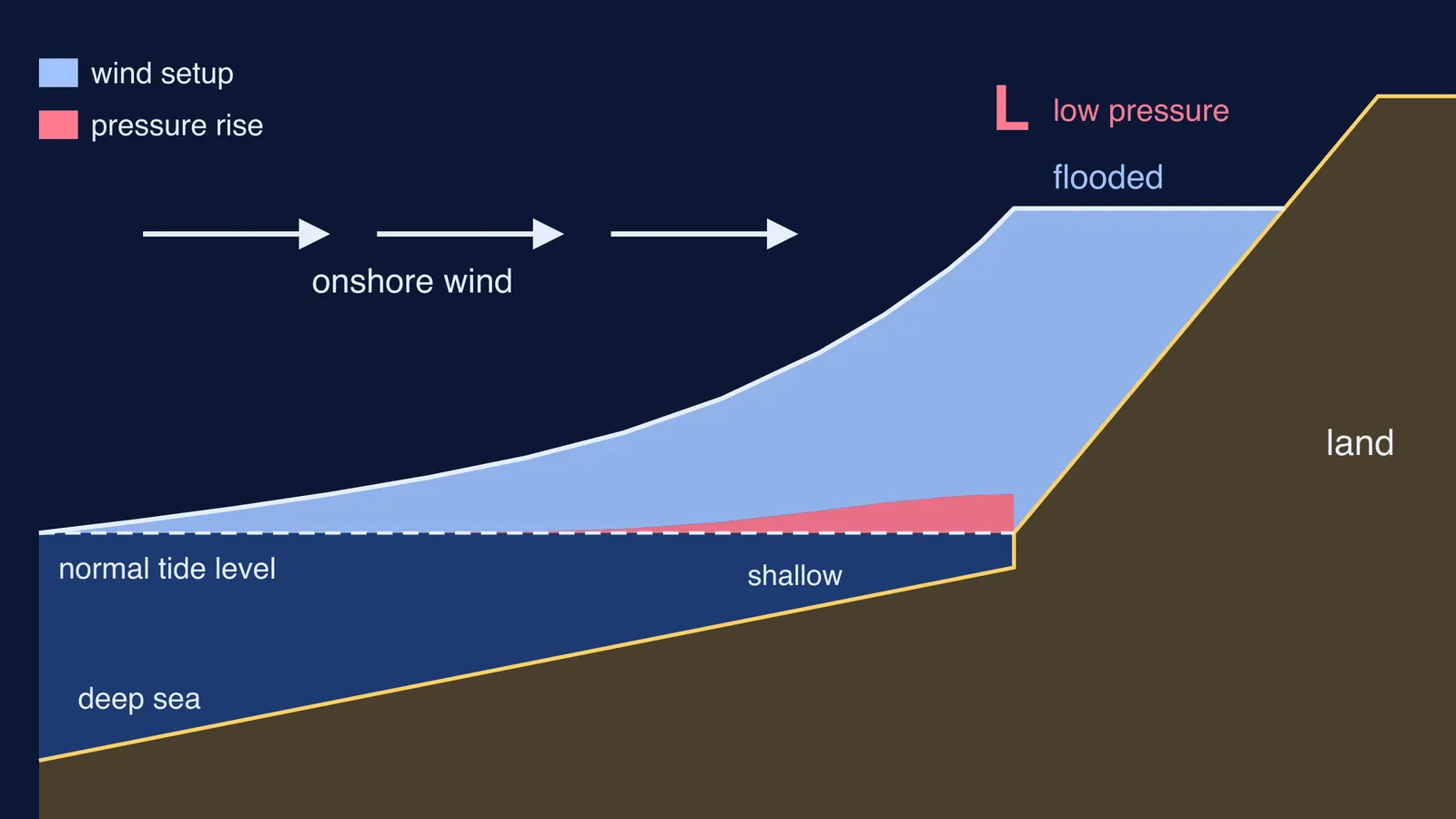
Two forces lift the water. The bigger one is wind. NOAA's Ocean Service says surge comes mainly from "a storm's winds pushing water onshore" (NOAA Ocean Service).
Wind setup. Wind drags surface water towards the coast, where it piles up. The pile stops growing when gravity, acting on the sloping surface, pushes back as hard as the wind pushes forward. In the simplest model, slope = wind stress / (density x g x depth). Depth is in the denominator, so the same wind builds a higher pile over shallow water. That is why the National Hurricane Center says a "wide, gently sloping continental shelf will allow for a higher storm surge" (NOAA National Hurricane Center).
Pressure rise. Air presses down on the sea. Under a cyclone the air pressure is lower, so the sea there bulges up. This is called the inverse barometer effect. A practical rule of thumb is that a drop of 1 hPa in surface pressure raises the local water level by about 1 cm (Kristensen et al., arXiv 2025).
Worked example: how much does low pressure alone lift the sea?
Take a cyclone whose centre is 50 hPa below its surroundings. Treat the bulge as a seawater column whose weight replaces the missing air pressure.
Pressure difference: 50 hPa = 5,000 Pa.
Rise in level: h = (pressure difference) / (density of seawater x g).
h = 5,000 / (1,025 x 9.8) = about 0.50 m.
That matches the 1 cm per hPa rule. Now compare a real surge. When the Odisha super cyclone made landfall near Paradip on 29 October 1999, its surge raised the sea by more than 20 feet, roughly 6 metres, according to a synopsis by S. R. Kalsi in the India Meteorological Department's journal Mausam (2006). Even a 100 hPa drop would lift the sea only about 1 m, so most of a surge that size comes from the wind piling up the sea.
Why is the surge worse on some coasts and at some times?
According to the National Hurricane Center, surge height depends on the storm's intensity, forward speed, size, angle of approach to the coast, the shape of the coastline, and the width and slope of the continental shelf.
Side of the track matters too. The National Weather Service says the greatest surge "generally occurs just to the right of the storm track, where the strongest winds of the storm are blowing onshore" in the Northern Hemisphere (National Weather Service). For how pressure differences drive these winds, see pressure, winds and cyclones explained.
Timing matters as well. NOAA notes that the highest storm tides often come when a storm coincides with a new or full moon (NOAA Ocean Service).
For why India's east coast faces so many cyclones in the first place, see why the Bay of Bengal gets more cyclones.
If air pressure pushing on water feels abstract, the Fermi Simulation Lab has interactive simulations for ideas easier to see than to read.
How do you explain storm surge in an exam answer?
For a 3-5 mark geography or physics answer, this frame covers the main points:
Define it: an abnormal rise in sea level caused by a storm, above the normal tide.
Cause 1, wind: strong onshore winds push surface water towards the coast, where it piles up.
Cause 2, pressure: low pressure at the centre lets the sea bulge up, about 1 cm per hPa.
Amplifiers: a shallow, gently sloping shelf, a coastline that funnels water, the right-hand side of the track, and a high tide.
Effect: seawater floods low-lying land; name an example such as Odisha in 1999.
Add a side-view sketch like the one at the top. Keep the surge separate from the storm's calm centre; see why the eye of a cyclone is calm.
If pressure in fluids is the shaky step, the Fermi Concept Library gives every physics concept its own lesson.


