

On this page
The geography and physics of the Indian subcontinent mean the East Coast gets battered by cyclones far more often than the West Coast. If you look at the historical data, the disparity is stark. The answer lies in the ocean's temperature, the rivers that flow into it, and the thermodynamic concept of latent heat.
Why is there a 4:1 historical ratio?
Historically, for every one cyclone in the Arabian Sea, four typically form in the Bay of Bengal (Deshpande et al., 2021).
This 4:1 ratio makes eastern coastal states like Odisha, Andhra Pradesh, and West Bengal significantly more vulnerable to extreme weather. The Bay of Bengal provides a perfect breeding ground for these massive storm systems, while the Arabian Sea has traditionally been a more hostile environment for them.
How does latent heat fuel a cyclone?
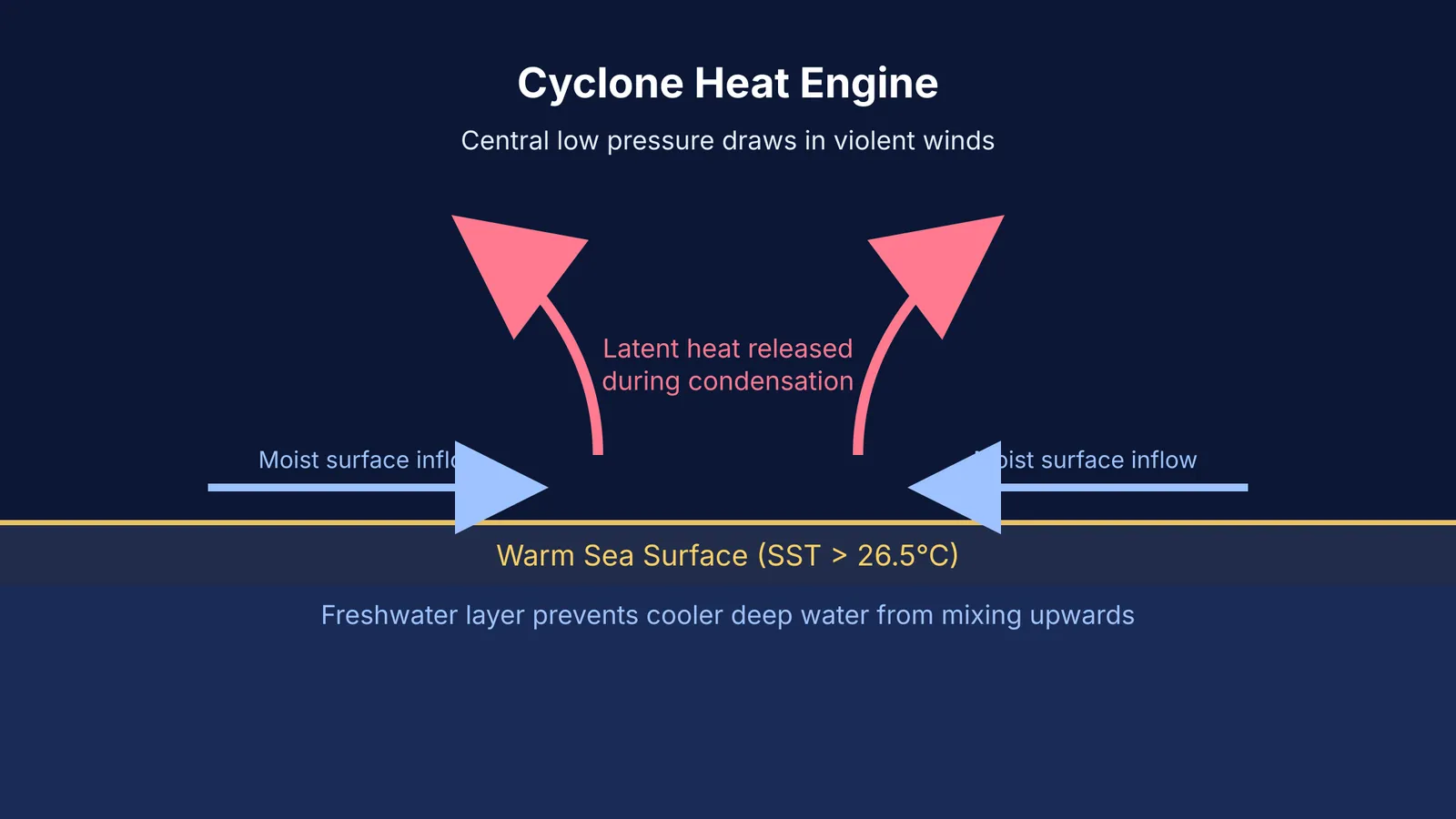
Cyclones are essentially giant heat engines fueled by latent heat. Cyclones require a minimum sea surface temperature of 26.5°C to form (Deshpande et al., 2021).
The Bay of Bengal is consistently warmer than the Arabian Sea, often hovering around 28°C to 30°C. When water evaporates from this warm surface, it stores massive amounts of energy. As this moist air rises and cools, it condenses into clouds, releasing that stored energy as the latent heat of condensation. This sudden release of heat warms the surrounding air, making it lighter. The air rises faster, lowering the surface pressure and drawing in even more violent winds.
Students studying thermodynamics or reading latent heat graphs will recognise this principle: changing phase from gas to liquid releases massive amounts of energy. The warmer the water, the more fuel the engine gets.
How does a freshwater cap trap heat?
The Bay of Bengal receives massive freshwater discharge from perennial rivers like the Ganga and Brahmaputra.
This creates a low-salinity layer of lighter freshwater on the ocean surface. This layer acts as a cap, preventing cooler, deeper ocean water from mixing upwards. The heat remains trapped at the surface, ready to fuel a storm. In contrast, the Arabian Sea is saltier, and its strong winds drive upwelling that brings cooler deep water to the surface, effectively shutting down the cyclone's heat engine.
Do typhoons from the Pacific reach India?
Many cyclones in the Bay of Bengal are not entirely homegrown. The Bay of Bengal also receives leftover weather systems from the Northwest Pacific (Krishnan et al., 2020).
After striking Southeast Asia, the remnants of powerful typhoons travel westward and cross into the Bay. Once they hit the warm, stratified waters of the Bay of Bengal—and encounter its relatively low vertical wind shear—these pre-existing low-pressure systems easily re-intensify into full-blown cyclones. The Arabian Sea lacks this steady supply of external triggers.
Is the Arabian Sea catching up?
While the Bay of Bengal dominates the historical record, climate change is shifting the balance.
A 2021 study by researchers from the Ministry of Earth Sciences found a 52% increase in the frequency of cyclonic storms in the Arabian Sea over the last two decades (Deshpande et al., 2021).
This rise is driven by rapidly warming ocean temperatures across the Arabian basin, which now frequently exceed the 26.5°C threshold needed to sustain these thermodynamic engines.
Checklist: Answering a cyclone physics question
When a geography or physics exam asks about cyclone formation, examiners look for four specific keywords:
Sea Surface Temperature (SST): State the minimum threshold of 26.5°C.
Latent Heat of Condensation: Explain that as rising water vapour condenses, it releases heat, which powers the storm.
Low Vertical Wind Shear: Note that winds must be uniform to keep the storm's vertical structure intact.
Coriolis Force: Mention that this force (absent at the equator) is needed to give the storm its spin.
Understanding the interplay of states, evaporation and latent heat is key to mastering Earth's climate. If you are preparing for physics exams, visualizing these large-scale energy transfers can make the mathematics intuitive. You can explore interactive simulations of these principles in the Fermi Simulation Lab to see exactly how heat converts to work.


