On this page
Mother's Day is the one play in Snapshots, the Class 11 supplementary reader. The plot fills one afternoon and evening in one living room, but examiners use it to ask about respect, unpaid work at home and whether shock tactics are fair. Everything below is checked against the NCERT text of the play, which describes it as a humorous look at the mother's place in a family and dates it to the 1950s.
What is Mother's Day by J. B. Priestley about?
Annie Pearson, a kind, nervous woman in her forties, lives in a London suburb with her husband George and their grown-up children, Doris and Cyril. All three treat her like a servant: they give orders, rush out every evening and never say thank you.
Her neighbour, Mrs Fitzgerald, a bold, smoking fortune-teller who learned her tricks in the East, urges Annie to stand up to them. Annie admits she cannot, so Mrs Fitzgerald says a spell and the two women exchange personalities, each keeping her own body.
The family comes home to someone who looks like Mum but sounds nothing like her. She smokes, plays cards, drinks stout, refuses to make tea and meets every demand with a sharp question. Doris, Cyril and George are hurt, then frightened, then quiet. The real Annie, trapped in her neighbour's body, cannot bear watching her family suffer and begs to switch back. Back in herself, she is warned not to apologise or explain. The family, now careful, agree to her plan: rummy, the children cooking supper, and a talk with George.
Who swaps with whom, and how does each family member change?
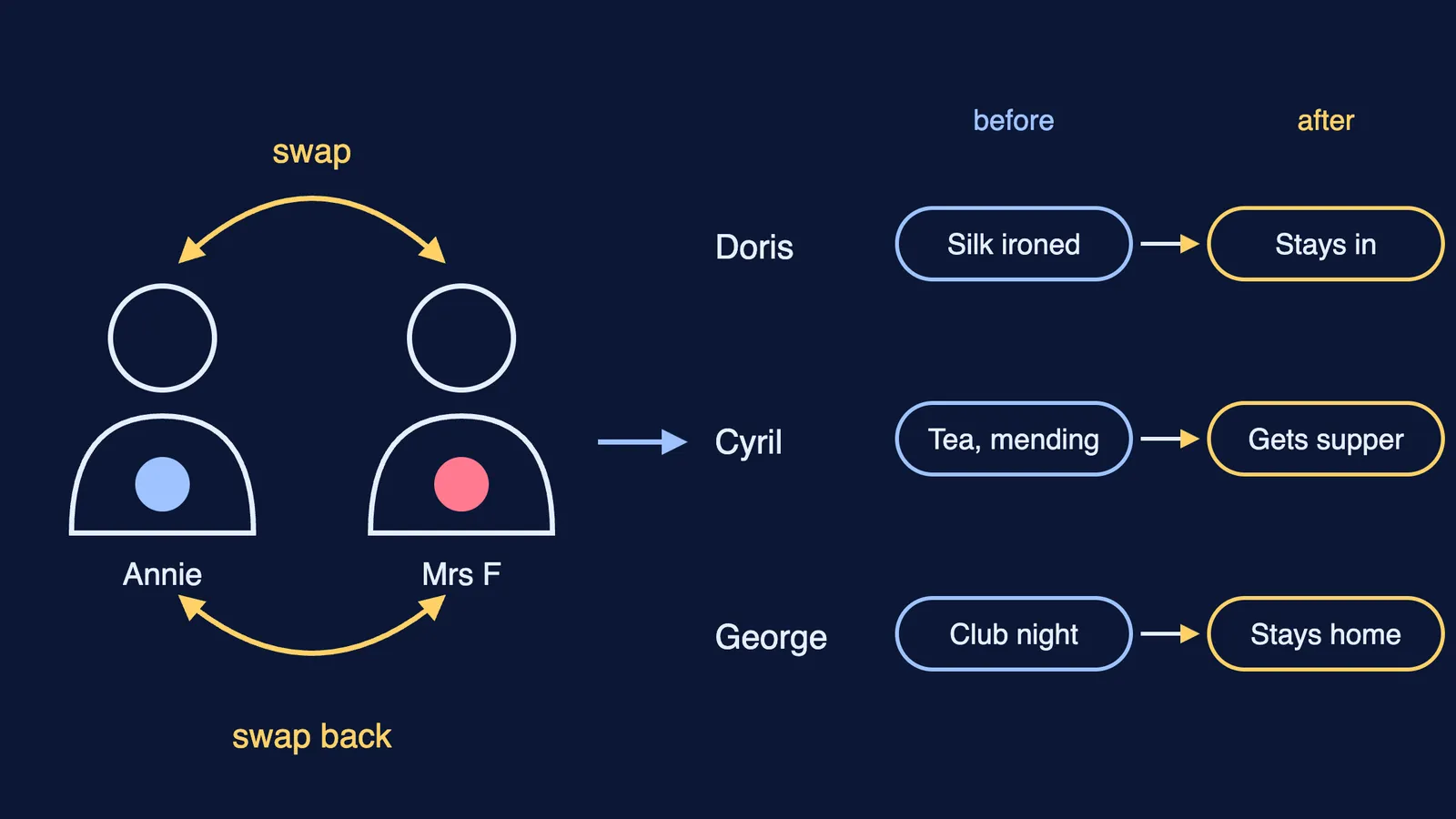
The swap is between Annie and Mrs Fitzgerald only. In every scene with the family, Mrs Fitzgerald's personality is inside Annie's body.
Doris, in her early twenties, wants her yellow silk dress ironed for a date with Charlie Spence. *Mum* mocks Charlie and refuses. By the end Doris has cancelled the date, stays in and agrees to make supper.
Cyril expects tea on the table and his clothes mended. *Mum* compares her work to his union hours and announces a forty-hour week with weekends off. He ends up agreeing at once to whatever she suggests.
George, about fifty and pompous, plans a snooker night at his club. *Mum* tells him the members laugh at him and call him "Pompy-ompy Pearson", and Cyril confirms it. He gives in and stays home.
Annie learns that firmness works; the open question is whether she keeps it up.
What are the main themes of Mother's Day?
Unpaid work at home. The family counts their office hours but treats her full day as nothing. The play turns the language of working hours back on them.
Respect has to be shown, not assumed. Love alone did not stop Annie being taken for granted.
Assertion versus aggression. Mrs Fitzgerald gets results, but she is cruel at times. A strong answer notes both.
Comedy as a vehicle for a serious point. The body swap is pure fantasy, which lets the audience laugh while they recognise their own homes.
Compare tones with My Mother at Sixty-six next year: a quiet, private fear, where Priestley goes loud and comic.
How is Mother's Day asked in the Class 11 exam?
The CBSE English Core curriculum for 2026-27 lists Mother's Day among five Snapshots chapters. Snapshots carries one extract worth 4 marks, one short answer worth 3 marks in 40-50 words and one long answer worth 6 marks in 120-150 words, with a choice of two questions for the short and long answers. Any of the five chapters can appear, so prepare all of them.
How do you write a 6-mark answer on Mother's Day?
Try this practice question, written by us: "Mrs Fitzgerald's methods were harsh. Were they justified?" Use this five-move plan.
Opening (about 20 words): state your view in one sentence.
The problem (about 30 words): one concrete example of the family's behaviour, such as Doris demanding her dress be ironed.
The method (about 35 words): what Mrs Fitzgerald did to each person.
The result (about 30 words): the family stays home and helps with supper.
Your judgement (about 25 words): the shock worked, but lasting change depends on Annie staying firm.
That totals about 140 words, inside the limit. The same structure works for a story with a turning point, like The Rattrap.
Our guide on spotting invented details in AI chapter summaries shows how to run that check quickly.
If physics or maths keeps squeezing out English revision, Fermi's AI tutor can work out what you already know and build a plan for the session, so the play still gets its evening.