On this page
The triangular plate usually turns up as one step inside a bigger rotation problem. Here you get Ma²/12 without calculus, then Ma²/24 from the perpendicular axis theorem, then an integration check.
What is the moment of inertia of an equilateral triangular plate about its centroid?
The moment of inertia of a continuous body is I = ∫r² dm: each bit of mass times the square of its distance from the axis, added up (OpenStax University Physics, section 10.5).
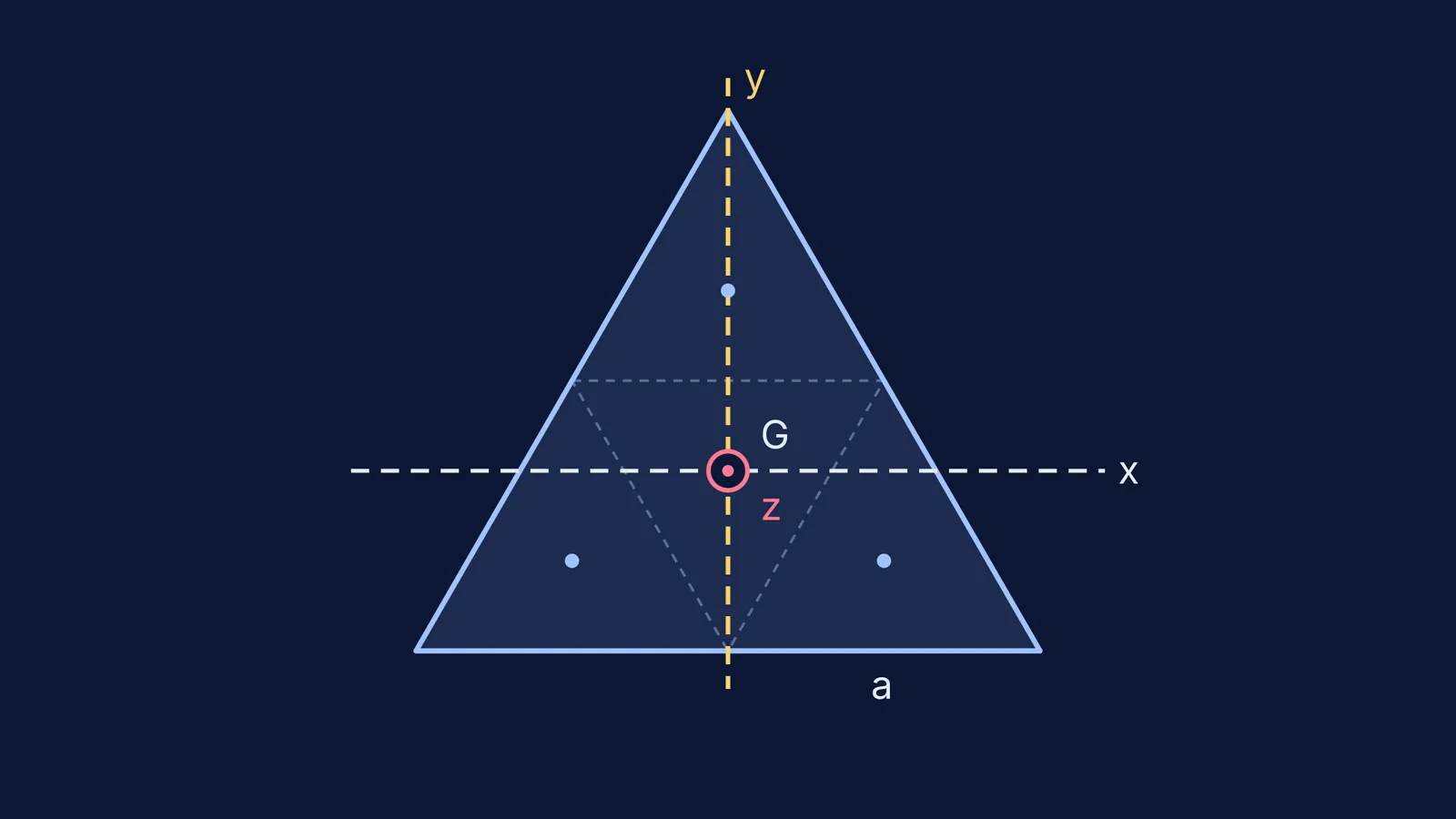
For a uniform equilateral triangular plate of mass M and side a, about the axis through the centroid G perpendicular to the plate, I = Ma²/12.
The general formula for any triangle with sides a, b, c about its centre of mass is m(a² + b² + c²)/36 (List of moments of inertia, Wikipedia). With all three sides equal to a, that gives 3a²/36 = a²/12, so the two routes agree.
How do you get Ma²/12 without integration?
Every equilateral triangle has the same shape, so by units alone I about G must be kMa² for some pure number k.
Join the midpoints of the sides to get four equilateral triangles of side a/2, each of mass M/4. About its own centroid, each has k(M/4)(a/2)² = kMa²/16.
The middle (upside-down) triangle has its centroid exactly at G, so it contributes kMa²/16.
Each corner triangle has its centroid a distance d from G. The full height is h = (√3/2)a, and G sits 2h/3 from a vertex along the median, because the centroid divides each median in the ratio 2:1. The corner triangle's centroid sits 2/3 of its own height h/2 from the same vertex, which is h/3. So d = 2h/3 − h/3 = h/3, and d² = a²/12.
The parallel axis theorem says I = I_cm + md² (OpenStax, same section). Each corner triangle therefore contributes kMa²/16 + (M/4)(a²/12) = kMa²/16 + Ma²/48.
Add all four pieces: kMa² = 4(kMa²/16) + 3(Ma²/48) = kMa²/4 + Ma²/16.
So (3/4)k = 1/16, which gives k = 1/12 and I = Ma²/12.
How does the perpendicular axis theorem give Ma²/24 about a median?
For a flat plate, I_z = I_x + I_y, where x and y lie in the plate and meet where the perpendicular z-axis passes (Perpendicular axis theorem, Wikipedia). See our explainer on the parallel and perpendicular axis theorems for when each applies.
Put the y-axis along one median, through G.
Put the x-axis through G, parallel to the side that median meets, so it is perpendicular to the median.
The z-axis is the perpendicular axis through G, so Ma²/12 = I_x + I_y.
If I_x = I_y, then 2I_y = Ma²/12, and the moment of inertia about a median is Ma²/24.
Why is I_x = I_y? As an in-plane axis turns about G through angle θ, its moment of inertia can only vary like A + B cos 2θ + C sin 2θ. The triangle looks identical after a 120° turn, so this must also repeat every 120°, which forces B = C = 0. Every in-plane axis through G has the same value. The same argument settles the square plate about its diagonal.
How do you check Ma²/24 by integration?
Cut the plate into thin strips perpendicular to the median, at distance t from the top vertex. Each strip has width 2t/√3 and acts like a rod spinning about its centre, so it contributes (1/12)dm(2t/√3)². With surface density σ = 4M/(√3a²) and t running from 0 to h, the integral comes to σh⁴/(18√3). Putting in h⁴ = 9a⁴/16 gives Ma²/24, as expected.
Which value goes with which axis?
Once you have the two centroid values, the parallel axis theorem gives the rest. The distance from G to a vertex is a/√3, and from G to a side is h/3 = a/(2√3).
Perpendicular to the plate, through G: Ma²/12
Any line in the plate through G (a median, or the line parallel to a side): Ma²/24
Perpendicular to the plate, through a vertex: Ma²/12 + Ma²/3 = 5Ma²/12
Along one side: Ma²/24 + Ma²/12 = Ma²/8
To practise these moves on other shapes, the Fermi Problem Library has worked problems with a step-by-step solver that explains the reasoning rather than printing an answer. If the perpendicular axis theorem itself still feels shaky, the Fermi Concept Library gives each physics concept its own lesson.
Next time you meet a triangular plate, first ask where the axis passes and which way it points.