

On this page
You have probably memorised that the centroid sits two-thirds of the way down every median, but the reason is rarely shown. Here are two short proofs, one with coordinates and one with pure geometry, plus a check with real numbers.
What does "the centroid divides the median in the ratio 2:1" mean?
A median joins a vertex of a triangle to the midpoint of the opposite side, and the centroid is the point where the three medians meet (Wikipedia: Centroid).
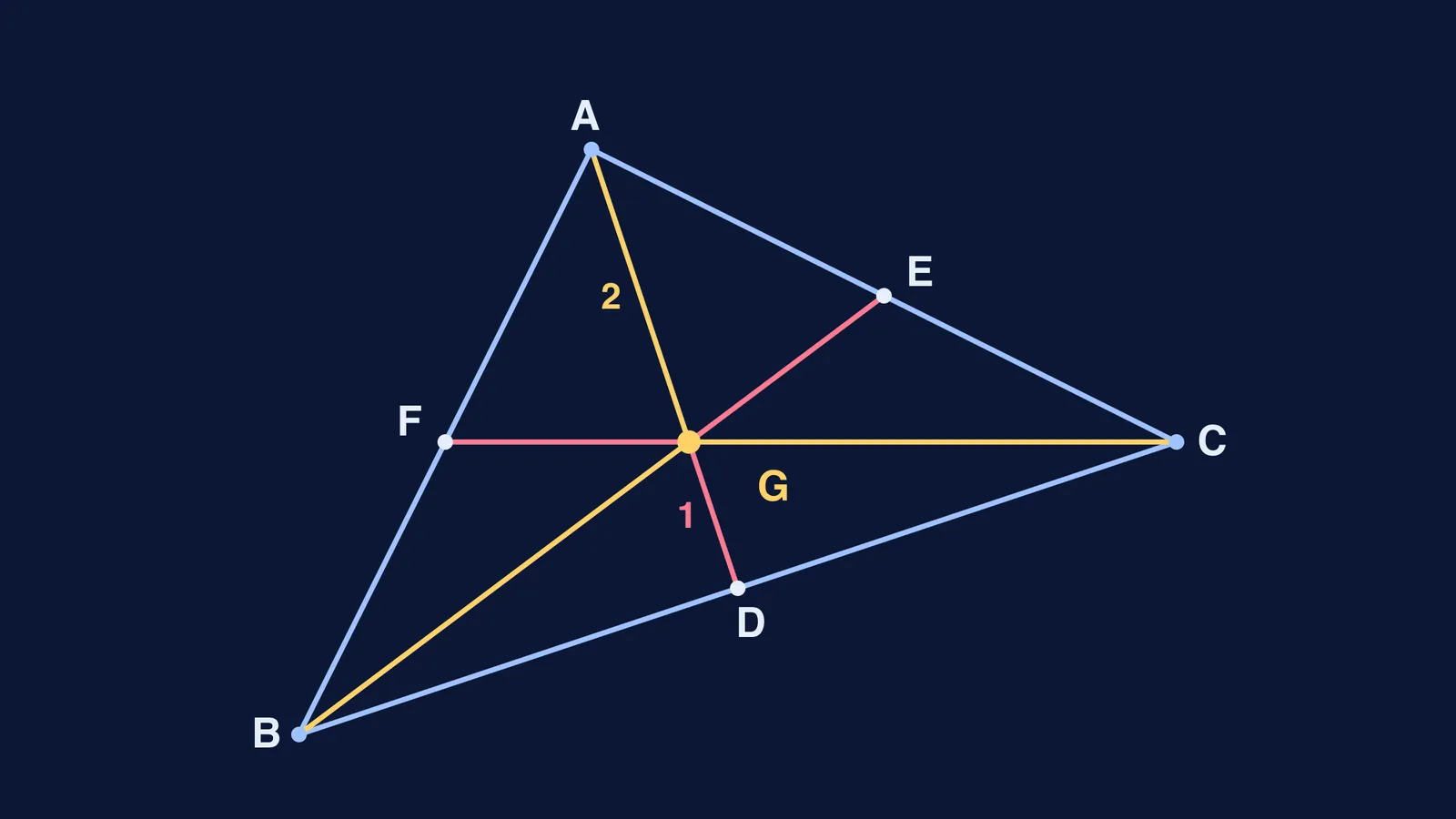
The centroid divides each median in the ratio 2:1, so it is twice as far from the vertex as from the midpoint of the opposite side (Wikipedia: Median)). Put another way, it is two-thirds of the way from each vertex to the midpoint of the opposite side (Wolfram MathWorld: Triangle Centroid). In the diagram above, the yellow part of each median is twice as long as the pink part.
How do you prove it with the section formula?
The section formula in the NCERT Class 10 coordinate geometry chapter says that the point dividing the segment from A(x1, y1) to B(x2, y2) internally in the ratio m1 : m2 is ((m1x2 + m2x1)/(m1 + m2), (m1y2 + m2y1)/(m1 + m2)) (NCERT Class 10 Mathematics, Chapter 7). The midpoint is the special case m1 = m2 = 1.
Let the vertices be A(x1, y1), B(x2, y2) and C(x3, y3), and let D be the midpoint of BC, so D = ((x2 + x3)/2, (y2 + y3)/2).
Find the point G that divides AD in the ratio 2 : 1. The weight 2 goes on D, the far end: x = (2 × (x2 + x3)/2 + 1 × x1)/3 = (x1 + x2 + x3)/3. In the same way, y = (y1 + y2 + y3)/3.
The answer treats all three vertices alike, so the medians from B and C give exactly the same point.
So the medians meet at a single point, it divides each of them 2:1, and its coordinates are the averages of the vertices' coordinates.
How do you prove it with the midpoint theorem?
The midpoint theorem says that the segment joining the midpoints of two sides of a triangle is parallel to the third side and half its length (Wikipedia: Midpoint theorem)).
In triangle ABC, let E be the midpoint of AC and F the midpoint of AB. Let the medians BE and CF meet at G.
In triangle ABC, the midpoint theorem gives FE ∥ BC and FE = BC/2.
Let P and Q be the midpoints of GB and GC. In triangle GBC, the same theorem gives PQ ∥ BC and PQ = BC/2.
So FE and PQ are parallel and equal. A quadrilateral with one pair of opposite sides equal and parallel is a parallelogram, so FEQP is a parallelogram.
Its diagonals EP and FQ bisect each other, and they cross at G. So GE = GP. Since P is the midpoint of GB, GP = PB, which gives BG = 2GE. The same argument gives CG = 2GF.
Run steps 1 to 5 with the medians AD and BE: their meeting point also divides BE 2:1, and only G does that. So the third median passes through G too.
Does the 2:1 split hold with real numbers?
Take A(2, 7), B(−1, 1) and C(8, 4), the triangle in the diagram above.
Centroid: G = ((2 − 1 + 8)/3, (7 + 1 + 4)/3) = (3, 4).
Midpoint of BC: D = ((−1 + 8)/2, (1 + 4)/2) = (3.5, 2.5).
AG = √((3 − 2)² + (4 − 7)²) = √10.
GD = √((3.5 − 3)² + (2.5 − 4)²) = √2.5, which is √10/2.
AG : GD = √10 : √10/2 = 2 : 1.
Try one yourself: F, the midpoint of AB, is (0.5, 4). Work out CG and GF and confirm that CG is twice GF.
Where do students usually slip?
Putting the weights the wrong way round in the section formula. For the point that is 2 parts from A and 1 part from D, the 2 multiplies D's coordinates, not A's.
Calling the centroid "the midpoint of the median". It sits one-third of the way up from the side.
The three medians also cut the triangle into six smaller triangles of equal area (Wikipedia: Median)).
If you know the formula but keep putting the ratio in the wrong place, the Fermi Problem Library has worked problems with a step-by-step solver that explains the reasoning rather than printing an answer. To revise the midpoint theorem or the section formula from the start, the Fermi Concept Library gives each concept its own lesson and its place in the map.
Next time you write (x1 + x2 + x3)/3, you will know where it comes from.


