On this page
The CBSE Class 10 Science curriculum for 2026-27 lists this as experiment 3: observe what Zn, Fe, Cu and Al do in ZnSO₄, FeSO₄, CuSO₄ and Al₂(SO₄)₃ solutions, then arrange the metals in decreasing order of reactivity. The same document gives practical work 5 of the 20 internal assessment marks. Here is how to run it and read the order from your own results.
What is the rule behind metal displacement reactions?
The NCERT Class 10 chapter on metals and non-metals puts it in one line: if metal A displaces metal B from its solution, A is more reactive than B.
The reactivity series is a list of metals arranged in order of decreasing activity, and NCERT's Table 3.2 places aluminium above zinc, zinc above iron, and iron above copper.
Every tube that changes is a redox reaction: the more reactive metal loses electrons and the ions of the other metal gain them. Our guide to oxidation and reduction in Class 10 covers the definitions, and the same logic explains why chlorine displaces bromine and iodine from their salts.
How do you set up the reactivity of metals practical?
Four metals in four solutions make 16 pairs. Leave out each metal in its own salt and you have 12 test tubes.
Rub every metal piece clean with sandpaper just before use, as NCERT does with the iron nails in Activity 1.9 and with tarnished samples in Activity 3.11.
Label the tubes by metal and solution, for example 'Zn in CuSO₄'.
Pour about 10 mL of solution into each, the amount NCERT uses in Activity 1.9.
Note the colour of each solution and metal before you start.
Add the metals and leave them for about 20 minutes, the time NCERT gives in Activities 1.9 and 3.12.
Record the solution colour, the metal surface and any deposit.
Follow your teacher's lab rules, keep the solutions away from your face, and wash your hands afterwards.
What colour changes should you see in each tube?
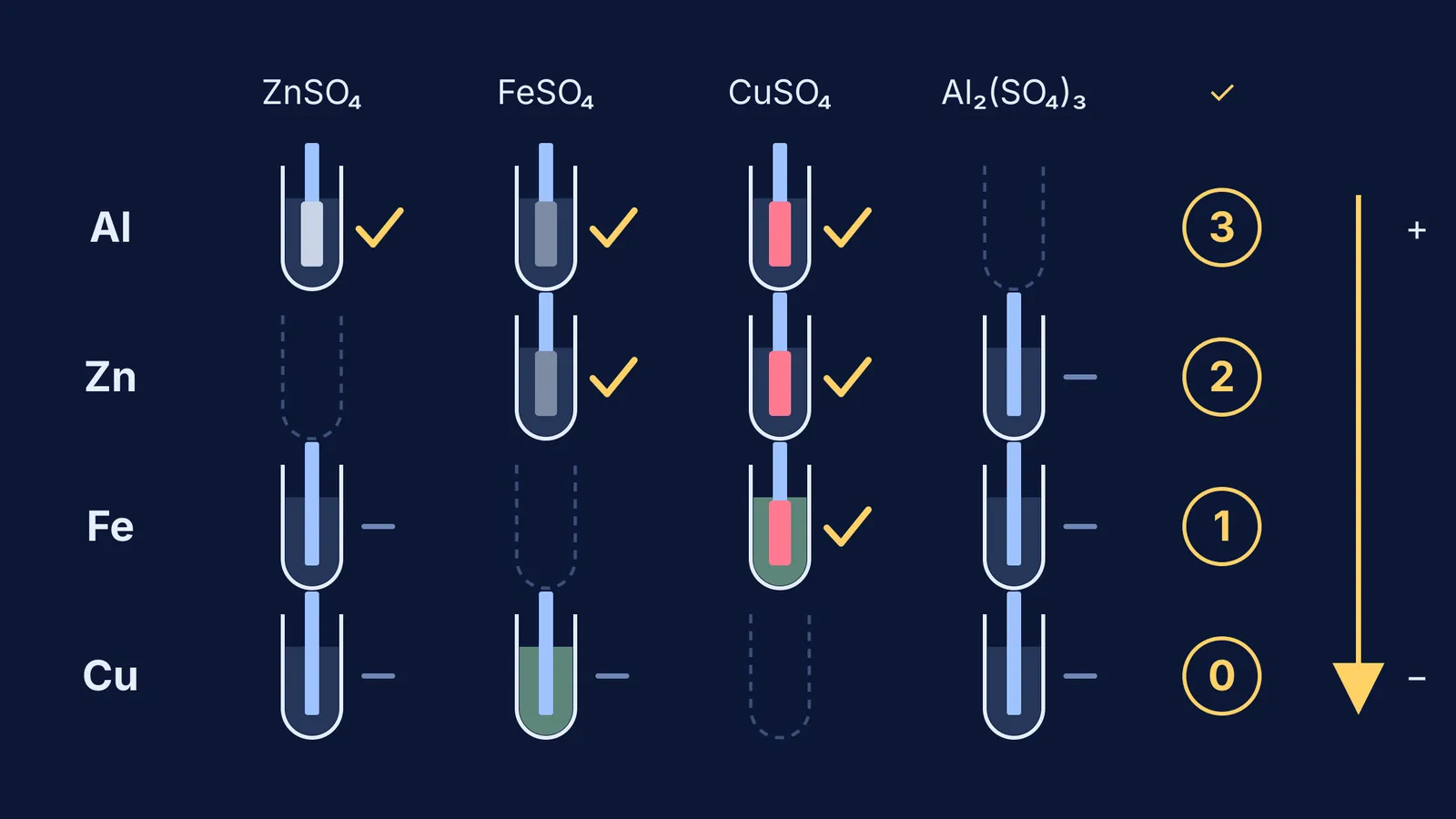
NCERT's Activity 1.9 describes the classic case: an iron nail in copper sulphate turns brownish and the blue colour fades, because Fe + CuSO₄ → FeSO₄ + Cu. Read the rest one metal at a time.
Aluminium: in CuSO₄ the blue fades and reddish-brown copper forms on the foil. In FeSO₄ the pale green fades and a dark iron deposit appears. In ZnSO₄ both solutions are colourless, so look for a grey coating on the foil.
Zinc: in CuSO₄ the blue fades and copper coats the granule (Zn + CuSO₄ → ZnSO₄ + Cu). In FeSO₄ the green fades. In Al₂(SO₄)₃, no change.
Iron: in CuSO₄ the blue turns pale green and the iron gets a brown coating. In ZnSO₄ and Al₂(SO₄)₃, no change.
Copper: no change in any of the three solutions.
Now count how many solutions each metal changed: aluminium 3, zinc 2, iron 1, copper 0. That count is the reactivity order, Al > Zn > Fe > Cu, and it matches NCERT's table.
Why might aluminium not react in your test tube?
This is a common surprise. NCERT explains that at ordinary temperature, metals such as aluminium and zinc are covered with a thin oxide layer that prevents further oxidation (NCERT, Metals and Non-metals). On aluminium foil, the same layer can slow displacement, so a tube may look unchanged for a long time.
Rub the foil hard with sandpaper just before it goes in, and wait the full time. If nothing happens, record what you actually saw and add a line about the oxide layer. An honest observation with a reason is better practice than a copied textbook result. The Al₂(SO₄)₃ bottle may also test slightly acidic, a separate effect explained in why aluminium salt solutions are acidic.
If the reactivity series still feels like a list to memorise, the Fermi Concept Library gives each chemistry concept its own lesson and its place in the map, so you can see where displacement sits next to oxidation and reduction.
What do examiners ask in the viva?
Practise answering these aloud:
Why does the blue colour fade? Copper ions are turned into copper metal, so fewer remain in solution.
Why does copper not react with FeSO₄? Copper is less reactive than iron, so it cannot displace it.
Why clean the metals first? To remove the oxide layer so the metal itself meets the solution.
Where does hydrogen sit? Between lead and copper in NCERT's Table 3.2, which fits copper not reacting with dilute HCl.
Balance aluminium in copper sulphate. 2Al + 3CuSO₄ → Al₂(SO₄)₃ + 3Cu.
The last one trips people up, because three Cu²⁺ ions must match two Al³⁺ ions. If equations like this keep costing you marks, the Fermi Problem Library has worked problems with a step-by-step solver that explains the reasoning rather than printing an answer.
In your record book, list the 12 observations under each metal, then the counts, then one result line: the decreasing order of reactivity is Al > Zn > Fe > Cu.