On this page
Gregor Mendel did not pick the garden pea by luck. Before he describes a single cross in *Experiments in Plant Hybridization*, read at two meetings on 8 February and 8 March 1865, he sets out what a plant must offer for the results to be trusted (Mendel 1865, English translation on MendelWeb).
Why did Mendel choose the pea plant?
Mendel wrote that the plants for his experiments must "possess constant differentiating characteristics", that their hybrids must be protected from foreign pollen during flowering, and that the hybrids and their offspring should suffer no marked loss of fertility over the generations (Mendel 1865).
The garden pea met all three needs, plus some practical ones:
Clear, constant traits. Distinct pea varieties differ in characters that are "easily and certainly recognizable".
A closed flower. The pollen-making and pollen-receiving parts sit packed inside the keel, and the anthers burst inside the bud, so the stigma is covered with the flower's own pollen before it opens. Mendel called this "especially important".
Fertile hybrids. When the hybrids are crossed they give fully fertile offspring, so every generation can be counted.
Easy to grow, quick to mature. Peas grow in open ground and in pots, with a relatively short growing period.
Crossing is possible. He opened the bud early, removed the keel and stamens with forceps, then dusted on pollen from the other variety.
He also tested his material first. He obtained 34 varieties of peas from several seedsmen, grew them for two trial years to check they bred true, and kept 22 for the experiments (Mendel 1865). Among more than 10,000 plants he examined, he found only a very few cases of accidental cross-pollination.
What were Mendel's seven pairs of contrasting traits?
Mendel dropped differences that were "more or less" and hard to separate cleanly. He kept seven pairs that stood out clearly (Mendel 1865). The dominant form is listed first:
Seed shape: round or roundish, or angular and wrinkled.
Seed colour (the albumen inside the seed): yellow, or green.
Seed-coat colour: grey or grey-brown with violet flowers, or white with white flowers.
Pod shape: inflated, or constricted between the seeds.
Unripe pod colour: green, or yellow.
Flower position: axial (along the stem), or terminal (bunched at the top).
Stem length: long (6 to 7 ft), or short (3/4 to 1 1/2 ft).
Mendel tied white seed coats to white flowers, so many textbooks list the third pair as flower colour, violet or white. It is the same trait.
Which traits were dominant, and how close was 3:1?
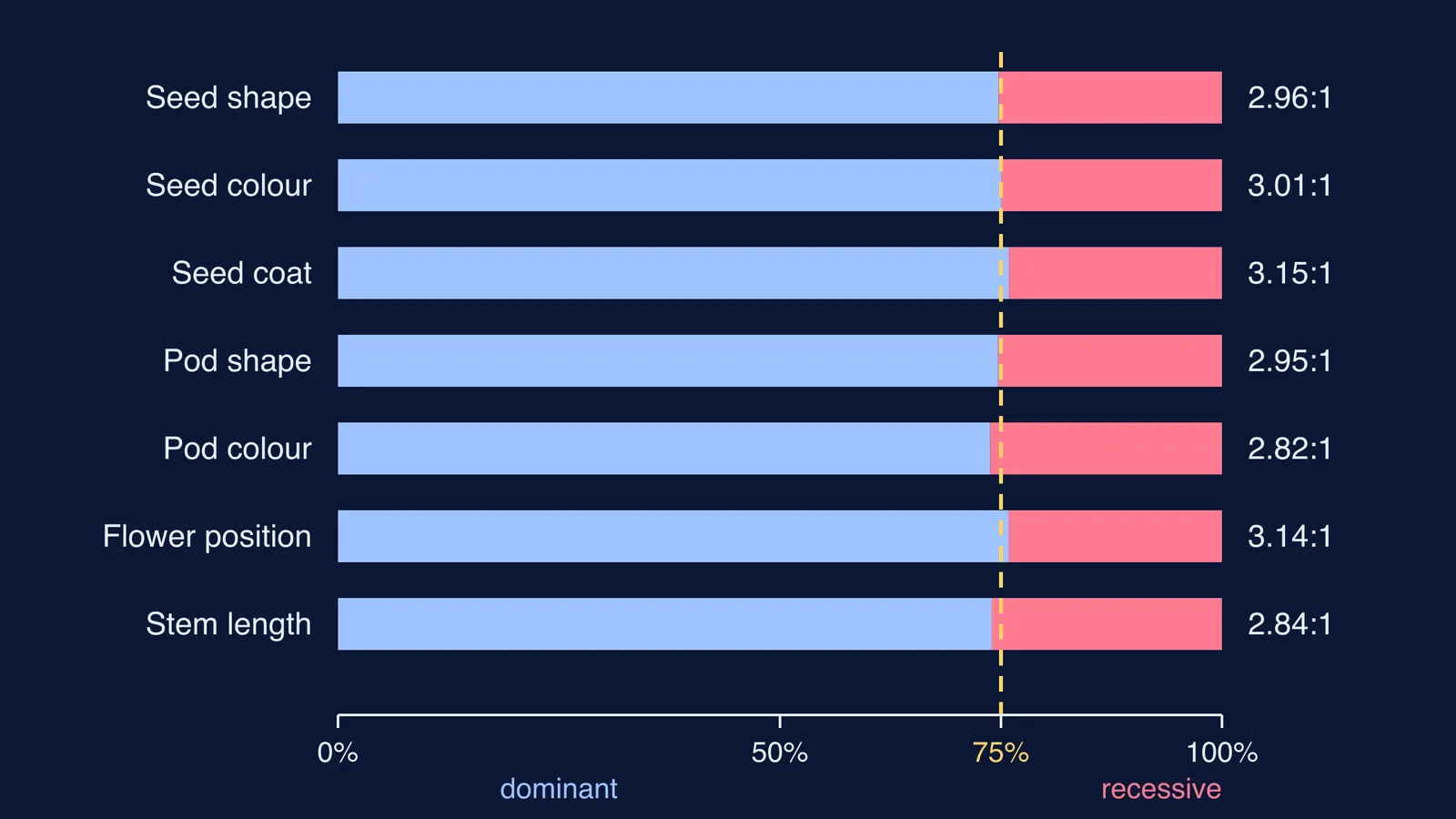
Mendel defined the terms in this paper: the form that shows in the hybrid is dominant, and the form that disappears in the hybrid but comes back unchanged in the next generation is recessive (Mendel 1865). In the generation grown from the hybrids, his counts were:
Seed shape: 5,474 round, 1,850 wrinkled (2.96:1).
Seed colour: 6,022 yellow, 2,001 green (3.01:1).
Seed coat: 705 grey-brown, 224 white (3.15:1).
Pod shape: 882 inflated, 299 constricted (2.95:1).
Pod colour: 428 green, 152 yellow (2.82:1).
Flower position: 651 axial, 207 terminal (3.14:1).
Stem length: 787 long, 277 short (2.84:1).
Taken together, the average ratio was 2.98:1, which Mendel rounded to 3:1. He saw no in-between forms in any experiment.
The genes behind these traits took far longer to find. By 2011, four had been sequenced: A (flower colour), LE (stem length), I (seed or cotyledon colour) and R (seed shape) (Reid and Ross 2011, *Genetics*).
How do you check Mendel's numbers yourself?
Take stem length. With 1,064 plants and a 3:1 ratio, you expect three quarters tall: 1,064 × 3/4 = 798 tall and 266 short. Mendel counted 787 and 277, a gap of 11 plants each way, about 1% of the total (Mendel 1865).
Our piece on why Mendel's 3:1 ratio needs large numbers shows what happens with 10 plants. When you combine two traits, the product rule and sum rule in genetics give you 9:3:3:1.
How do you remember the seven traits for the exam?
Use this three-step self-test:
Write the seven headings in order of the plant, seed to stem: seed shape, seed colour, seed coat, pod shape, pod colour, flower position, stem length.
Next to each, write the dominant form, then the recessive. The pair that trips students up is colour: yellow wins for the seed, but green wins for the unripe pod.
For one trait, write the cross from true-breeding parents to the 3:1 generation using letters, then say why the pea made this cross possible.
If the idea of a gene pair is shaky, the Fermi Concept Library has a lesson for each concept in biology and shows where it sits in the map. For monohybrid and dihybrid questions, the Fermi Problem Library has worked problems with a step-by-step solver that explains the reasoning.
Next, see where these factors live in our guide to the chromosomal theory of inheritance.