On this page
Memories of Childhood is Chapter 6 of Vistas, the NCERT supplementary reader for Class 12 English Core: two short autobiographical pieces by women from marginalised communities (NCERT chapter text). Both parts are on the Vistas list in CBSE's English Core curriculum for 2026-27.
Who wrote Memories of Childhood?
Background from the NCERT introduction:
Zitkala-Sa is the pen name of Gertrude Simmons Bonnin, a Native American woman born in 1876. From 1900 she wrote articles critical of the Carlisle Indian school.
Bama is the pen name of a Tamil Dalit woman from a Roman Catholic family. Her account is taken from her 1992 autobiography Karukku, named after palmyra leaves with saw-toothed edges on both sides.
What happens in The Cutting of My Long Hair?
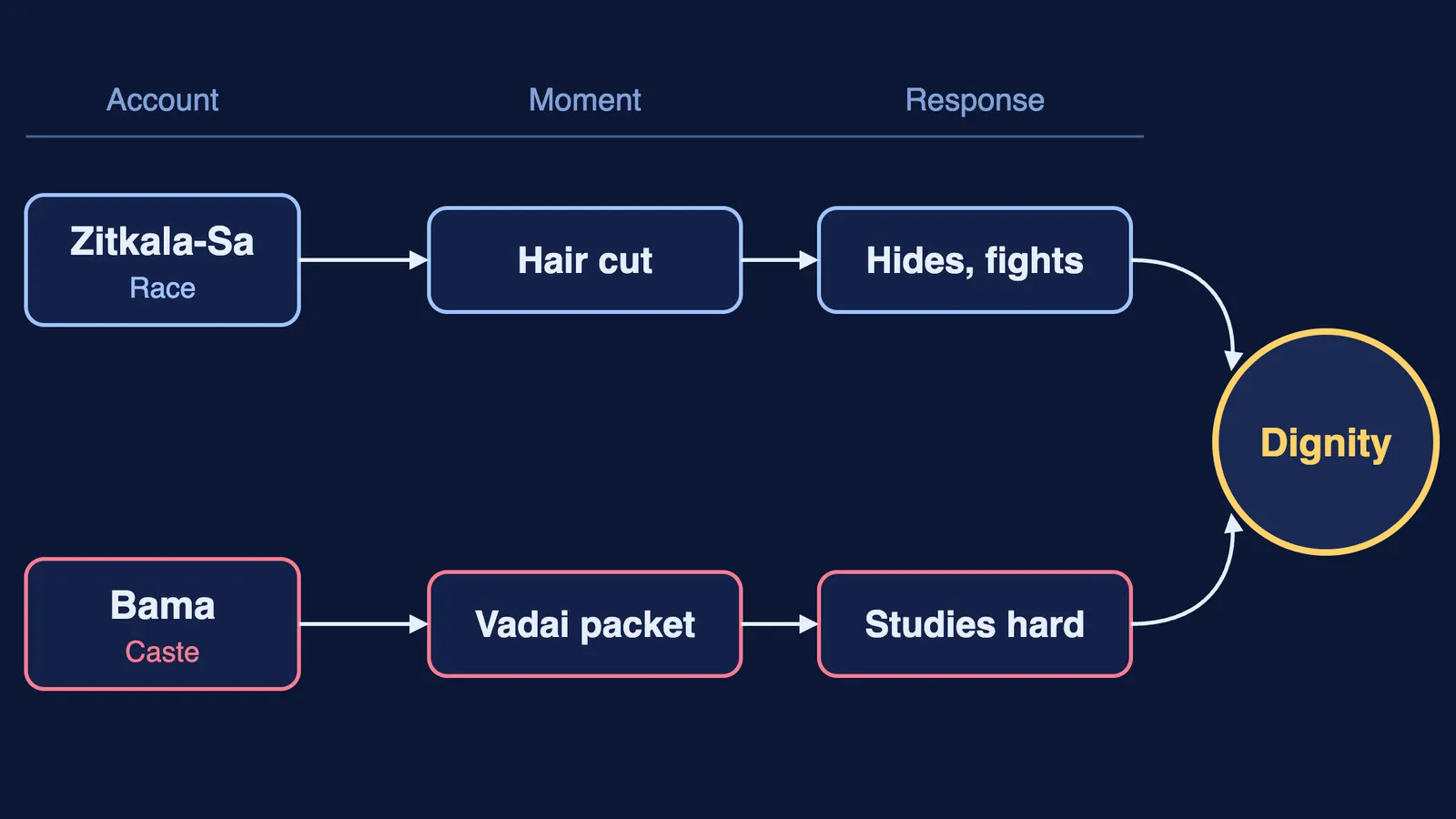
Zitkala-Sa recalls her first day at a school for Native American children in what she calls the land of apples, far from her mother. Bells rule every meal. At breakfast she sits too early, rises, sits again, and ends up in tears, too scared to try anything else. Her blanket has been taken; later that day her moccasins are swapped for squeaking shoes.
Her friend Judewin, who knows a little English, warns her that the staff plan to cut the girls' long hair. Among her people, short hair marked mourners, shingled hair marked cowards, and captured warriors were shorn by the enemy: a deep shame. Judewin thinks they must give in. Zitkala-Sa answers, "No, I will not submit!" She hides under a bed upstairs, but is found, dragged out kicking, tied to a chair, and her braid is cut. She calls for her mother, but nobody comforts her; she feels herded like an animal.
What happens in We Too Are Human Beings?
Bama is in the third class. Her ten-minute walk home stretches to half an hour or more because the bazaar is full of things to watch.
One day she sees an elder of her community carrying a packet of vadais by its string, without touching it, and handing it to the landlord with a low bow. She finds it funny. At home her elder brother, Annan, explains that people who think of themselves as upper caste believe they must not touch Bama's community, or they will be polluted; hence the string. Her laughter turns to sadness, then anger. Annan, home from university, was once asked by one of the landlord's men which street he lived on, a way to find out his caste. He tells her that study is how they can rise above such treatment. She studies hard, stands first in her class and makes many friends.
What are the main themes of Memories of Childhood?
Loss of dignity. Zitkala-Sa loses her blanket, her moccasins and her hair; Bama's elder has to bow low and carry the snack by its string.
Seeing wrong while young. Bama has felt untouchability before she has heard anyone speak openly about it, and Zitkala-Sa senses the insult at once.
Two ways to answer. Zitkala-Sa resists openly, by hiding and fighting. Bama resists through study, following Annan's advice.
Identity. Hair, dress and language mark who Zitkala-Sa is; asking which street Annan lives on is a way to find out his caste.
If you are studying Lost Spring too, our Lost Spring Class 12 summary covers another chapter about children and social injustice.
What questions can come from Memories of Childhood in the board exam?
The CBSE 2026-27 question paper design takes three kinds of question from Vistas: one prose extract out of two (4 x 1 marks), two short answers out of three in 40-50 words (2 x 2 marks), and one long answer out of two in 120-150 words (1 x 5 marks). Any Vistas chapter can come; treat these as practice.
Extract: the breakfast scene or the vadai packet: who is watching and what they misread.
Short answer: Why does Zitkala-Sa fear the haircut? What makes Bama stop laughing?
Long answer: Contrast open defiance and quiet effort as ways of meeting unfair treatment, using both girls.
For the 5-mark comparison, aim for about 140 words in five moves:
Stance: different continents and communities, one shared wound: being denied equal dignity.
Zitkala-Sa: the haircut means shame in her culture; she hides, fights, and is overpowered.
Bama: the vadai packet looks comic until Annan explains untouchability; laughter turns to anger.
Responses: open defiance against quiet, steady effort through education.
Close: both girls saw injustice early, and both grew up to write about it.
To link prejudice and dignity across Vistas, read our The Enemy Class 12 summary and On the Face of It Class 12 guide.
For science papers, if knowing where to start is the hard part, Fermi's AI tutor can work out what you already know and build a plan for the session. For this chapter, retell both accounts aloud in two minutes each, then write the comparison.