On this page
You cannot put Earth on a weighing scale, but every falling stone does the weighing for you. Measure g, know Earth's radius and the gravitational constant G, and three lines of algebra give you the planet's mass. One more gives its average density.
Where does g = GM/R² come from?
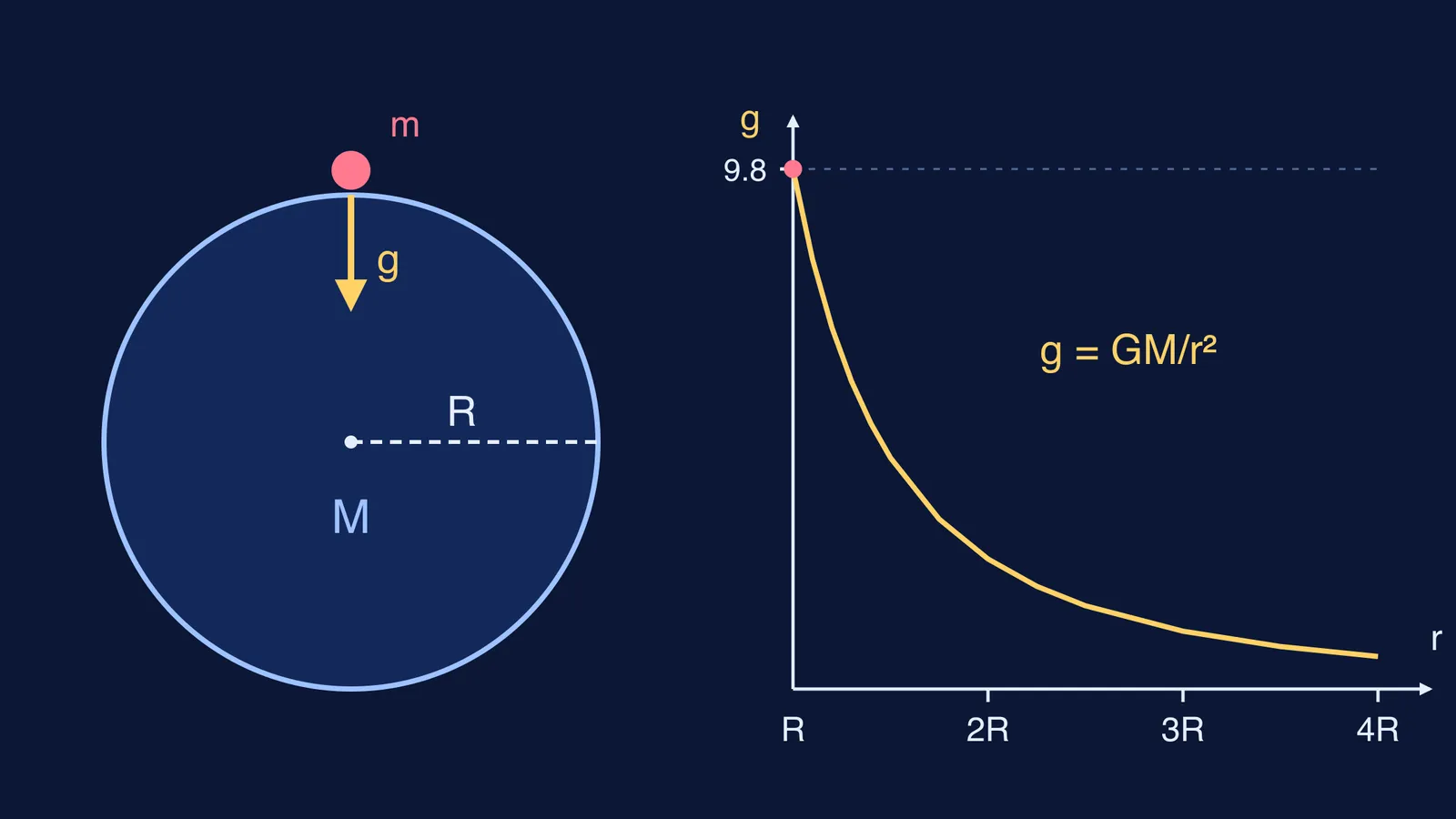
Newton's law of gravitation says two masses M and m a distance r apart attract with force F = GMm/r². For a body of mass m sitting on Earth's surface, r is Earth's radius R, and that force is simply the body's weight, mg.
Set the two equal: mg = GMm/R². The m cancels on both sides, which is why a heavy and a light ball fall with the same acceleration. What is left is g = GM/R².
This treats Earth as a non-spinning sphere, which is why real g varies a little; see why you weigh more at the poles than at the equator. For finding the mass, it is close enough.
How do you calculate the mass of Earth using g?
Rearrange g = GM/R² to make M the subject: M = gR²/G. Now you need three numbers.
g = 9.8 m/s². The standard acceleration of gravity is defined as 9.806 65 m/s², according to NIST's CODATA 2022 values.
R = 6,371 km = 6.371 × 10⁶ m. This is Earth's volumetric mean radius on NASA's Earth fact sheet.
G = 6.674 30 × 10⁻¹¹ m³ kg⁻¹ s⁻², the CODATA 2022 recommended value published by NIST.
Now work it through, keeping powers of ten separate from the digits.
Square the radius: R² = (6.371 × 10⁶ m)² = 40.59 × 10¹² m² = 4.059 × 10¹³ m².
Multiply by g: gR² = 9.8 × 4.059 × 10¹³ = 3.978 × 10¹⁴ m³/s².
Divide by G: M = 3.978 × 10¹⁴ ÷ 6.674 × 10⁻¹¹ = 0.596 × 10²⁵ kg = 5.96 × 10²⁴ kg.
Earth's mass is 5.9722 × 10²⁴ kg, according to NASA's Earth fact sheet. Our answer is within about 0.2% of that; the gap comes from rounding g and using one mean radius for a slightly flattened planet.
Step 2 hides a check: gR² equals GM, and the same NASA sheet lists Earth's GM as 0.39860 × 10⁶ km³/s², or 3.986 × 10¹⁴ m³/s².
How do you find Earth's mean density from g?
Density is mass divided by volume, and Earth's volume is that of a sphere: V = (4/3)πR³.
R³ = (6.371 × 10⁶ m)³ = 2.586 × 10²⁰ m³.
V = (4/3) × π × 2.586 × 10²⁰ = 1.083 × 10²¹ m³.
ρ = M/V = 5.96 × 10²⁴ ÷ 1.083 × 10²¹ ≈ 5,500 kg/m³.
Earth's mean density is 5,513 kg/m³, according to NASA's Earth fact sheet, so the estimate is close.
You can skip the mass altogether. Put M = (4/3)πR³ρ into g = GM/R² and you get g = (4/3)πGρR, or ρ = 3g/(4πGR). Exam setters like it: on a planet of the same density but twice the radius, g doubles.
The number also says something about Earth's interior. Typical crustal rock has a density of about 2.7 g/cm³, while Earth as a whole averages about 5.5 g/cm³, as this Oberlin College geology lecture points out. Since the surface is light, the deep interior must be much denser.
Why did weighing Earth have to wait for G?
M = gR²/G is useless without G, and G is tiny and hard to measure. Henry Cavendish used a torsion balance devised by John Michell to detect the pull between lead balls, and published the result in 1798 as Experiments to determine the density of the earth in the Philosophical Transactions of the Royal Society. Notice the title: he reported Earth's density, not a value of G, which is the calculation above run the other way. G can be worked out from his result. Our explainer on how Cavendish measured G with a torsion balance covers the apparatus.
The same idea works for bodies you cannot stand on. Replace the falling stone with an orbiting planet and you can find the mass of the Sun from Earth's orbit.
What mistakes cost marks in this calculation?
Using R in kilometres. R² then comes out 10⁶ times too small, and so does M.
Squaring 6.371 but forgetting to square 10⁶. (10⁶)² is 10¹², not 10⁶.
Using Earth's diameter instead of its radius, which makes M four times too big.
Using surface g for a satellite or a mountain top. Above the surface, the distance is R + h, not R.
If you keep losing marks to the same slip, practise a run of gravitation numericals in the Fermi Problem Library, where the step-by-step solver explains the reasoning rather than printing an answer, so you can see exactly which line went wrong. To revisit the ideas behind g, G and density first, start from gravitation in the Fermi Concept Library.