On this page
Bent-wire questions in JEE Main and board exams look long, but many shrink once you spot one rule: a straight segment gives zero field at any point on its own line. Here is why, where the rule stops, and two worked examples.
Why is the magnetic field zero on the line of a straight wire?
The Biot-Savart law gives the field of a small piece of wire, length dl, carrying current I, as dB = (μ0/4π) I dl × r̂ / r² (OpenStax University Physics, Volume 2, section 12.1). In the same section, the permeability of free space is μ0 = 4π × 10⁻⁷ T·m/A, so μ0/4π is exactly 10⁻⁷ T·m/A.
The magnitude form is dB = (μ0/4π) I dl sin θ / r², where θ is the angle between dl and r̂ (OpenStax, section 12.1).
Now put your point P on the straight line the wire lies along, beyond one of its ends. For every element of that wire, the vector r from the element to P runs along the wire. So θ is 0° if P is ahead of the current and 180° if it is behind.
The cross product of two parallel or antiparallel vectors is zero, because sin 0° = sin 180° = 0 (OpenStax University Physics, Volume 1, section 2.4). OpenStax spells out what this means for the Biot-Savart law: if θ = 0, then dB = 0, and a current element produces no field component along its own direction (section 12.1).
Every element contributes zero, so the whole segment does too, with no integral needed. If the vector side of this feels shaky, our post on when the cross product of two vectors is zero goes through it.
Where does the rule stop working?
It applies to one segment at a time. The other segments of the same circuit still contribute.
P must be exactly on the line. Slightly off it, θ is no longer 0° or 180°, so the segment contributes. Use the finite-wire formula.
P must be on the line, not inside the wire. The formula has r² in the denominator, so it can't be used at r = 0.
How do you use it on bent wire problems?
Take μ0/4π = 10⁻⁷ T·m/A in both examples. For a long straight wire, B = μ0I/(2πR) at perpendicular distance R (OpenStax, section 12.2).
Example 1: an L-shaped wire
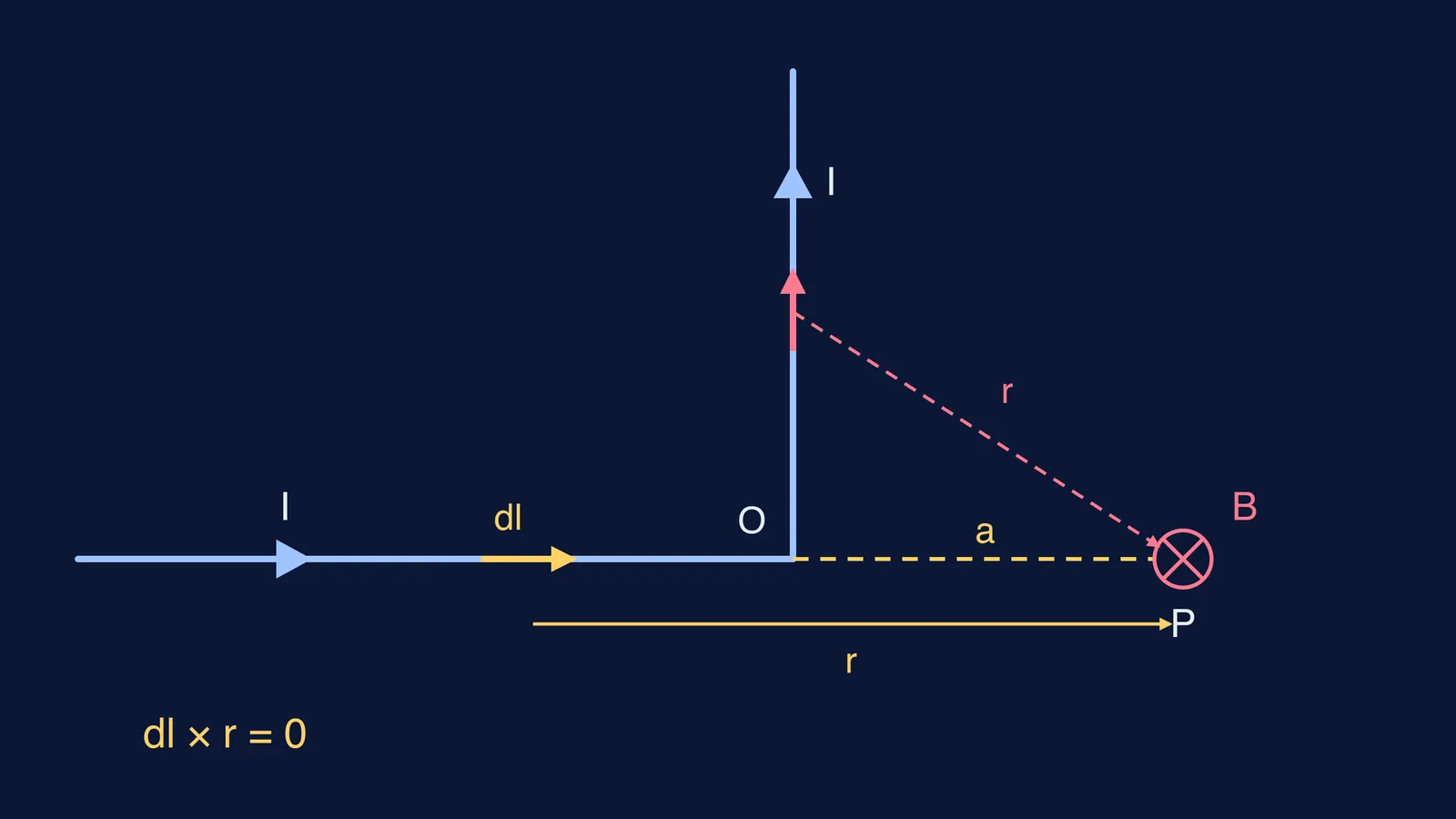
Two long straight wires meet at a right angle at corner O and carry I = 5 A, as in the diagram above. Point P lies on the extension of the horizontal arm, a = 10 cm beyond O.
Horizontal arm: P is on its line, so it contributes 0.
Vertical arm: it is semi-infinite, and P is level with its end O, at perpendicular distance a. A wire running to infinity in both directions gives μ0I/(2πa), and by symmetry each half gives the same share. So this arm gives μ0I/(4πa).
B = 10⁻⁷ × 5 / 0.10 = 5 × 10⁻⁶ T, or 5 μT.
Direction: the current runs up the vertical arm and P is to its right, so the right-hand rule gives a field into the page.
Example 2: a pie-slice loop
A loop is made of two radial straight wires and a circular arc of radius R that subtends an angle θ at the centre C. Both radial wires point straight at C, so C lies on each of their lines and both contribute 0. Only the arc counts, and OpenStax's Example 12.2 gives B = μ0Iθ/(4πR) for an arc (OpenStax, section 12.1).
For a quarter circle (θ = π/2) with I = 5 A and R = 10 cm, B = μ0I/(8R) = (4π × 10⁻⁷ × 5)/(8 × 0.10) ≈ 7.9 × 10⁻⁶ T. Our post on the field at the centre of arcs and straight segments has more shapes like this.
How do you make this automatic before an exam?
Run this checklist on every bent-wire question:
Mark P and number every straight segment and arc.
Extend each straight segment with a dashed line. Write 0 next to any segment whose line passes through P.
For the rest, choose the right result: infinite wire μ0I/(2πd), semi-infinite wire with P level with its end μ0I/(4πd), any other finite segment the angle formula, an arc μ0Iθ/(4πR). Our guide to the finite wire angle formula covers the third case.
Find each direction with the right-hand rule, mark it ⊙ or ⊗, and add with signs.
If your answer doesn't match the key and you can't see why, the Fermi Problem Library has worked problems with a step-by-step solver that explains the reasoning rather than printing an answer, so you can find the segment you mishandled. If the gap is the cross product itself, the Fermi Concept Library gives each concept in physics and mathematics its own lesson.
Try the checklist on your next three bent-wire questions, dashed lines first.