

On this page
What is the magnetic field formula for a finite straight wire?
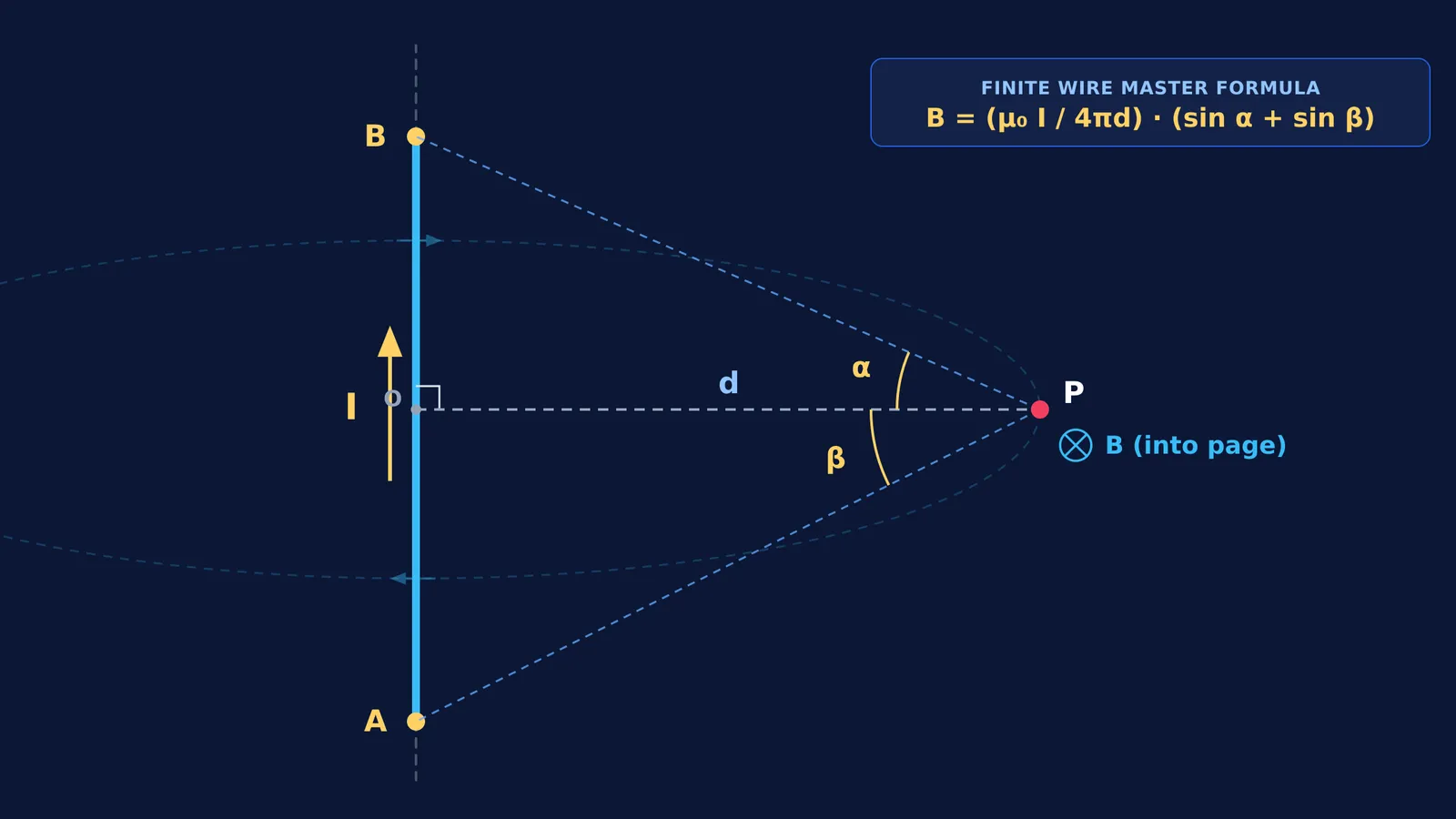
When electric current flows through a conductor, it produces a circulating magnetic field. For a finite straight wire carrying steady current I, the magnetic field magnitude B at observation point P is:
B = (μ₀I / 4πd) × (sin α + sin β)
Documented in OpenStax University Physics Volume 2, B is the field in teslas (T), μ₀ = 4π × 10⁻⁷ T·m/A is the permeability of free space, I is current in amperes (A), and d is the perpendicular distance to the wire line in metres (m). Angles α and β are subtended by the wire's ends at point P, measured from the perpendicular normal.
In 1820, Jean-Baptiste Biot and Félix Savart established that current elements produce magnetic fields via an inverse-square law, detailed in NCERT Class 12 Physics Chapter 4. Integrating these elements along a straight wire yields an angular integral of cos θ dθ, giving the sum of sines. This geometry resembles the electric field of a finite charged rod, but the magnetic field curls around the wire rather than pointing radially.
How do you measure the angles α and β correctly?
The most common exam mistake is measuring angles from the wire axis instead of the perpendicular line, as noted in NCERT Class 12 Physics Chapter 4.
To determine α and β:
Drop a perpendicular of length d from point P to the wire line, identifying the foot.
Connect point P to both wire ends with straight sightlines.
Measure α and β between the perpendicular line and each sightline.
If a problem provides interior angles θ₁ and θ₂ against the wire, use complementary angles: α = 90° − θ₁ and β = 90° − θ₂. Since sin(90° − θ) = cos θ, the formula becomes B = (μ₀I / 4πd)(cos θ₁ + cos θ₂).
The position of the foot determines whether to add or subtract:
Foot between endpoints: Ends lie on opposite sides of the normal, so add sines: B = (μ₀I / 4πd)(sin α + sin β).
Foot at one endpoint: Setting one angle to 0° gives B = (μ₀I / 4πd) sin α.
Foot outside the segment: Both ends lie on the same side of the normal, so subtract sines: B = (μ₀I / 4πd)(sin α − sin β).
How do the infinite and semi-infinite wire limits work?
The finite wire formula simplifies into standard textbook expressions at extreme limits, as shown in OpenStax University Physics Volume 2:
Infinitely long wire: When the wire extends infinitely in both directions, α and β approach 90°. With sin 90° = 1, B = (μ₀I / 4πd)(1 + 1) = μ₀I / (2πd), matching Ampère's circuital law. Compare both derivations in our guide to Biot-Savart and Ampère's law.
Semi-infinite wire: When point P aligns with one end of a wire extending infinitely in one direction, the near angle is 0° and the far angle is 90°. With sin 0° = 0 and sin 90° = 1, B = (μ₀I / 4πd)(1 + 0) = μ₀I / (4πd), exactly half the infinite-wire field.
Symmetrical finite wire: If point P lies on the perpendicular bisector of a wire of length L, then α = β. Because sin α = (L/2) / √(d² + L²/4) = L / √(4d² + L²), the field is B = (μ₀I L) / [2πd √(4d² + L²)].
What is the magnetic field at the centre of a square loop?
Consider a square loop of side 2a carrying steady current I, a classic problem from NCERT Class 12 Physics Chapter 4.
Segment geometry: The centre lies at distance d = a from each side. Connecting the centre to the corners of one edge gives α = 45° and β = 45°.
Single-side field: Using sin 45° = 1/√2, B₁ = (μ₀I / 4πa)(sin 45° + sin 45°) = (√2 μ₀I) / (4πa).
Superposition: Right-hand grip rules show each clockwise segment creates an inward-directed field at the centre. Check our walkthrough of right-hand-rule conventions for magnetic fields for vector conventions. Summing all four segments gives B_total = 4B₁ = (√2 μ₀I) / (πa), or (2√2 μ₀I) / (πL) for side L = 2a.
How do you systematically solve finite wire problems?
To solve finite current segment problems reliably:
Find field direction: Point your right thumb along current I and curl your fingers to check whether B points into or out of the page.
Drop the perpendicular: Draw normal line d to the wire axis, extending the line if the foot falls outside.
Choose the sign: Add sines if the foot lies between endpoints; subtract them if both ends lie on one side.
Use side lengths: Express sines as opposite over hypotenuse directly from geometry rather than calculating angles.
When solving multi-segment circuits, a clear procedure avoids geometric traps. The Fermi Problem Library features worked problems with a step-by-step solver that explains the reasoning rather than printing an answer. To explore where the Biot-Savart law fits into electromagnetism, visit the Fermi Concept Library, which covers every concept in physics, chemistry, biology, mathematics and computing, each with its own lesson and its place in the map.


