

On this page
A JEE question shows a wire bent into a hairpin, a D or a loop with long leads, and asks for B at one point. The job is always the same: split the wire into arcs and straight pieces, find each field, give each a direction, add.
What is the magnetic field at the centre of a circular arc?
For an arc of radius R that turns through an angle θ in radians, the field at its centre is B = μ0Iθ/(4πR) (OpenStax University Physics Volume 2, section 12.1). The constant μ0 = 4π × 10⁻⁷ T·m/A is the permeability of free space (same source).
Every bit of the arc is the same distance R from the centre and perpendicular to the line to it, so the answer is the full loop's field scaled by θ/2π:
Full circle (θ = 2π): μ0I/(2R)
Semicircle (θ = π): μ0I/(4R)
Quarter circle (θ = π/2): μ0I/(8R)
How do you find the field of a straight segment or a half-infinite wire?
For a straight wire at perpendicular distance a from point P, MIT's 8.02 course notes derive B = (μ0I/4πa)(cos θ1 + cos θ2), where θ1 and θ2 are the angles between the wire and the lines from P to its two ends (MIT 8.02 course notes, Example 9.1). Books that measure the angles from the perpendicular write sin instead of cos; the result is the same.
Two limits follow:
Infinite wire: both angles shrink to zero, so B = μ0I/(2πa), the standard long-wire result (MIT notes above; OpenStax section 12.2).
Half-infinite wire with P opposite its end: one angle is 90° (cos = 0) and the other is 0 (cos = 1), so B = μ0I/(4πa).
One piece gives zero. A straight piece whose line passes through P adds nothing, because the current element and the line to P are parallel and their cross product vanishes (OpenStax section 12.1).
Which way does each piece point?
Straight wire: hold it in your right hand with your thumb along the current, and your fingers curl the way B goes (OpenStax section 12.2).
Arc: curl the fingers of your right hand along the current around the centre. Your thumb points along B at the centre.
Whole circuit: any piece that carries current anticlockwise around P, as you see it on the page, gives a field out of the page. Any piece going clockwise gives a field into the page.
Write + (out) or − (in) next to each piece before adding magnitudes. If signs still trip you up, our post on right-hand-rule mistakes with magnetic forces drills the same hand habits.
Four exam-style wire shapes, worked
Semicircle with straight leads along its diameter. The leads lie on a line through the centre, so they give zero. B = μ0I/(4R).
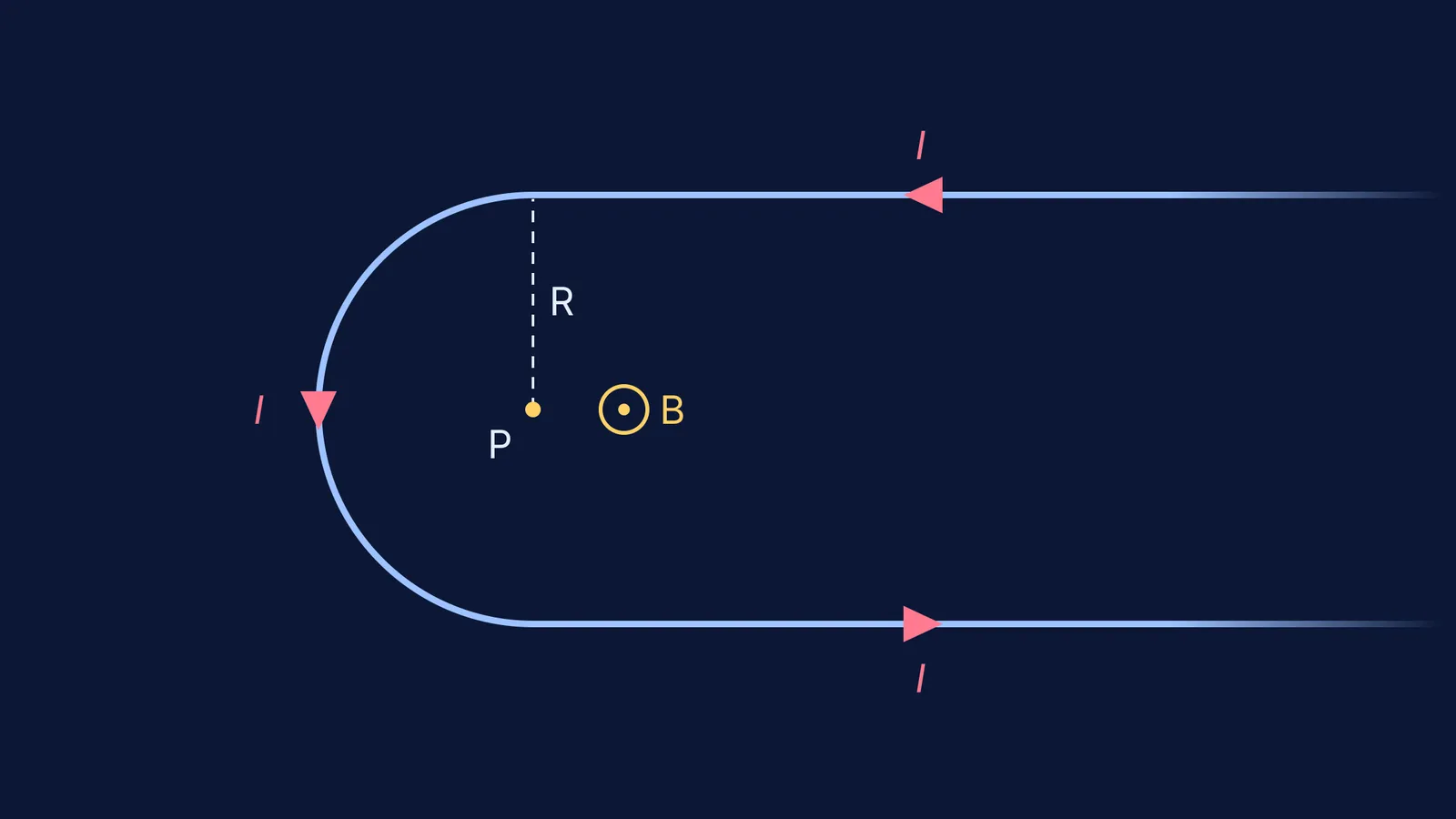
Hairpin: two parallel half-infinite wires joined by a semicircle of radius R, with P at the centre. Each straight wire ends opposite P at distance R, giving μ0I/(4πR) each, and all three pieces circulate the same way. B = μ0I/(4R) + μ0I/(2πR) = (μ0I/4R)(1 + 2/π).
Long straight wire with one circular loop in it, the straight part passing a distance R from the loop's centre. If the loop circulates around the centre the same way as the straight part, B = (μ0I/2R)(1 + 1/π); if it runs the other way, B = (μ0I/2R)(1 − 1/π).
Sector loop: arcs of radii a and b (a < b) through the same angle θ, joined by two radial straight pieces. The radial pieces give zero. The two arcs circulate in opposite senses around the centre, so B = (μ0Iθ/4π)(1/a − 1/b), pointing the way the inner arc gives.
Numbers for the hairpin, with I = 5 A, R = 2.0 cm and μ0 = 4π × 10⁻⁷ T·m/A (OpenStax section 12.1): the arc gives 7.85 × 10⁻⁵ T and the two straight wires together give 5.0 × 10⁻⁵ T. The total is about 1.29 × 10⁻⁴ T, out of the page if the current goes round P anticlockwise.
How do you combine fields from arcs and straight wires in any problem?
Mark P and split the wire into arcs and straight pieces.
Cross out every straight piece whose line passes through P.
Write each remaining magnitude: μ0Iθ/(4πR) for an arc, (μ0I/4πa)(cos θ1 + cos θ2) for a straight piece.
Give each one a sign, out of the page (+) or into it (−), by the right-hand rule.
Add with the signs. If the pieces lie in different planes, their fields point in different directions, so add them as vectors.
If your magnitudes are right but the total is wrong, the Fermi Problem Library has worked problems with a step-by-step solver that explains the reasoning rather than printing an answer, so you can see which step went wrong. For where these formulas come from, read our guide to the Biot-Savart and Ampère's laws for wires, loops and solenoids. Then try the next step, the force between two parallel currents.


