On this page
Five small insect-eating warblers nest in the same spruce forests and hunt insects on the same trees. By the logic of competition, one of them should have pushed the others out. Robert MacArthur's explanation of why that did not happen, published in Ecology in 1958, is now a classic textbook example of resource partitioning.
What did MacArthur find in the spruce trees?
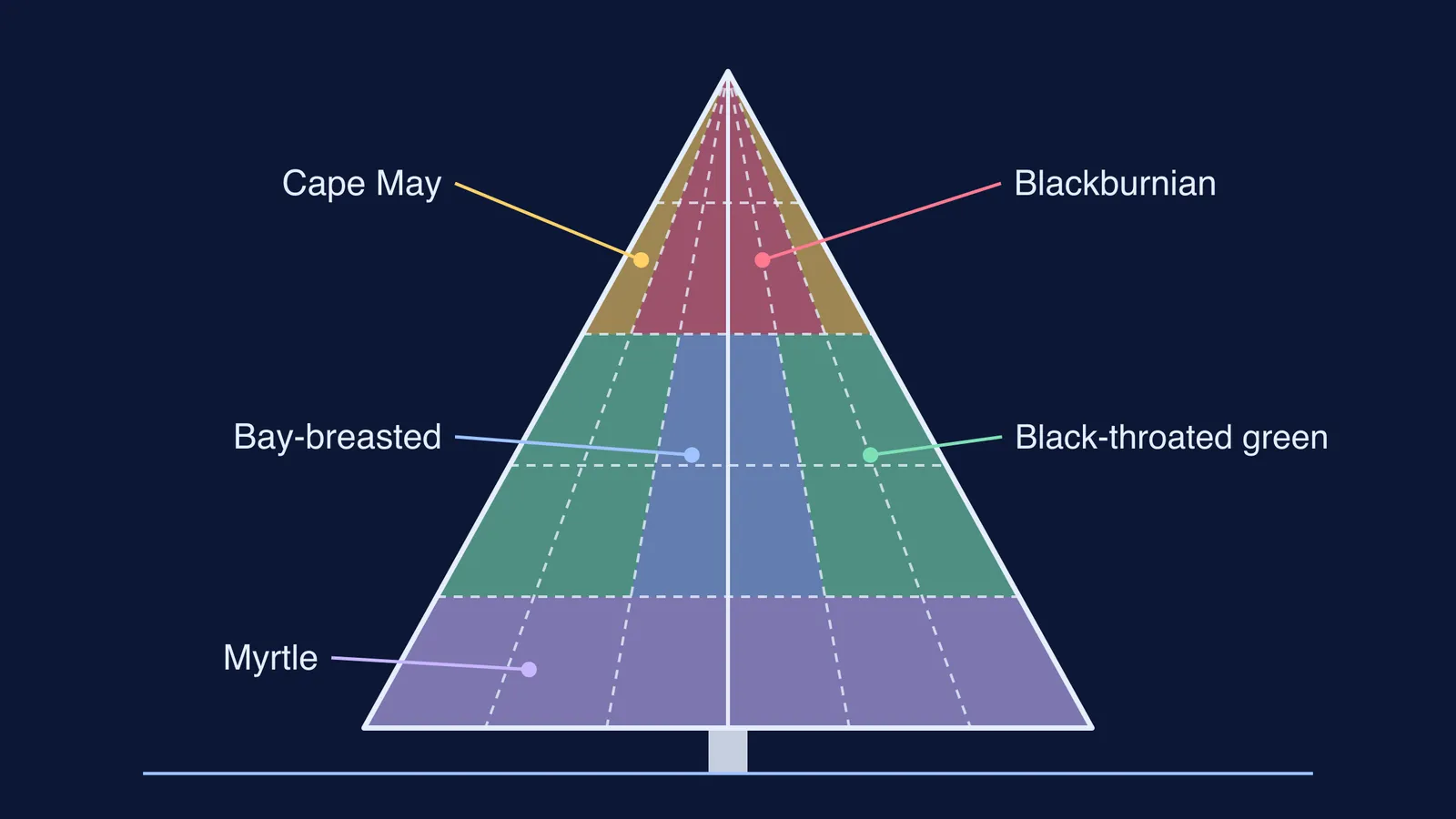
MacArthur watched the birds in spruce woods in Maine and Vermont in 1956 and 1957, according to the Ecological Society of America's summary of the paper. One site was behind Bass Harbor Lighthouse in Acadia National Park, as the US National Park Service describes. He divided each tree into zones by height and by distance from the trunk. The Stanford Birds essay on his study says he distinguished 16 feeding positions, with codes such as "T3" for a branch tip 20 to 30 feet from the top.
The National Park Service account sums up where each species fed most:
Cape May warbler: outer branches near the top.
Blackburnian warbler: also high up, but closer to the trunk, and sometimes lower than the Cape May.
Bay-breasted warbler: the middle of the tree, working inward to the trunk.
Black-throated green warbler: also the middle, but out away from the trunk.
Myrtle (now yellow-rumped) warbler: the lowest branches, near the ground.
The NPS notes that black-throated green warblers hovered significantly more often than the others. The Stanford essay adds that Cape May warblers caught flying insects much more often than Blackburnian warblers, and that the species nested at somewhat different times, so their peak food needs did not coincide.
Why does resource partitioning let competitors coexist?
Competition is fiercest when two species need exactly the same limited resource, in the same place, at the same time. Resource partitioning splits that resource by space, time, food type or feeding method, so each species depends mostly on its own share.
Think of five friends sharing one tiffin. If all five want only the paneer, someone goes hungry. If each takes a different dish, the same box feeds everyone.
The warblers' zones overlap at the edges, but each species has its own main zone. A bird at the outer tips near the top is mostly not chasing the same insects as one in the lowest branches.
How is resource partitioning different from competitive exclusion?
Competitive exclusion is the rule that two species competing for exactly the same resources in the same place cannot both persist. Garrett Hardin put it in four words in Science in 1960: "Complete competitors cannot coexist." He traced the idea to Georgy Gause's 1934 contention that two species with similar ecology cannot live together in the same place. His conditions: the same niche, the same territory, and if one population multiplies even the least bit faster, it eventually displaces the other completely. Our post on Georgy Gause and the competitive exclusion principle covers the experiments behind it.
So the warblers do not break Gause's rule; they show how species escape it. Exclusion is what happens when niches are identical. Close watching showed the warblers were not complete competitors.
Three ideas students often mix up:
Competitive exclusion: same niche, same place, so one species is eventually eliminated.
Resource partitioning: the niche is divided, so the species coexist. This is the warblers.
Competitive release: remove the stronger competitor and the other spreads into space it was kept out of, as in Connell's barnacle experiment.
The five warblers share a habitat, the spruce forest, but not a niche. If that distinction feels shaky, read habitat vs niche first.
How do you answer an exam question on MacArthur's warblers?
A typical question: "Five closely related warbler species live on the same tree without one eliminating the others. Explain." A four-step answer:
Name the principle being tested: Gause's competitive exclusion principle says complete competitors cannot coexist.
Give the mechanism: the species avoid direct competition through resource partitioning. MacArthur showed that each feeds mostly in a different zone of the tree.
Add one specific detail: Cape May warblers feed at the outer branches near the top, while myrtle warblers feed in the lowest branches.
Conclude: because their niches differ, competition between the species is reduced and they coexist.
Then check for the common slips:
Writing that the warblers share a niche. They share a habitat.
Saying they disprove competitive exclusion. They show how species avoid it.
Forgetting that partitioning can be by time or feeding method, not only by space.
If niche, habitat and competitive exclusion still feel like three words for the same thing, the Fermi Concept Library gives each concept its own lesson and its place in the map, so you can see how they connect. To practise building answers step by step, the Fermi Problem Library has worked problems with a step-by-step solver that explains the reasoning rather than printing an answer.