On this page
A rational function is one polynomial divided by another. When its limit as x tends to infinity exists, it is the height of its horizontal asymptote. One method does almost all of the work, and one look-alike, √(x² + x) − x, catches students out.
Why do you divide by the highest power of x?
OpenStax Calculus Volume 1 gives the rule plainly: to evaluate a limit at infinity of a rational function, divide the numerator and denominator by the highest power of x appearing in the denominator (OpenStax, section 4.6).
It works because every term a/xⁿ, with n positive, shrinks to 0 as x grows.
Worked example: find the limit of (3x² − 5x + 2)/(6x² + x − 7) as x → ∞.
The highest power in the denominator is x², so divide every term by x².
You get (3 − 5/x + 2/x²)/(6 + 1/x − 7/x²).
As x → ∞, the terms 5/x, 2/x², 1/x and 7/x² all go to 0.
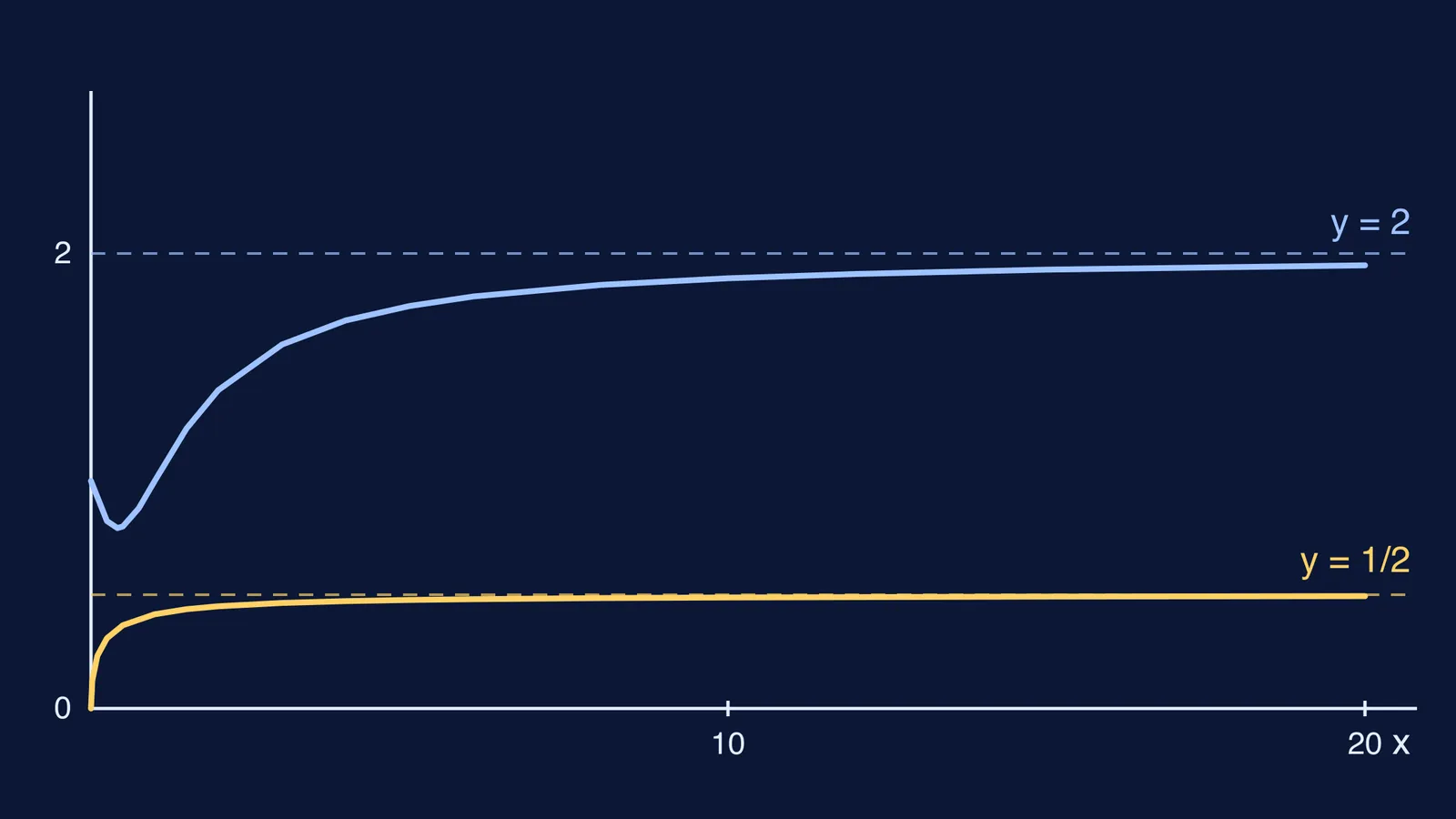
What is left is 3/6, so the limit is 1/2. The lower-degree terms never mattered.
What are the three cases for the degree of a rational function?
Call the degree of the numerator n and the degree of the denominator m. The same OpenStax section (4.6, Limits at Infinity and Asymptotes) sorts every rational function into one of three cases.
n = m (equal degrees): the limit is the ratio of the leading coefficients, as in the worked example above.
n < m (bottom-heavy): the limit is 0, so the horizontal asymptote is y = 0. Example: (4x + 1)/(x² + 3). Divide by x² to get (4/x + 1/x²)/(1 + 3/x²), which goes to 0/1 = 0.
n > m (top-heavy): there is no horizontal asymptote; the function grows without bound in size. Example: (x³ + 2)/(5x² − 1). Divide by x² to get (x + 2/x²)/(5 − 1/x²), and the lone x in the numerator runs off to infinity.
OpenStax adds a useful detail for the top-heavy case: when the numerator's degree is exactly one more than the denominator's, the graph approaches a slanted line called an oblique asymptote. For (2x² + 1)/(x − 3), long division gives 2x + 6 + 19/(x − 3), so the graph hugs the line y = 2x + 6.
For x → −∞ the first two cases give the same answer; in the top-heavy case check the sign, since (x³ + 2)/(5x² − 1) heads to −∞.
For practice, the Fermi Problem Library has worked problems with a step-by-step solver that explains the reasoning rather than printing an answer, so you can see where each term vanishes. See also our post on when to use the lowest power and when to use the highest power in limits.
Why doesn't √(x² + x) − x work the same way?
Find the limit of √(x² + x) − x as x → ∞.
The tempting argument is: for large x, √(x² + x) is about √(x²) = x, so the expression is about x − x = 0. That answer is wrong. Both terms grow without bound, so the question has the form ∞ − ∞, which is indeterminate. Our explainer on why infinity minus infinity is indeterminate covers why you cannot simply cancel.
The fix is to rationalise: multiply and divide by the conjugate, √(x² + x) + x.
The numerator becomes (x² + x) − x² = x.
So the expression equals x/(√(x² + x) + x).
Divide top and bottom by x (for x > 0, √(x² + x)/x = √(1 + 1/x)).
You get 1/(√(1 + 1/x) + 1), which goes to 1/(1 + 1) = 1/2.
At x = 100, √10100 − 100 is about 0.4988. At x = 10,000 it is about 0.49999. The small "x" inside the root was never negligible: it shifts the root by about half a unit, and that half is the whole answer.
Remember that √(x²) = |x|, which equals −x when x is negative. OpenStax's example (3x − 2)/√(4x² + 5) uses exactly this to get different limits at +∞ and −∞. As x → −∞, √(x² + x) − x has no finite limit at all, because both √(x² + x) and −x are large and positive. More practice with this move is in our post on evaluating limits by rationalisation.
What should you check before writing the answer?
Is it a plain polynomial over polynomial? Compare degrees, then divide by the highest power of x in the denominator.
Is there a root with a subtraction, like √(x² + x) − x? Spot the ∞ − ∞ form and rationalise first.
Is x → −∞? Replace √(x²) with |x| = −x, and recheck the signs of leading terms.
Plug in x = 1000 as a sanity check on your final value.
If the idea of a limit still feels shaky, the Fermi Concept Library gives every concept in mathematics its own lesson and its place in the map, so you can revisit the definition first.