On this page
Take a big number away from an equally big number and you get zero. So surely ∞ − ∞ = 0? In a limits question, that one line can cost you the whole problem. The trouble sits in the word "equally": two quantities can both grow without end and still never be equal.
Why is infinity not a number?
In real analysis, ∞ "is not a real number itself", and the notation x → ∞ means that x increases without bound (Wikipedia: Infinity). So read ∞ as a direction, not a value: "keeps going up, past every number you can name".
Even when mathematicians add +∞ and −∞ to the number line, building what is called the extended real number line, the expression ∞ − ∞ is usually left undefined (Wikipedia: Extended real number line). Two things heading in the same direction tell you nothing about the gap between them.
Picture two trains leaving New Delhi on an endless track. Both travel forever, so both distances head to ∞. But one train might stay exactly 5 km behind the other, or fall a little further behind every hour. Knowing that both go to infinity does not tell you which.
Why is infinity minus infinity indeterminate?
∞ − ∞ is one of the standard indeterminate forms, alongside 0/0, ∞/∞, 0 × ∞, 0⁰, 1^∞ and ∞⁰ (Wikipedia: Indeterminate form). The same page explains what indeterminate means: knowing the limit of each part separately is not enough to find the limit of the combination.
Indeterminate does not mean "the answer does not exist". It means "this form alone does not decide the answer, so do more work". The OpenStax calculus textbook handles ∞ − ∞ by combining the terms into a single quotient, which turns it into a 0/0 form that L'Hôpital's rule can finish (OpenStax Calculus Volume 1, section 4.8). We have a separate guide to the 0 × ∞ limit form, the close cousin of this one.
Three ∞ − ∞ limits, three different answers
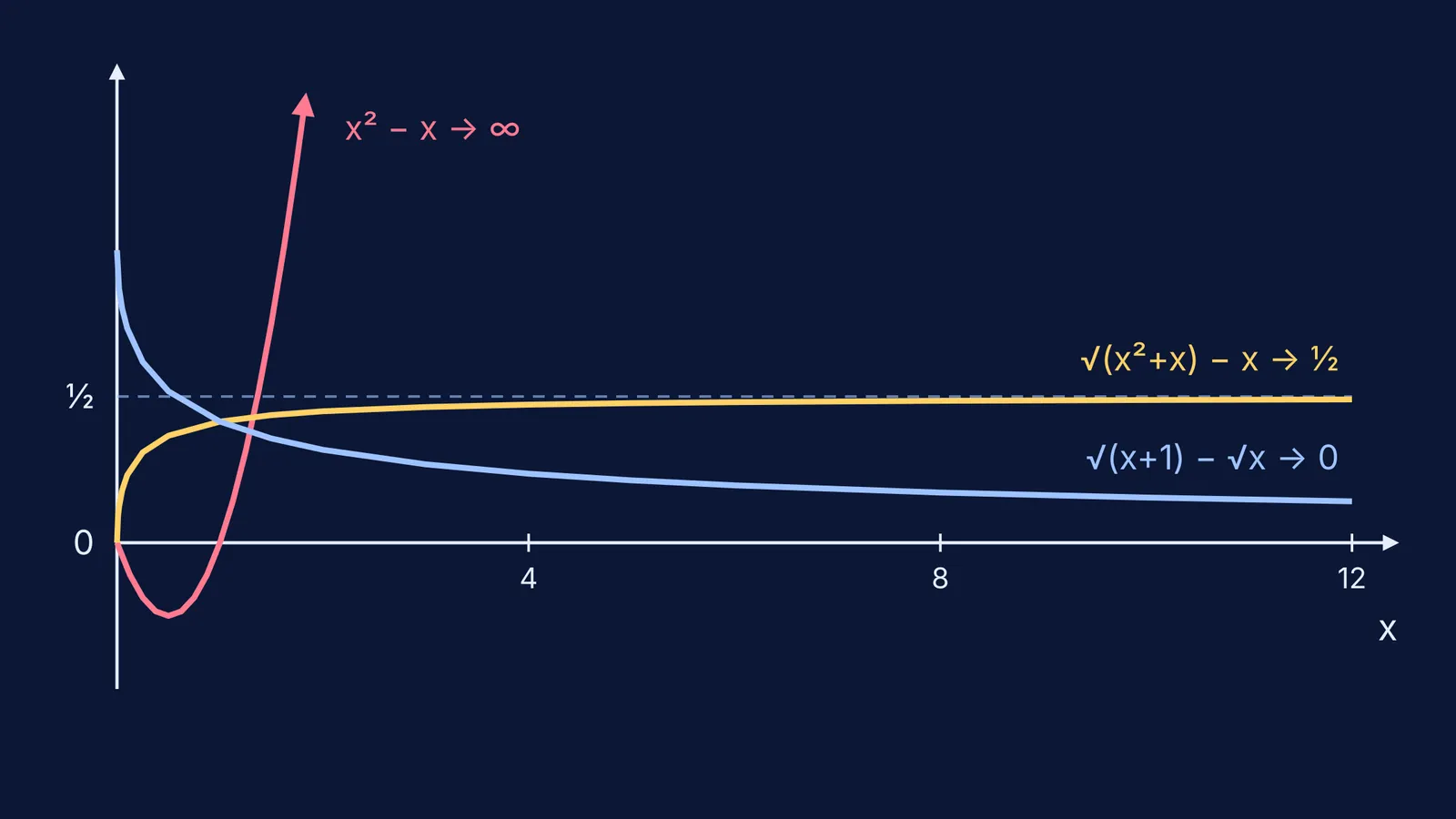
In every example below, both parts go to ∞ as x → ∞. Only the speed differs.
Limit 1: √(x + 1) − √x goes to 0. Multiply and divide by the conjugate, √(x + 1) + √x:
√(x + 1) − √x = 1 / (√(x + 1) + √x)
The denominator grows without bound, so the limit is 0. Check with a calculator: at x = 100 the expression is about 0.0499, and at x = 10,000 it is about 0.0050. The two square roots crowd together.
Limit 2: √(x² + x) − x goes to 1/2. Same conjugate trick, then divide top and bottom by x:
√(x² + x) − x = x / (√(x² + x) + x) = 1 / (√(1 + 1/x) + 1)
As x → ∞, 1/x → 0, so the limit is 1/(1 + 1) = 1/2. At x = 100 the value is about 0.4988; at x = 10,000 it is about 0.49999. The gap settles at one half.
Limit 3: x² − x goes to ∞. Factor it: x² − x = x(x − 1). Both factors grow without bound, so the product does too. At x = 100 the value is already 9,900. Here the first term simply wins.
Same form, three answers. Swap in (x + 5) − x and the limit is 5; with the right pair of functions, ∞ − ∞ can come out to any number you choose. If ∞ − ∞ were a number, it could not equal 0, 1/2, 5 and ∞ at once. That is the cleanest argument that it is not one.
How do you solve an ∞ − ∞ limit in an exam?
Use this order every time:
Substitute first. If you get ∞ − ∞, write the form in your rough work so your hand does not slip into writing 0.
Square roots? Multiply by the conjugate, as in limits 1 and 2. Our walkthrough of the limit of √(x² + x) − x at infinity works limit 2 in more detail.
Two fractions? Combine them over a common denominator.
Polynomials? Take out the highest power: x² − x = x²(1 − 1/x).
You now have 0/0, ∞/∞ or a clear product. Finish with algebra, a standard limit or L'Hôpital's rule.
Sanity-check by putting in a large value, such as x = 1,000, on a calculator. It will not prove a limit, but it catches sign slips fast.
If you keep writing 0 on autopilot, practise on worked limits in the Fermi Problem Library, where a step-by-step solver explains the reasoning rather than printing an answer, so you can see exactly where the rewrite happens. If the idea of ∞ as a direction still feels slippery, the Fermi Concept Library gives every mathematics concept its own lesson and its place in the map.
Next time you see ∞ − ∞, read it as a question, not an answer: which side grows faster, and by how much?