

On this page
When you evaluate a limit and get a result of 0 × ∞, it feels like a trick question. On one hand, zero multiplied by any number should be zero. On the other hand, infinity multiplied by anything should be infinity. These two mathematical rules fight each other, and neither automatically wins. This is why 0 × ∞ is classified as an indeterminate form.
To find the true limit, you need a different tool. Most students reach for L'Hôpital's rule. However, as the calculus notes from Lamar University point out, L'Hôpital's rule can only be applied to quotients: specifically, the forms 0/0 or ∞/∞. You cannot take the derivative of the two parts of a product directly and expect to get the right answer.
If you differentiate a product directly—a common mistake known as the "product rule error"—you will get an incorrect limit. Instead, you have to rewrite the expression so that it fits the strict requirements of L'Hôpital's rule. Here is how to transform a zero times infinity problem so you can solve it, using the classic example of x ln x.
Why rewrite 0 × ∞ to use L'Hôpital's rule?
L'Hôpital's rule states that if the limit of f(x) / g(x) evaluates to 0/0 or ∞/∞, you can take the derivative of the numerator and the denominator separately to find the limit.
Because 0 × ∞ is a product, it lacks a numerator and a denominator. You have to force it into a fraction by taking one of the terms, flipping it into its reciprocal, and moving it to the denominator.
For a limit of f(x) × g(x), you always have two choices:
Move g(x) to the bottom by writing it as f(x) / (1/g(x)). This creates a 0/0 indeterminate form.
Move f(x) to the bottom by writing it as g(x) / (1/f(x)). This creates an ∞/∞ indeterminate form.
Both algebraic transformations are mathematically correct. However, one path usually leads to a quick solution, while the other creates a chain of derivatives that becomes more complicated with every step.
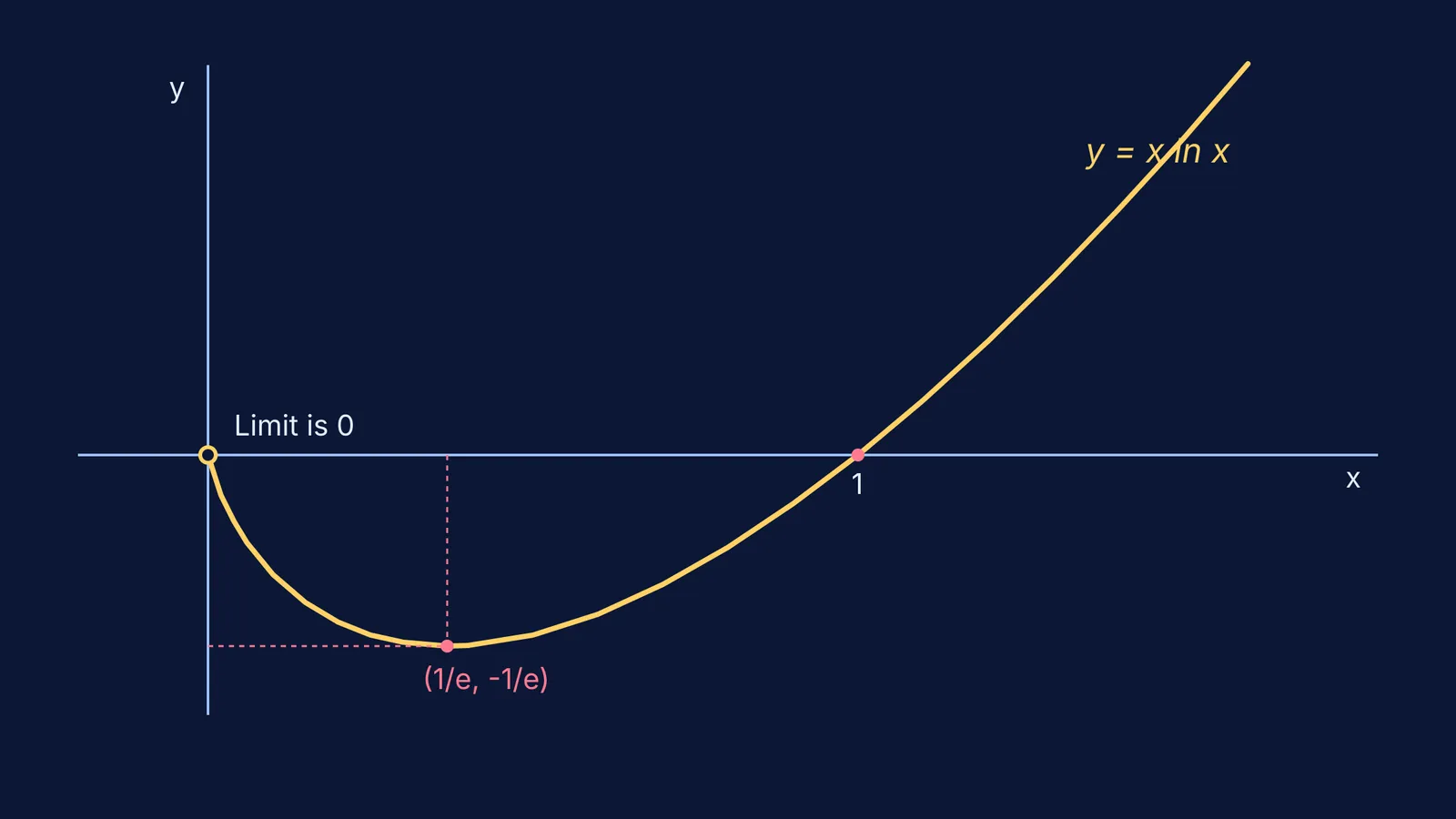
What is the limit of x ln x as x approaches 0?
Consider the following limit: lim (x → 0⁺) [x ln x]
If you plug in numbers very close to 0, the x term approaches 0 and the ln x term approaches −∞. This gives you the 0 × ∞ indeterminate form.
Step 1: Choose which term to move We can move x to the denominator as 1/x, or we can move ln x to the denominator as 1/(ln x). Taking the derivative of 1/x gives −1/x², which relies on a simple power rule. Taking the derivative of 1/(ln x) requires the chain rule and creates a messy fraction that will not simplify easily. Therefore, the smart move is to drop x to the denominator.
Rewrite the limit as: lim (x → 0⁺) [ (ln x) / (1/x) ]
Step 2: Check the new indeterminate form As x approaches 0 from the right, the numerator ln x goes to −∞ and the denominator 1/x goes to ∞. We now have the ∞/∞ form. Because we have reached a valid quotient, L'Hôpital's rule is now allowed.
Step 3: Apply L'Hôpital's rule Take the derivative of the top and the bottom separately. Do not use the quotient rule here; just differentiate the two pieces on their own.
The derivative of ln x is 1/x.
The derivative of 1/x (which is x⁻¹) is −1/x².
This transforms the limit into: lim (x → 0⁺) [ (1/x) / (−1/x²) ]
Step 4: Simplify and solve Do not try to plug in 0 just yet. You must simplify the complex fraction first. Multiply the numerator by the reciprocal of the denominator: (1/x) × (−x² / 1) = −x
Now, take the limit of the simplified expression: lim (x → 0⁺) [−x] = 0
The limit of x ln x as x approaches 0 from the right is exactly 0.
Which function should you move to the denominator?
Knowing which term to move to the bottom saves you from wasting time on algebraic loops. When you face a 0 × ∞ limit during an exam, follow these guidelines:
Keep logarithms in the numerator. Moving ln x to the bottom creates 1/(ln x), which almost always makes the next round of derivatives worse. Keep it on top.
Move polynomials to the denominator. Terms like x, x², or √x flip easily into x⁻¹, x⁻², or x⁻⁰.⁵. These negative exponents are straightforward to differentiate using the power rule.
Move exponentials if needed. A term like eˣ flips cleanly into e⁻ˣ, which is very easy to work with in the denominator.
If you find yourself stuck in a loop of derivatives that never simplify, stop. You likely flipped the wrong term in your first step. Go back to the original product and move the other function to the denominator.
Mastering these transformations takes practice. If you are preparing for competitive exams like JEE, memorising the final formula is not enough; you have to know when and how to bend the algebra to fit the rules. If you are struggling to remember the specific conditions for each form, the Concept Library maps out the core calculus rules clearly. If you get stuck on a specific function and cannot figure out which term to flip, the Fermi Problem Library will walk you through the step-by-step reasoning for any limit problem you bring it.
For a look at exponential indeterminate forms, see our guide on limits of the form 1^∞. If you want to learn where the fraction rule itself comes from, read about Guillaume de l'Hôpital and the 0/0 rule. You might also find it useful to review how to evaluate limits at infinity of rational functions.


