

On this page
When evaluating limits at infinity in Class 11 calculus and competitive exams like JEE Main, few problems appear as deceptively simple as finding the limit of √(x² + x) − x as x approaches infinity. Many students assume that because √(x² + x) behaves like √x² = x for large x, the expression reduces to x − x = 0. Others treat infinity as a number and assume ∞ − ∞ cancels to zero. Both assumptions are incorrect.
Why does the limit of root x squared plus x minus x give an indeterminate form?
Direct substitution into √(x² + x) − x as x → ∞ produces the expression ∞ − ∞. As explained in the NCERT Class 11 Mathematics textbook, direct substitution can yield indeterminate forms such as 0/0, which do not represent a definite numerical value until simplified. In the same way, the expression ∞ − ∞ is indeterminate because the algebraic structure hides the true limiting behavior.
The term √(x² + x) grows without bound, but so does x. The critical question is how rapidly the difference between them evolves. To see why this difference does not vanish, consider the binomial expansion for positive x: √(x² + x) = x · √(1 + 1/x) = x · (1 + 1/(2x) − 1/(8x²) + ...)
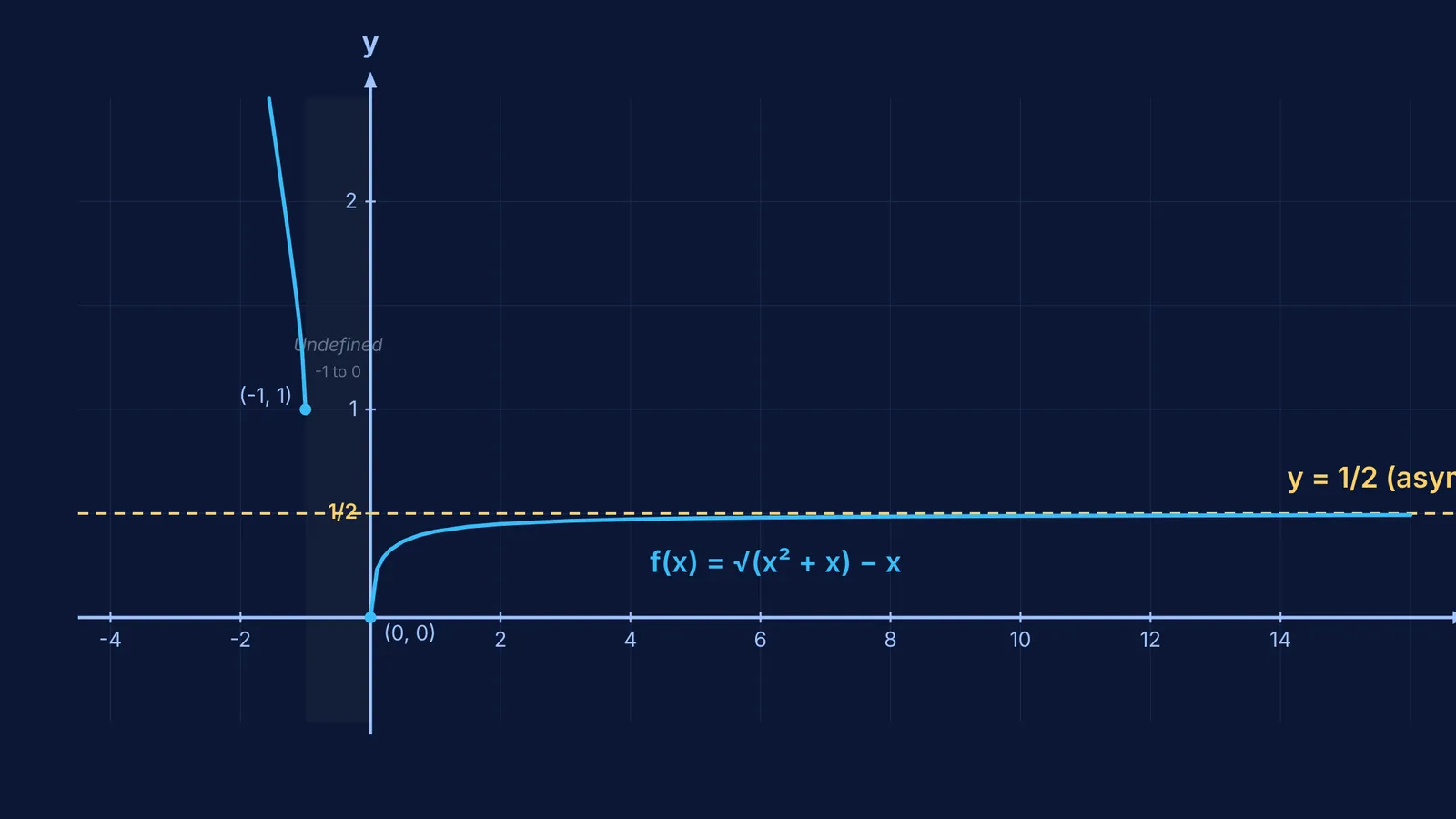
Multiplying x through gives x + 1/2 − 1/(8x) + ... Subtracting x leaves: (x + 1/2 − 1/(8x) + ...) − x = 1/2 − 1/(8x) + ...
As x grows arbitrarily large, the fraction 1/(8x) and higher terms vanish, leaving 1/2. While this series provides immediate intuition, exam rubrics require a formal proof using rationalisation, similar to solving 0/0 limits by factorisation.
How do you evaluate the limit using the conjugate method?
The algebraic method to resolve the ∞ − ∞ form multiplies and divides by the conjugate expression. As outlined in OpenStax Calculus Volume 1, Section 2.3, the conjugate of a difference involving a radical (A − B) is (A + B). Multiplying them uses the difference of two squares identity, (A − B)(A + B) = A² − B², to clear the radical from the numerator.
Here is the step-by-step derivation for positive infinity:
Multiply and divide by the conjugate:
lim (x → ∞) [√(x² + x) − x] = lim (x → ∞) [(√(x² + x) − x)(√(x² + x) + x)] / [√(x² + x) + x]
Expand the numerator:
[(√(x² + x))² − x²] / [√(x² + x) + x] = [x² + x − x²] / [√(x² + x) + x] = x / [√(x² + x) + x]
Divide numerator and denominator by x:
Because x → +∞, x is strictly positive, meaning x = √(x²). Dividing through gives: (x / x) / [√(x² + x) / x + x / x] = 1 / [√(1 + 1/x) + 1]
Compute the limit:
As x → ∞, the term 1/x approaches 0: lim (x → ∞) 1 / [√(1 + 1/x) + 1] = 1 / [√(1 + 0) + 1] = 1/2
This mirrors the technique used in limits of polynomial ratios at 0 and infinity, where dividing by the dominant power isolates the finite constant.
When practicing calculus problems for exams like JEE Main, wrong-method mistakes often hide inside routine algebraic manipulation. The Fermi Problem Library provides worked problems with a step-by-step solver that explains the reasoning rather than printing an answer, making it easy to catch where a radical simplification broke down.
What happens to the limit when x approaches negative infinity?
A frequent error in advanced calculus is assuming that limits at negative infinity mirror those at positive infinity. Consider what happens when x → −∞.
First, check lim (x → −∞) [√(x² + x) − x]. Under the square root, x² + x = x(x + 1) is positive for x < −1, so the radical is real and approaches +∞. The second term is −x. When x is negative, −x is positive, so −x → +∞. Thus: √(x² + x) − x → (+∞) + (+∞) = +∞
This form is not indeterminate. Attempting to multiply by the conjugate here is unnecessary because two positive quantities add together.
Now examine the indeterminate counterpart at negative infinity: lim (x → −∞) [√(x² + x) + x]. Here, the radical tends to +∞ while x tends to −∞, creating the ∞ − ∞ form.
According to OpenStax Calculus Volume 1, Section 4.6, the crucial identity when factoring radicals at negative infinity is: √(x²) = |x| = −x for all x < 0
If you divide √(x² + x) by x when x is negative, you cannot simply push x under the radical as x²: √(x² + x) / x = √(x² + x) / (−√(x²)) = −√[(x² + x) / x²] = −√(1 + 1/x)
Multiplying [√(x² + x) + x] by its conjugate [√(x² + x) − x] yields: x / [√(x² + x) − x]
Dividing numerator and denominator by x (where x < 0) gives: 1 / [−√(1 + 1/x) − 1]
As x → −∞, this limit equals 1 / (−1 − 1) = −1/2. Alternatively, substituting x = −t (with t → +∞) gives √(t² − t) − t, which yields −1/2 directly without sign pitfalls.
How can you test your limits with a quick sanity check?
Before finishing a calculus solution, apply three verification checks:
Numerical check: Substitute a large number such as x = 100:
√(100² + 100) − 100 = √10100 − 100 ≈ 100.498756 − 100 = 0.498756 This confirms that the expression approaches 1/2 from below.
Sign check: Confirm whether the variable is positive or negative before removing it from a radical. For x < 0, always use √(x²) = −x.
Rule suitability: Avoid applying L'Hôpital's rule immediately to radical differences. Turning ∞ − ∞ into a quotient without rationalising creates circular derivatives, as discussed in L'Hôpital's rule and its failure cases.
If you want to explore the geometric relationship between curves, horizontal asymptotes, and rationalised fractions, the Fermi Concept Library maps every concept in physics, chemistry, biology, mathematics and computing, each with its own lesson and its place in the map. When an unexpected negative sign appears during exam revision, Fermi's AI tutor can work out what you already know, hold a line of reasoning across the session, and notice where you are stuck to explain the step.


