

On this page
When you encounter the limit of a polynomial ratio, you do not always need to factorise, expand brackets, or repeatedly apply derivative rules. You can often find the exact answer just by looking at the powers of x.
The trick lies in understanding which terms carry the most weight at different extremes.
How do you find the limit of a polynomial ratio as x tends to 0 and infinity?
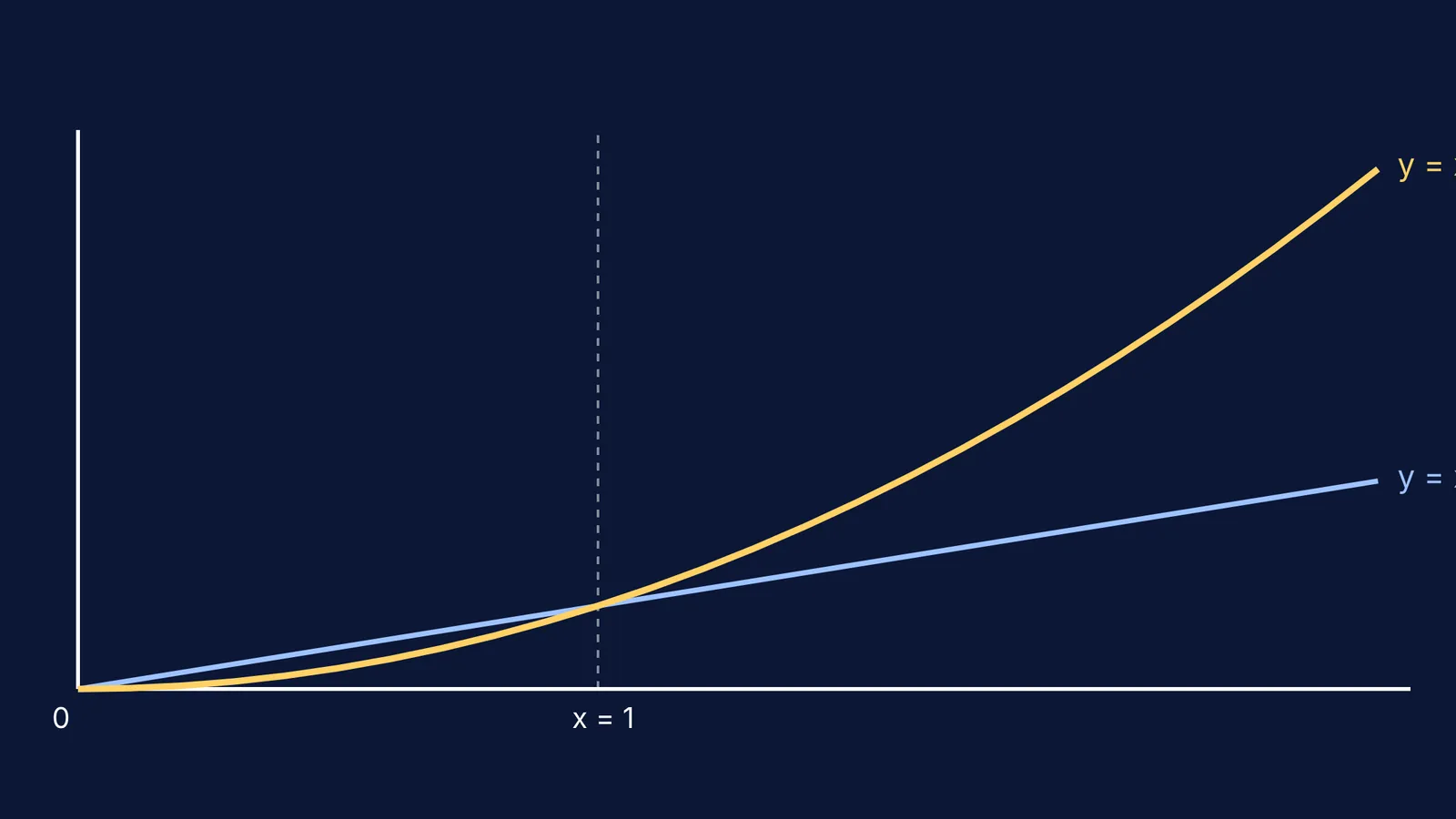
When x grows infinitely large, higher powers of x explode in value much faster than lower ones. To see why, imagine calculating x⁵ versus x² for x = 1,000. The term x⁵ becomes a mind-boggling 1,000,000,000,000,000, while x² is a mere 1,000,000. The larger x becomes, the more the highest power overshadows everything else. The end behaviour of any polynomial is determined solely by its term with the largest exponent (OpenStax). Consequently, when evaluating a limit as x → ∞, only the highest power in the numerator and the highest power in the denominator matter. Everything else becomes insignificant mathematical noise.
Conversely, think about what happens when x shrinks towards zero. If x = 0.01, raising it to a higher power makes it even smaller: x² becomes 0.0001, and x⁵ collapses to 0.0000000001. In this microscopic regime, the lowest non-zero power of x retains the most value. Therefore, for a limit as x → 0, only the lowest powers of x in the numerator and denominator dictate the outcome.
Let's look at a side-by-side example to see how this works in practice.
How do you solve the same ratio at 0 and at infinity?
Consider the rational function: f(x) = (4x⁵ − 3x² + 2x) / (7x⁴ + 5x² − x)
Case 1: As x → ∞
Look only at the terms with the highest powers in the top and bottom:
Numerator's highest power: 4x⁵
Denominator's highest power: 7x⁴
The limit as x → ∞ simplifies exactly to the limit of 4x⁵ / 7x⁴, which reduces to 4x / 7. Because 4x / 7 grows indefinitely as x increases, the limit is infinity. (If the highest powers matched perfectly, the x terms would cancel out, leaving just the ratio of their leading coefficients—a rule you can explore further in Limits at infinity of rational functions: compare the degrees).
Case 2: As x → 0
Now, discard the high powers and keep only the terms with the lowest powers:
Numerator's lowest power: 2x
Denominator's lowest power: −x
The limit as x → 0 simplifies to the limit of 2x / −x, which evaluates cleanly to −2. The limit of the entire complex polynomial ratio as x tends to zero is exactly −2.
Why is this polynomial limit rule useful for exams?
Competitive testing formats demand that you manage your time ruthlessly. In the JEE Main, candidates face 75 questions in a 180-minute block, leaving an average of just 2.4 minutes per problem (NTA). If you try to expand complex brackets and apply Guillaume de l'Hôpital, the 0/0 rule and the first calculus textbook multiple times to a ratio of high-degree polynomials, you will likely run out of time and make sign errors along the way. Every derivative taken on a complicated rational function introduces new risks for algebraic mistakes.
If you have a concept gap on why a complicated rational function behaves a certain way, the Fermi Concept Library has a lesson on each concept and its place in the map. If you prefer to walk through the algebra step by step, Fermi's AI tutor works out what you know and builds a plan for the session, guiding you through the highest-power and lowest-power rules without just handing over the final answer.
What if the limit approaches a non-zero number?
This specific shortcut only works when x is trending towards infinity or zero. If a limit approaches a specific non-zero constant (like x → 2), no single polynomial term universally dominates the others. You cannot just discard terms because they all contribute to the final value. In those cases, you must factorise the polynomials to cancel common roots—often identifying a hidden (x − 2) term—or use established algebraic identities. If you plug in the number and hit an indeterminate form like 0/0, you must rely on factoring, rationalisation, or calculus techniques to break the deadlock. The same caution applies to non-polynomial limit formats, which you can read about in Limits of the form 1^∞: the e-power shortcut for JEE.
If you regularly make wrong-method mistakes when choosing how to start evaluating a limit, the Fermi Problem Library has worked problems with a step-by-step solver that explains the reasoning. Practice identifying the destination of x before you put pen to paper, and let the lowest and highest powers do the heavy lifting whenever they can.


