On this page
You see the flash, start counting, and the thunder arrives a few seconds later. That gap is a free physics experiment, and it tells you how far away the lightning struck. The US National Weather Service puts it simply: the sound of thunder takes about 5 seconds to travel a mile, so you divide your count by 5 for miles. In kilometres, that becomes divide by 3.
Why do you see lightning before you hear thunder?
The flash and the bang start at the same moment, in the same place. They just travel at very different speeds.
The speed of light in a vacuum is exactly 299,792,458 m/s, a defined constant listed by NIST. Light in air is only very slightly slower. So light from a strike 3 km away reaches you in about 10 microseconds, far too short for you to notice.
Sound is much slower. The speed of sound in air is 343 m/s at 20 °C, according to the OpenStax University Physics textbook. At that speed, sound needs about 2.9 seconds to cover one kilometre. That is why you can treat the flash as "time zero" and the thunder as the arrival time of a slow messenger.
If you want to see where the thunder itself comes from, our post on how lightning forms inside a storm cloud explains the charge build-up behind the flash.
How far away is lightning if you count the seconds?
Here is the rule, step by step.
Watch for the flash and start counting seconds straight away. A phone stopwatch is better than counting aloud.
Stop the moment you hear the first sound of thunder, not the loudest part.
Divide the seconds by 3. The answer is the distance in kilometres.
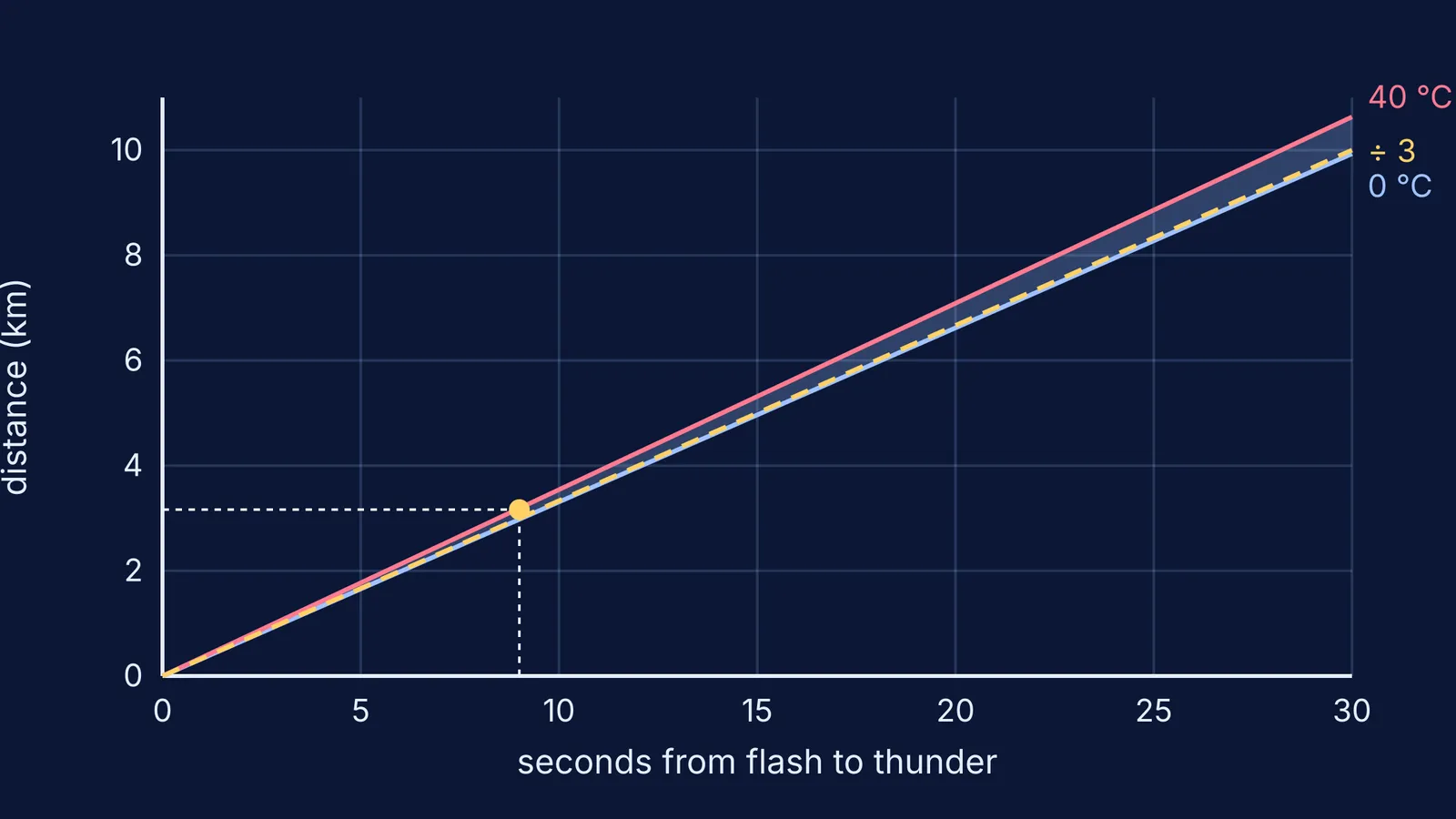
Dividing by 3 assumes sound travels 1,000 m in 3 s, about 333 m/s. That is within about 3% of the 343 m/s textbook value, which is more accurate than your thumb on a stopwatch.
Use the first sound because thunder rumbles on. A lightning channel can be kilometres long, so sound from its nearest part reaches you first and sound from farther parts keeps arriving after it. Our explainer on why thunder rumbles instead of cracking once goes through this in detail.
Does temperature change the answer?
Yes, a little. Sound travels faster in warm air. OpenStax gives the speed in air as v = 331 m/s multiplied by the square root of (T / 273 K), where T is the temperature in kelvin, and 331 m/s is the value at 0 °C.
Worked through that formula:
At 0 °C (a winter evening in the hills): 331 m/s, about 3.0 seconds per kilometre.
At 20 °C: 343 m/s, about 2.9 seconds per kilometre.
At 35 °C (a hot pre-monsoon afternoon on the plains): about 352 m/s, about 2.8 seconds per kilometre.
Worked example: a 9-second count on a hot day
You count 9 seconds on a 35 °C afternoon.
Three-second rule: 9 ÷ 3 = 3.0 km.
With the temperature: 9 s × 352 m/s ≈ 3,170 m, about 3.2 km.
The same 9 seconds at 0 °C: 9 s × 331 m/s ≈ 2,980 m, about 3.0 km.
So a 35-degree swing in temperature moves the answer by about 200 m, roughly 6%. Now compare your timing. If you start or stop the stopwatch half a second late, that alone shifts the answer by about 170 m. For a real storm, the three-second rule is good enough. For an exam question, use the temperature the question gives you.
If you mix up m/s and km/h while doing this, the Fermi Problem Library has worked problems with a step-by-step solver that explains the reasoning rather than printing an answer. And if the formula itself feels shaky, the Fermi Concept Library gives each physics concept its own lesson.
What should you do when the count is short?
The count is a measuring tool, not a safety rule. The National Weather Service says that if you hear thunder, you are likely within striking distance of the storm. It also advises waiting 30 minutes after the last rumble of thunder before going back outside, and says the only completely safe action is to get inside a safe building or vehicle.
So if you can hear thunder at all, go indoors, then count from there for practice. In India, IITM Pune has developed DAMINI, a mobile app built on its Lightning Location Network. If you are caught on the road, our post on whether you are safe inside a car during lightning explains the physics of shelter.
The next time a storm rolls in, you have a stopwatch, a formula and a reason to check the thermometer. For more problems like this one, browse the Fermi Problem Library.