

On this page
A small firecracker explodes at a single point, sending out a spherical shockwave that reaches your ears in milliseconds to produce one sharp bang.
When lightning strikes, it produces a prolonged, rolling roar because a discharge is an extended line source stretching several kilometres. A cloud-to-ground flash superheats a narrow column of air to approximately 30,000 K (about 50,000 °F) in microseconds, as documented by the National Weather Service. This explosive expansion drives a shockwave that slows to the ambient speed of sound in air—approximately 343 metres per second at 20 °C—within roughly 5 to 10 metres of the channel. As explored in our guide on sound propagation and echoes, sound travels at finite speeds through the atmosphere. Sound emitted near the ground reaches your ears first, while sound from higher along the channel arrives seconds later.
Why does thunder rumble instead of making a single bang?
The fundamental explanation for thunder rumbling lies in the geometry of an extended line source. When lightning strikes, electric current heats the ionized channel almost simultaneously, turning every metre of the path into an independent acoustic emitter.
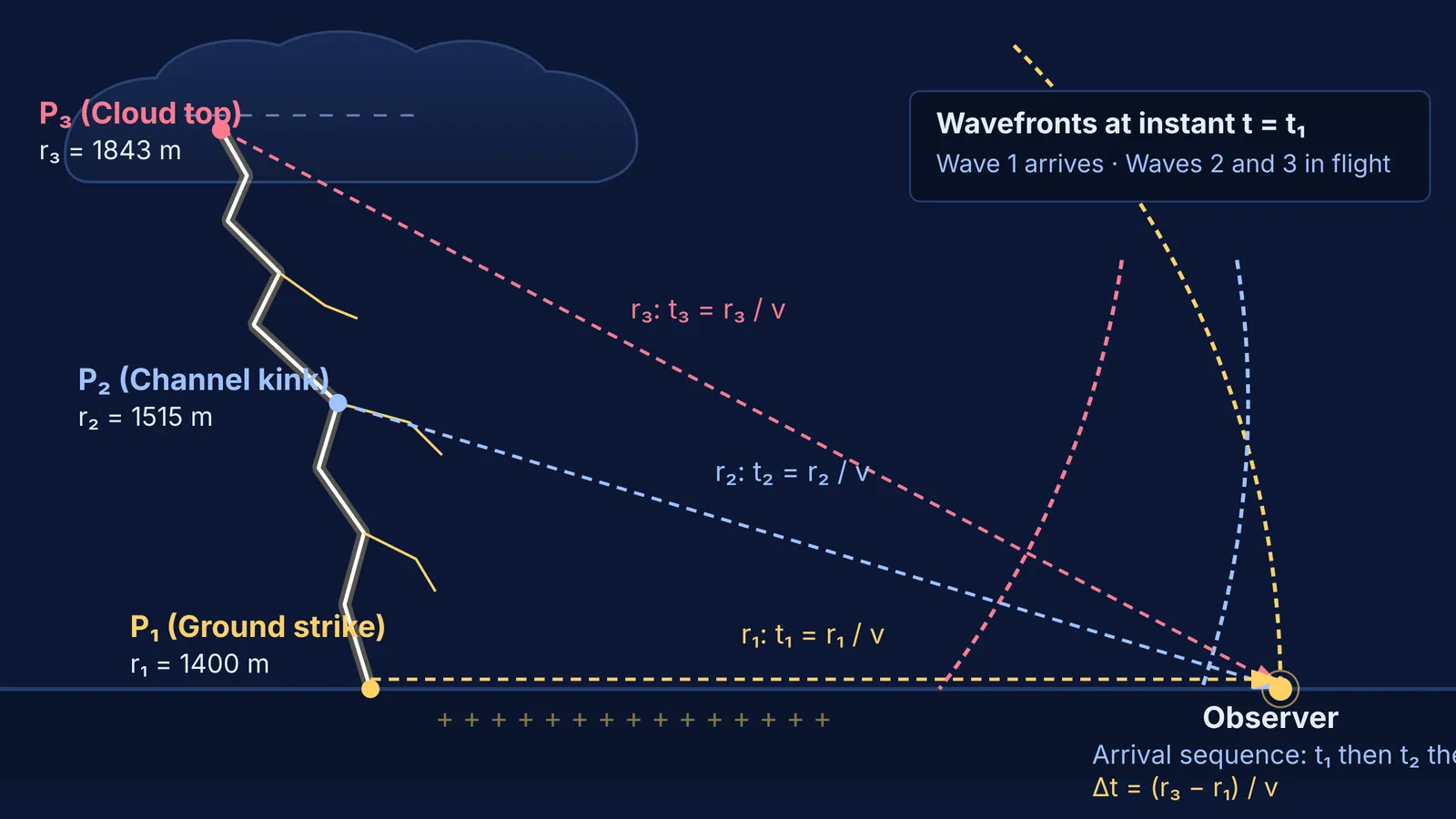
Because an observer is positioned at different geometric distances from each segment, sound waves emitted simultaneously travel paths of unequal length. If the nearest point is at distance r_near and the farthest segment is at r_far, the physical path difference is:
Δr = r_far − r_near
With sound propagating at speed v, arrival times range from t_start = r_near / v to t_end = r_far / v. The rumble duration is directly proportional to this path difference:
Δt = (r_far − r_near) / v = Δr / v
In the *Journal of Geophysical Research*, Arthur A. Few (Few, 1970) used microphone arrays to demonstrate that the arrival sequence of thunder claps reconstructs the three-dimensional geometry of the lightning bolt. This delay demonstrates the connection between phase difference and path difference. To visualise how acoustic wavefronts expand from a jagged line source and reach an observer at staggered time intervals, you can explore the Fermi Simulation Lab, which provides interactive simulations for ideas that are easier to see than to read.
What causes the sudden cracks and rolling peals within a rumble?
If a lightning channel were a straight line, thunder would diminish smoothly over time. Natural thunder fluctuates because real channels are tortuous, full of jagged bends, kinks, and branches.
In *The Journal of the Acoustical Society of America*, Herbert S. Ribner and Dipankar Roy (Ribner & Roy, 1982) developed an acoustic model showing that emissions from straight, collinear channel segments largely cancel out due to destructive interference in oblique directions. In contrast, sharp bends and kinks radiate uncanceled acoustic pulses in all directions.
Furthermore, the orientation of each channel segment relative to your line of sight dictates its acoustic impact:
Perpendicular segments: When a segment lies perpendicular to your line of sight, sound emitted along its length arrives simultaneously, producing a sharp, deafening clap.
Parallel segments: When a segment points toward or away from you, sound from along its length arrives spread out over time, producing a continuous roll.
How do you calculate thunder duration from strike distance?
You can calculate thunder duration using wave kinematics and geometry. Consider a cloud-to-ground strike at a horizontal distance d = 2,000 metres from your location, rising to an intra-cloud branch at an altitude of 4,500 metres and a horizontal distance of 2,500 metres, as modeled in lightning acoustics literature (National Weather Service).
Assuming ambient air at 20 °C where sound velocity is v = 343 m/s:
Nearest point (ground strike): r_near = 2,000 m, giving t_start = 2,000 m / 343 m/s ≈ 5.83 seconds.
Farthest point (channel top): r_far = √(2,500² + 4,500²) ≈ 5,148 metres, giving t_end = 5,148 m / 343 m/s ≈ 15.01 seconds.
Rumble duration: Δr = 5,148 m − 2,000 m = 3,148 metres, giving Δt = 3,148 m / 343 m/s ≈ 9.18 seconds.
The sound produced along that channel arrives stretched into a rumble lasting over 9 seconds. The speed of sound depends on temperature through v = √(γ R T / M), as detailed in our guide on the Laplace correction for the speed of sound. For students solving wave kinematics problems, the Fermi Problem Library offers worked problems with a step-by-step solver that explains the reasoning rather than printing an answer.
Why does distant thunder sound deeper than a nearby strike?
Nearby lightning begins with a sharp, high-pitched tearing crack, but distant strikes arrive as low, muffled bass rumbles.
In the *Journal of Geophysical Research*, Arthur A. Few (Few, 1969) established that peak acoustic energy in thunder typically centers between 50 and 200 Hz. While initial lightning shockwaves contain high-frequency components exceeding 500 Hz, air absorbs higher frequencies rapidly through molecular relaxation over 5 to 10 kilometres. Thermal refraction bends sound rays upward away from the surface, creating an acoustic shadow zone beyond 15 to 25 kilometres, while ground reflections smear the remaining low bass frequencies into a persistent rumble.


