On this page
Picture a loco pilot running at 130 km/h on a foggy winter morning. The next signal is red, but it is still out of sight. By the time it appears, the train may already be too close to stop. Kavach, named after the Hindi word for "shield", is the system Indian Railways built so that a missed or late signal does not have to end in a collision.
What is Kavach in Indian Railways?
Kavach is an indigenously developed Automatic Train Protection (ATP) system that provides train protection and collision prevention, according to the Press Information Bureau backgrounder of 6 February 2026. It was developed by Indian Railways through the Research Designs & Standards Organisation (RDSO), and it protects trains against Signal Passing at Danger (SPAD), excessive speed and collisions.
Kavach is certified to Safety Integrity Level 4 (SIL-4), the highest of the four levels on the SIL scale. The PIB Research Unit note of December 2024 explains that SIL-4 corresponds to a tolerable hazard rate of between one in a billion and one in a hundred million per hour for each safety function.
How does Kavach work?
Kavach runs on continuous real-time communication between trackside systems and the locomotive, as the February 2026 PIB backgrounder describes. Three parts do the work:
RFID tags on the track. Radio Frequency Identification tags along the track are read by a reader on the locomotive. They give the train its precise location.
Station Kavach. A wayside unit collects live data from the station's interlocking: signal aspects, point positions, track occupancy and route status.
Loco Kavach and UHF radio. From that data, plus the train's position, speed, gradients and speed limits, the wayside unit works out the Movement Authority, the distance the train is permitted to travel safely, and transmits it to the onboard unit over the Ultra High Frequency (UHF) radio link. The onboard unit monitors speed, shows target distance and signal aspects on a cab display, and generates braking curves.
If the train approaches a danger signal, exceeds the permitted speed or enters a conflicting route, Kavach applies the brakes automatically. If two trains in a block section are detected moving towards each other, it sends a Stop-on-Sight command to both.
Why can't the driver just brake at the red signal?
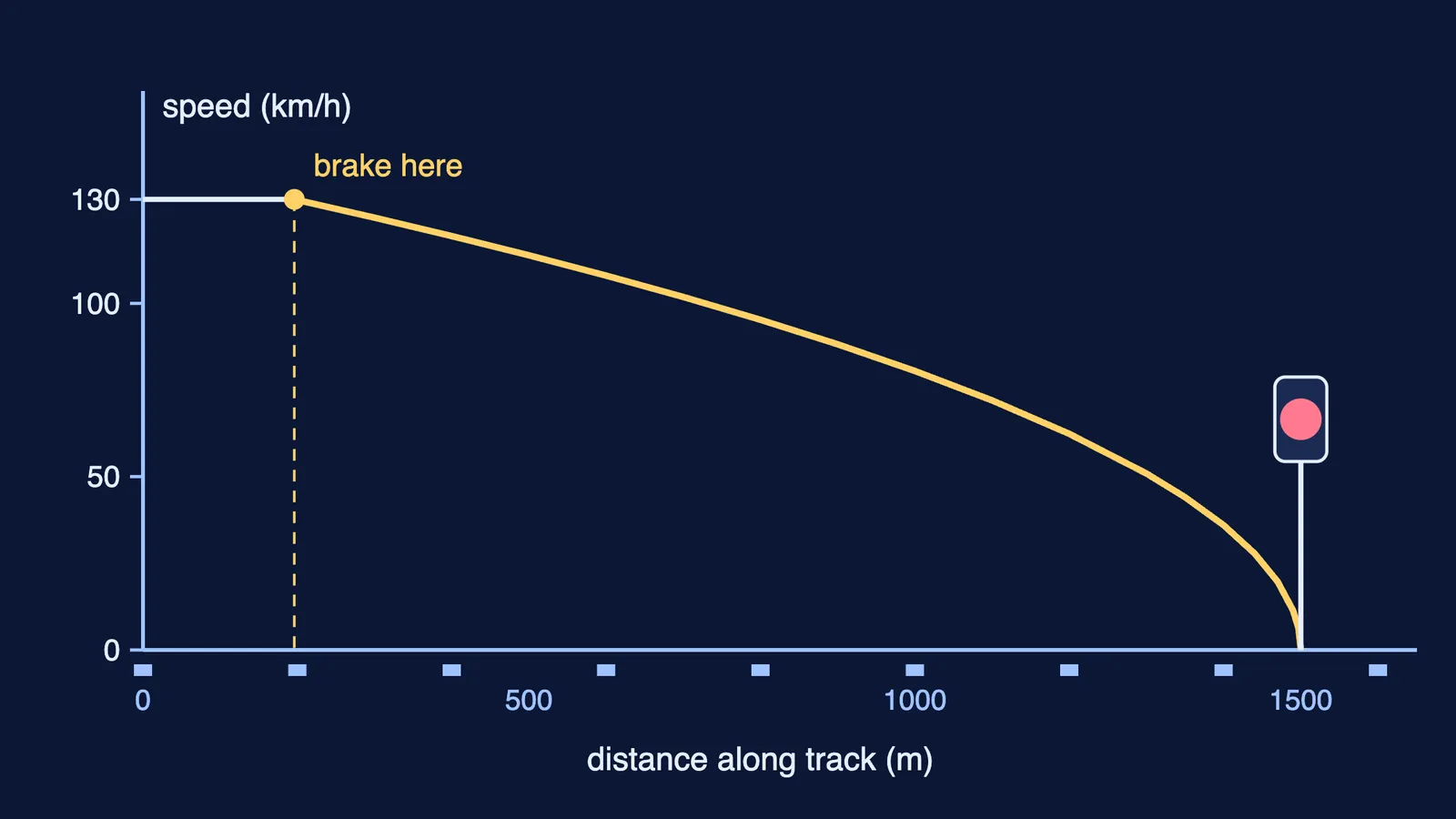
Because a fast train needs a long distance to stop, and fog can hide a signal until the train is inside it. The PIB backgrounder lists fog and reduced reaction time at high speeds among the reasons India needed automatic train protection. You can build a simple braking curve with Class 11 kinematics: v² = u² + 2as.
Set the final speed v to zero and the stopping distance is s = u²/2a. Work it through for 130 km/h:
Convert the speed: 130 km/h ÷ 3.6 = 36.1 m/s.
Assume a braking deceleration of 0.5 m/s². An illustrative round number, not a Kavach setting; real values depend on the train, its load and the gradient.
Stopping distance: 36.1² ÷ (2 × 0.5) ≈ 1,304 m.
Add three seconds of hesitation before the brakes go on: 36.1 × 3 ≈ 108 m more.
Now halve the speed to 65 km/h and the braking distance falls to about 326 m, a quarter, because distance grows with the square of speed. Turned around, this gives the diagram's braking curve: in this simple model, the highest safe speed at any point is √(2a × distance left to the signal). Kavach's real curves use actual train and track data; if the train runs above them and the loco pilot does not respond, Kavach brakes.
The same physics explains whether a heavier vehicle takes longer to stop and why passengers lurch forward when a bus brakes. If v² = u² + 2as feels abstract, the Fermi Simulation Lab has interactive simulations for ideas that are easier to see than to read, and the Fermi Problem Library works problems step by step and explains the reasoning.
Where is Kavach installed now?
As of February 2026, Kavach had been implemented on more than 2,200 route kilometres, and Kavach 4.0 covered over 1,300 route kilometres across five railway zones, according to the PIB backgrounder. Nearly 96% of railway traffic runs on the High-Density and Highly Used Network routes, and the Railway Board's first priority is high-density routes, including the New Delhi–Mumbai and New Delhi–Howrah sections.
The timeline, from the same document and the December 2024 PIB note:
February 2016: first field trials on passenger trains.
July 2020: adopted as India's National Automatic Train Protection system.
16 July 2024: RDSO approved Kavach version 4.0, with better location accuracy and station-to-station links over optical fibre.
April 2025: Kavach 5.0, designed for suburban sections, announced.
The Stop-on-Sight rule makes sense once you work out the relative speed of two trains heading towards each other.