

On this page
The driver brakes hard and you lurch towards the front of the bus. It feels like a shove, but nothing pushed you. The bus slowed down, and for a moment your body did not.
Why do passengers fall forward when a bus brakes?
Before the brakes go on, you and the bus move together at the same speed. When the driver brakes, the road pushes backwards on the tyres. That force acts on the bus, not on you. Your body only slows down when the bus pushes on it: through friction under your shoes, the back of the seat in front, or the rail you are holding.
The new NCERT Class 9 science textbook (Exploration, Chapter 6, How Forces Affect Motion) states Newton's first law like this: "An object at rest remains at rest, and an object in motion continues to move with a constant velocity, unless a net force acts upon the object."
The same chapter says Newton used the word inertia "to describe the tendency of objects to resist change in their state of rest or uniform motion" (NCERT).
So the lurch is not a forward force. Your body carries on at the old speed while the bus underneath it slows down.
Why do your feet stop while your head keeps going?
Your shoes touch the floor, so friction slows your feet along with the bus almost at once. Your head and chest are only connected to your feet through your body. For a moment they keep moving forward while your feet stay where they are, so you tip forward.
A hand on the rail fixes this because your arm can pull back on your upper body. That pull is the net force the first law asks for.
How big is the lurch? A worked example
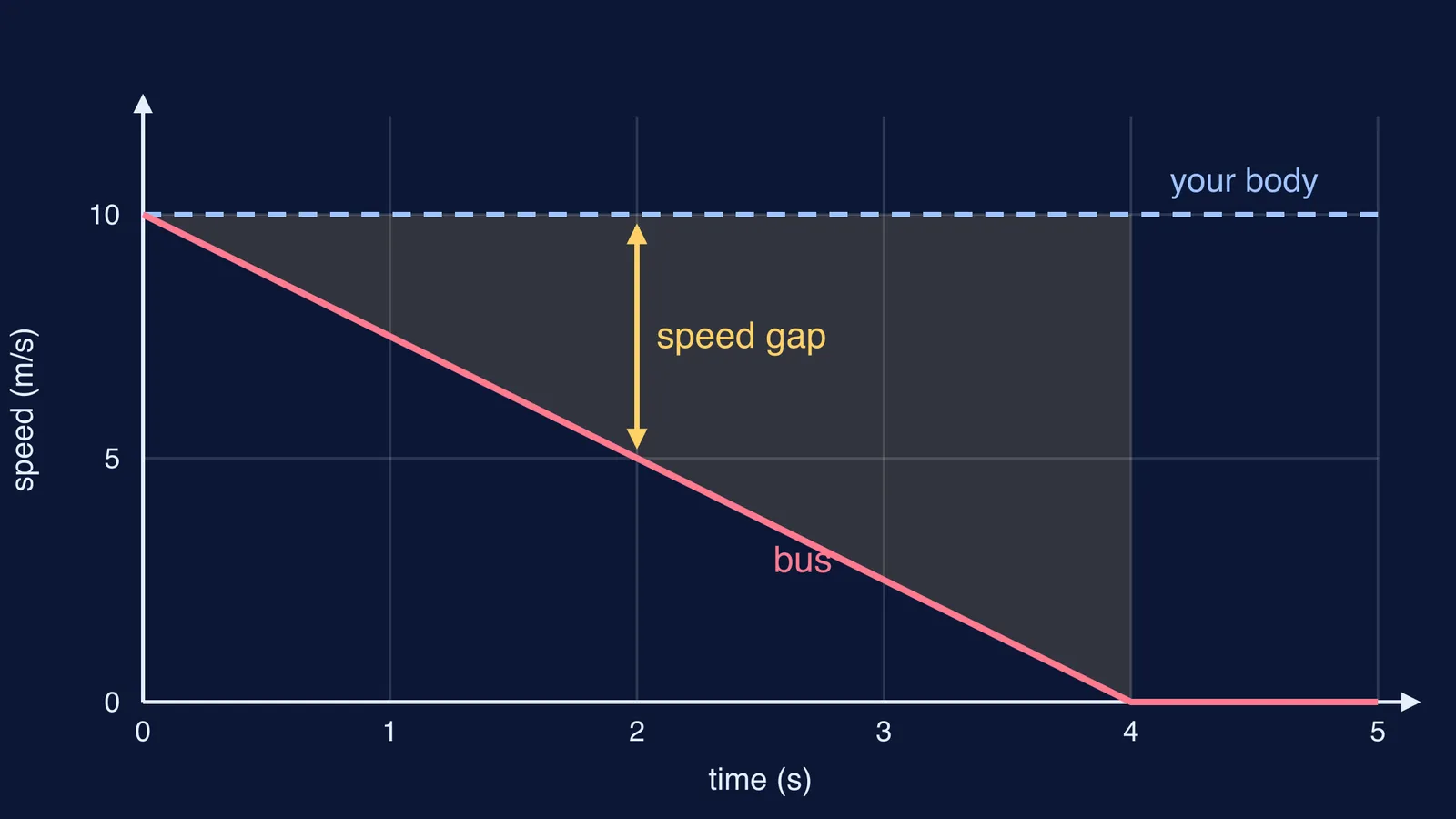
A 2021 study of standing bus passengers by Krašna and colleagues in Frontiers in Bioengineering and Biotechnology notes that for normal bus braking, reported decelerations range from 1.2 to 3.0 m/s². Let us take a bus at 36 km/h (10 m/s) braking at 2.5 m/s², which falls inside that range.
Time to stop: t = v/a = 10 ÷ 2.5 = 4 s.
Stopping distance: s = v²/2a = 100 ÷ 5 = 20 m.
After 0.5 s, the bus is moving at 10 − (2.5 × 0.5) = 8.75 m/s. A body that has not yet felt any force is still moving at 10 m/s.
How far ahead that body gets in those 0.5 s: ½ × 2.5 × 0.5² ≈ 0.31 m.
That is about 31 cm in half a second, roughly the length of a school ruler, if nothing held you back. In real life you grab a rail and tense your muscles, so the lurch is shorter, but it goes in the same direction.
The same study (Krašna et al., 2021) stood 24 volunteers on a moving platform that copied bus braking and acceleration. Even at a gentle braking pulse of only 1.0 m/s², below that normal range, the volunteers kept their balance without a recovery step in only about half of the trials. How many had to step depended on which way they were facing.
Why do you fall backward when the bus starts?
It is the same law in the other direction. When the bus pulls away, the floor pushes your feet forward. Your upper body was at rest and tends to stay at rest, so you tip backwards. On a sharp turn, your body tends to keep going straight, so you sway towards the outside.
If motion is easier for you to see than to read about, the Fermi Simulation Lab has interactive simulations for the ideas that are easier to see than to read.
How do you write this in a Class 9 exam answer?
Use this three-step frame:
Before: the passenger and the bus move together at the same speed.
The force: the brakes slow the bus, and friction slows the passenger's feet with it.
Inertia: the upper body has no force on it yet, so it keeps moving forward (Newton's first law).
A model answer you can adapt: "When the bus is moving, the passenger moves with it at the same speed. When the brakes are applied, the bus and the passenger's feet slow down, but the upper body tends to keep moving forward because of inertia of motion. So the passenger falls forward."
Check your answer against these common slips:
Calling inertia a force. It is a property of the body, not a push.
Leaving out the feet. The fall only happens because one part of the body is stopped and another is not.
If the idea of a net force still feels shaky, the Fermi Concept Library gives every physics concept its own lesson and shows where it fits in the map. Next time the bus brakes, try naming the force and the inertia before you reach for the rail.


