On this page
Your old guide may ask about the kangaroo rat and altitude sickness, but your textbook no longer does. NCERT's list of rationalised content for Class XII drops section 13.1, “Organism and Its Environment”, including 13.1.3 Adaptations and exercise questions 3 and 12. The current Organisms and Populations chapter now opens straight with populations. Older answer keys used Rohtang Pass altitude sickness for “Define phenotypic adaptation” and the kangaroo rat for desert adaptations, as this NCERT solutions page shows. The biology is still worth knowing.
How does a kangaroo rat survive without drinking water?
Metabolic water is the water your cells make when they oxidise food in respiration. Kangaroo rats depend on it because their diet of seeds holds little or no water, according to the Open University's course on desert animals. Bodil and Knut Schmidt-Nielsen worked out the animal's full water budget in their 1951 paper, A complete account of the water metabolism in kangaroo rats.
Saving water matters just as much (for camels and snakes, see how desert animals survive heat and little water):
Kidneys: Dipodomys merriami can concentrate its urine to more than 6,000 mosmol/kg of water, Urity and colleagues report in a study of how its loops of Henle are built.
Nose: its nasal passages recover about 54 per cent of the water vapour from its airways at 30°C and 83 per cent at 15°C, while humans recover no more than 16 per cent, the Open University course notes.
How much water does burning fat make?
Check it with Class 11 stoichiometry, using tripalmitin, a typical fat:
Balanced equation: C51H98O6 + 72.5 O2 → 51 CO2 + 49 H2O.
Molar mass of tripalmitin: 51(12.011) + 98(1.008) + 6(15.999) = 807.3 g/mol.
Water made: 49 × 18.015 = 882.7 g.
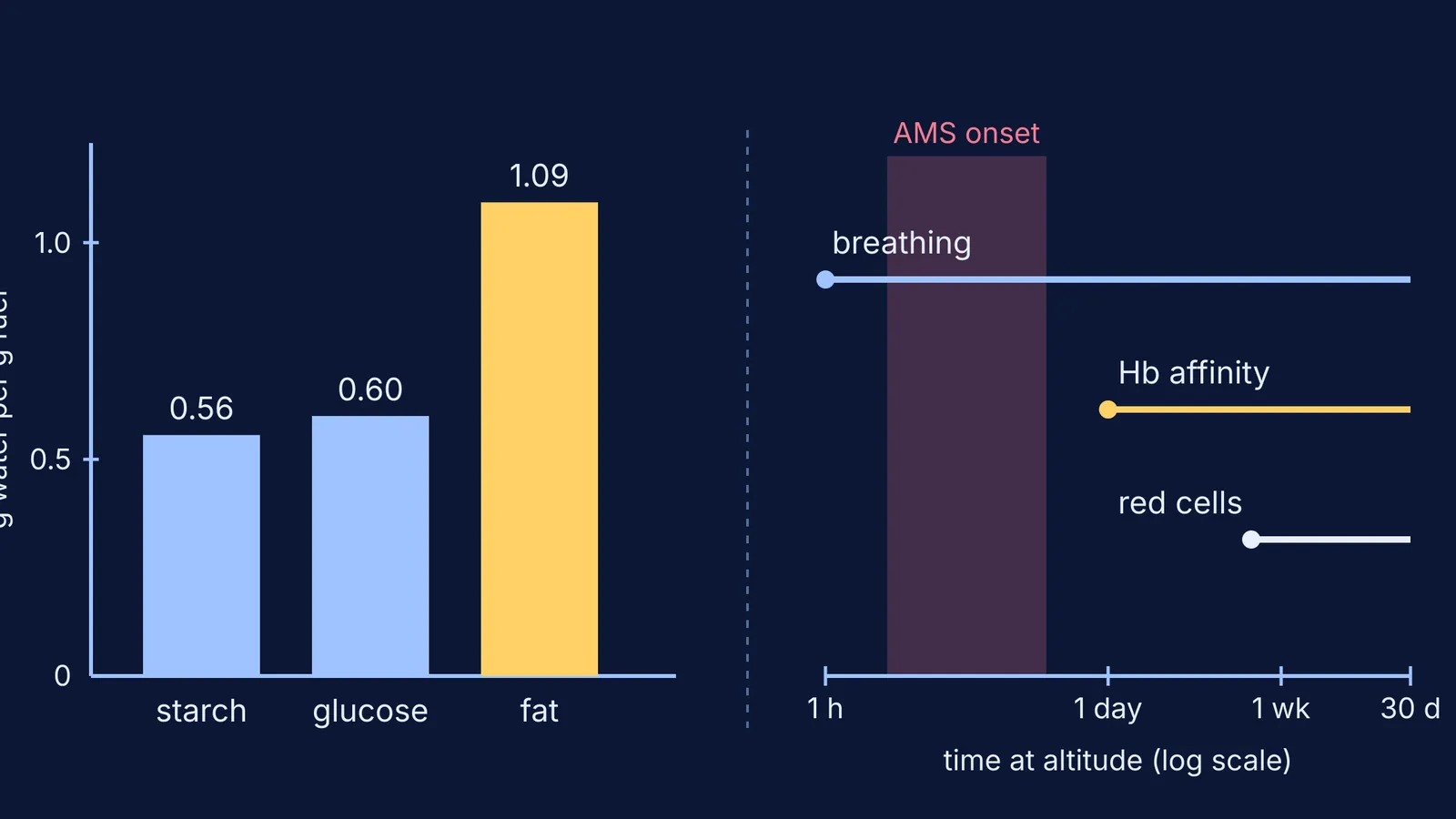
Water per gram of fat: 882.7 ÷ 807.3 = 1.09 g.
Do the same for glucose (C6H12O6 + 6 O2 → 6 CO2 + 6 H2O) and you get 108.1 ÷ 180.2 = 0.60 g of water per gram. A starch unit, C6H10O5, gives 90.1 ÷ 162.1 = 0.56 g. Fat yields the most water per gram because it is rich in hydrogen and poor in oxygen. Seeds are mostly starch, so in real life the kangaroo rat's water comes from carbohydrate as well as fat.
If balancing combustion equations still slows you down, the Fermi Problem Library has worked problems with a step-by-step solver that explains the reasoning rather than printing an answer.
What happens to your body at high altitude?
At about 3,050 m, the oxygen pressure you breathe in falls to 69 per cent of its sea-level value, says the CDC Yellow Book chapter on altitude illness. Acute mountain sickness (AMS) has headache as its main symptom, usually with loss of appetite, dizziness, fatigue, nausea or vomiting, and it usually starts 2 to 12 hours after arrival, the same chapter says. Leh sits at 3,500 m, according to Ladakh Tourism's advisory.
How does the body adjust to high altitude, and in what order?
The order matters: the change most people name first, more red blood cells, is the slowest.
From arrival: breathing rises. The CDC describes “a steady increase in ventilation” during the acute phase of acclimatisation, which runs over the first 3 to 5 days after ascent (CDC Yellow Book).
Within 24 hours: haemoglobin lets go more easily. Lenfant and colleagues (1968) found haemoglobin's affinity for oxygen changed within 24 hours of a change in altitude, alongside a rise in red-cell organic phosphate (2,3-DPG), which the authors link to more oxygen reaching tissues.
First days: blood gets more concentrated. Haemoglobin concentration rises because plasma volume falls, and “increased red cell production does not play a role in acute acclimatization” (CDC Yellow Book).
Days to weeks: new red cells. The hormone erythropoietin (EPO), which drives red cell production, rises within 1.5 to 2 hours, but young red cells take 5 to 7 days to mature, Vizcardo-Galindo and colleagues note, so extra red cell mass builds only with longer acclimatisation.
To see why a shift in affinity matters, read our explainer on haemoglobin vs myoglobin. Altitude adjustment is also a textbook case of homeostasis in the human body. If the oxygen dissociation curve is your gap, the Fermi Concept Library gives each concept its own lesson and its place in the map.
That is general guidance from Ladakh Tourism's advisory, not medical advice; talk to a doctor before the trip.
A three-line answer for any adaptation question
Stress: what is scarce or extreme (water in a desert, oxygen high in the mountains).
Response and mechanism: what changes and how (very concentrated urine; faster breathing and lower haemoglobin affinity).
Timescale: evolved over generations (kangaroo rat) or adjusted within one lifetime (a visitor to Leh).
Try writing both examples from memory with this template, then check them against the sources above.