On this page
Your textbook lists vitamin D with the vitamins. Your biology teacher may call it a hormone. Both are partly right, and the reason is a three-organ relay: skin, liver and kidney. Once you see the relay, the question answers itself.
Is vitamin D actually a hormone?
A vitamin, in the strict sense, is something your body cannot make enough of and must get from food. Vitamin D breaks that rule, because your skin makes it when sunlight falls on it.
The molecule your skin makes, vitamin D3, does very little by itself. The active molecule is 1,25-dihydroxyvitamin D, also called calcitriol, which Daniel Bikle's 2014 review in Chemistry & Biology describes as "the hormonal form of vitamin D".
A hormone is made in one organ, travels in the blood and acts on distant cells that carry a receptor for it. Calcitriol fits that description: the same review says the kidney is "the major if not the sole source" of the calcitriol in your blood, and describes its actions on distant tissues such as the gut and bone.
So the fair answer is this: vitamin D is the raw material, and calcitriol is the hormone made from it.
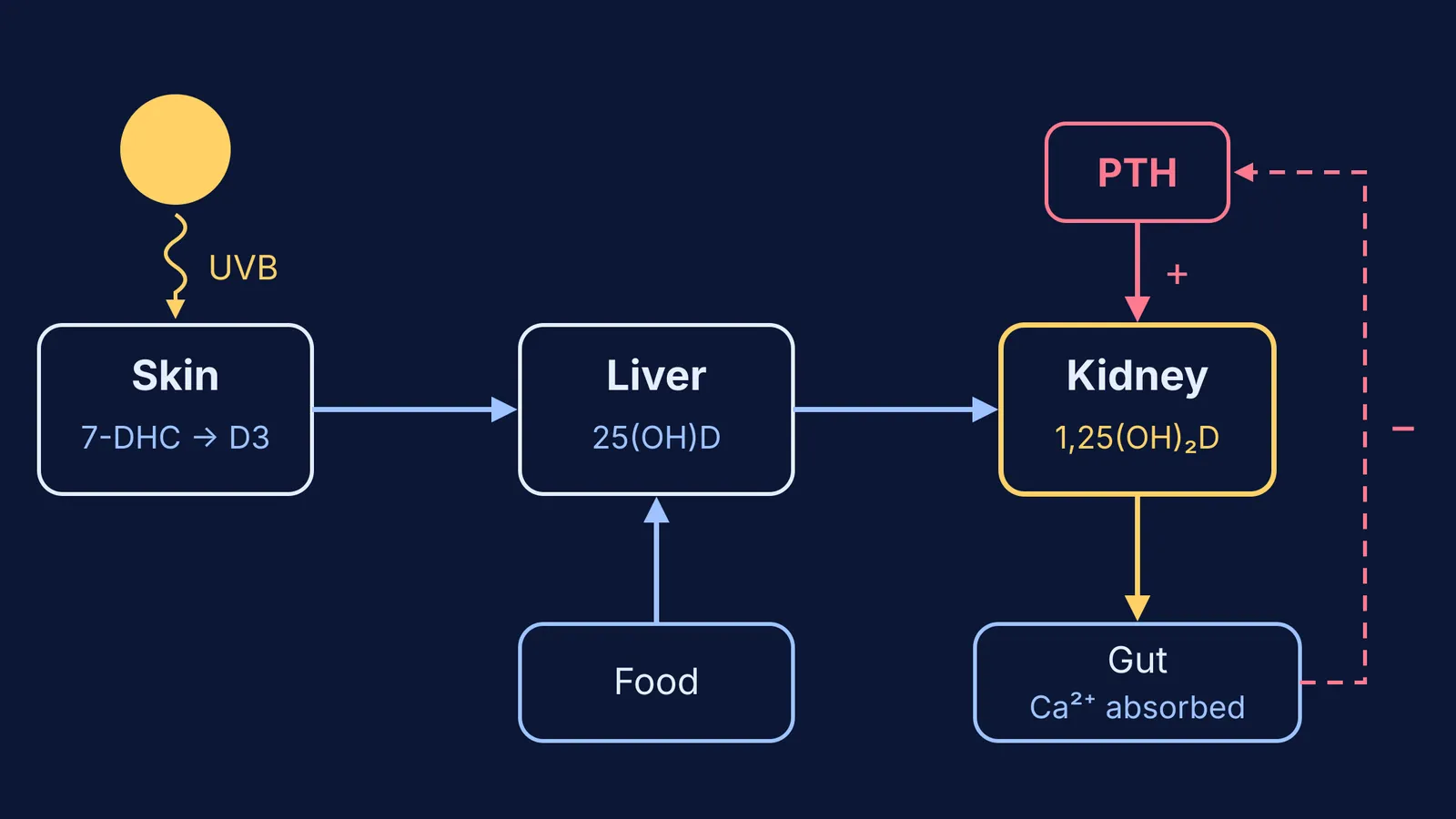
How do skin, liver and kidney make calcitriol?
All three steps below are described in Bikle's review.
Skin. Ultraviolet B light (280-320 nm) breaks one ring of 7-dehydrocholesterol, a cholesterol-like molecule in skin, to give previtamin D3. Body heat then rearranges it into vitamin D3, with no enzyme needed. Melanin blocks some of this UVB, and the farther you live from the equator, the less of the year you can rely on sunlight to do the job.
Liver. An enzyme, mainly CYP2R1, adds an OH group at carbon 25 to make 25-hydroxyvitamin D, or 25(OH)D. Blood tests measure this form, as a marker of your vitamin D supply.
Kidney. A second enzyme, CYP27B1, adds an OH group at carbon 1 to make 1,25(OH)2D: calcitriol.
Vitamin D from food joins the same relay at the liver, as a 2025 review in Frontiers in Nutrition explains. For the history, see Harry Steenbock and ultraviolet light.
Why does calcitriol behave like a steroid hormone?
Vitamin D3 is a secosteroid, a steroid whose ring has been opened, according to the Frontiers in Nutrition review. The opened ring is exactly the bond that UVB broke in your skin.
It also works the way steroid hormones work. Bikle's review states that the vitamin D receptor (VDR) is "a transcription factor and member of the steroid hormone nuclear receptor family". Calcitriol binds VDR inside the cell; VDR pairs with a partner receptor called RXR and attaches to stretches of DNA called vitamin D response elements, turning target genes on or, in some cases, off.
That is the same playbook as cortisol and the sex hormones: a fat-soluble signal, a receptor inside the cell, and a change in which proteins the cell makes. For peptide versus steroid hormones side by side, see the chemical nature of hormones.
How does calcitriol keep blood calcium in balance?
Calcitriol is one arm of a feedback loop run with parathyroid hormone (PTH). Bikle's review sets out the controls on the kidney enzyme: PTH switches CYP27B1 on, while calcitriol itself and another hormone, FGF23, switch it off. High calcium suppresses the enzyme mainly by lowering PTH.
The gut is where the payoff shows. A review by Alshahrani and Aljohani in Nutrients reports that with low vitamin D the small intestine absorbs about 10-15% of dietary calcium, rising to about 30-40% when vitamin D is adequate. The same review gives calcitriol a half-life under 15 hours, so the kidney has to keep making it.
Worked example. Suppose a meal contains 300 mg of calcium. At 10-15% absorption you take in 30-45 mg; at 30-40% you take in 90-120 mg. Same plate, two to four times as much calcium reaching your blood.
For how PTH and calcitonin pull blood calcium in opposite directions, read parathyroid hormone vs thyrocalcitonin.
How should you write this in an exam answer?
A five-line plan for a long answer:
Source: UVB converts 7-dehydrocholesterol in skin to vitamin D3; food adds more.
Liver: 25-hydroxylation gives 25(OH)D, the form measured in blood.
Kidney: 1-hydroxylation by CYP27B1 gives calcitriol, switched on by PTH.
Mechanism: calcitriol binds VDR, a steroid-family nuclear receptor, and changes gene transcription.
Effect: more calcium absorbed in the gut, action on bone, and feedback that lowers PTH.
Three common slips: saying the liver makes the active form, calling vitamin D3 itself active, and leaving PTH out of the loop.
If receptors and hormone types are the shaky part, the Fermi Concept Library gives each biology and chemistry concept its own lesson and its place in the map. Then work through the loop with Fermi's AI tutor; it checks your understanding as it goes.
Next time someone calls vitamin D a vitamin, you can say: it starts as one, and the kidney finishes it as a hormone.