On this page
On a January morning in Delhi you can lose sight of the car ahead, yet flights keep landing by following radio beams. For why the fog forms, read why dense fog covers north India on winter mornings.
Fog still causes trouble. In a February 2024 release, the Ministry of Civil Aviation said severe fog and cold wave conditions in January 2024 led to delays and cancellations at Delhi.
How does the instrument landing system guide a plane?
The instrument landing system (ILS) uses two radio transmitters: a localizer for left and right, and a glide slope for up and down. The US Federal Aviation Administration's Aeronautical Information Manual gives the numbers:
The localizer transmits between 108.10 and 111.95 MHz from the far end of the runway and guides the aircraft to the centreline.
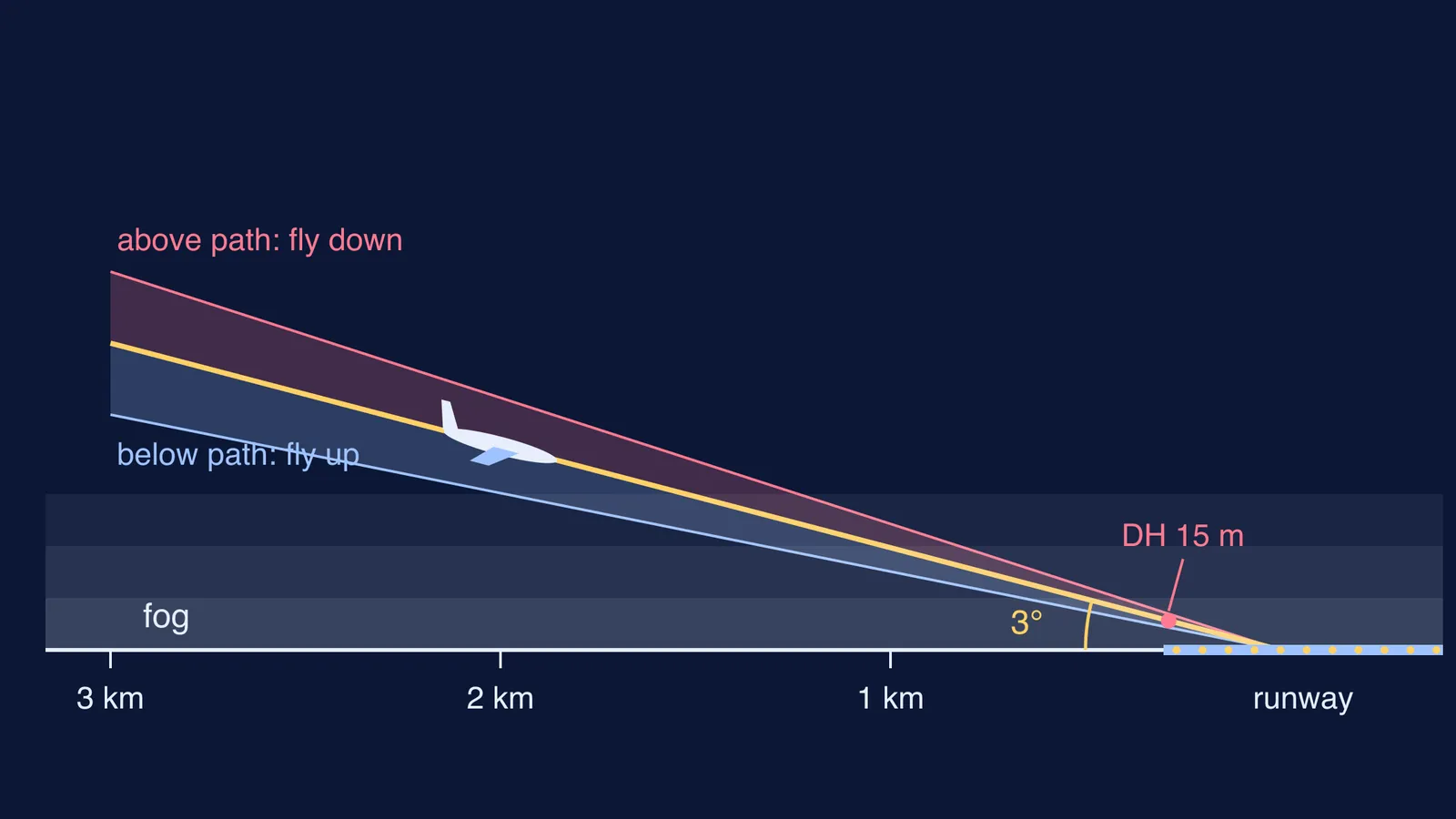
The glide slope transmits between 329.15 and 335.00 MHz, and its path is normally set 3 degrees above horizontal.
The glide slope beam is 1.4 degrees thick, top to bottom.
The signals carry two tones, at 90 Hz and 150 Hz, and the receiver compares how strongly each one comes through, as the instrument landing system article explains. Drift far left of the localizer course and the 90 Hz tone dominates, so the needle says fly right. Equal tones mean you are on the centreline. The glide slope does the same vertically.
What does a 3 degree glide path mean in numbers?
Here is a worked example with Class 11 trigonometry, using figures from the FAA manual. Height above touchdown is distance × tan 3°, and tan 3° ≈ 0.0524.
Ten nautical miles out (18.5 km), where the glide slope is normally usable: 18,520 m × 0.0524 ≈ 970 m up.
One nautical mile out (1,852 m): about 97 m, roughly 320 feet. A handy rule: about 300 feet per nautical mile.
Descent rate at an example ground speed of 140 knots (about 72 m/s): 72 × 0.0524 ≈ 3.8 m/s, roughly 740 feet per minute.
The CAT IIIB decision height is below 50 feet, about 15 m. 15 ÷ 0.0524 ≈ 290 m still to go before the glide path meets the runway. At 72 m/s, that is about 4 seconds.
Four seconds is not long to judge a landing by eye. The same ILS article says CAT III operations rely on an automatic landing system.
If the tan of a small angle still feels shaky, the Fermi Concept Library has a lesson for every concept in mathematics and physics, so you can fix the gap before a mechanics problem exposes it.
What is runway visual range?
Runway visual range (RVR) is the distance over which a pilot on the runway centreline can see the runway markings or lights, in the definition given by SKYbrary. It is not weather-report visibility: RVR takes runway light intensity into account, and it overrides reported visibility for landing decisions. For CAT III, RVR is reported for the touchdown zone, midpoint and stop end, the same page says.
What do CAT I, CAT II and CAT III mean?
Each category sets a decision height, where the crew must see the runway to continue, and a minimum RVR. The FAA manual lists these minimums:
CAT I: 200 feet and RVR 2,400 feet (about 730 m), or 1,800 feet with touchdown zone and centreline lighting.
CAT II: 100 feet and RVR 1,200 feet (about 370 m).
CAT IIIA: below 100 feet or none, RVR at least 700 feet (about 210 m).
CAT IIIB: below 50 feet or none, RVR at least 150 feet (about 46 m).
CAT IIIC: no decision height and no RVR limit.
In metric terms, SKYbrary's ILS page gives the CAT IIIB minimum as an RVR of 50 m.
Aircraft and crew must be certified too. The Ministry's 2024 release says DGCA rules require flight crew to be qualified for the CAT I, II or III minima they fly to, and lists six airports with a runway certified for CAT III: Delhi, Lucknow, Jaipur, Amritsar, Bengaluru and Kolkata. A January 2025 release said three Delhi runways had activated CAT III ILS, including runway 10/28.
Will my flight land in fog?
On a foggy morning, the decision comes down to four questions. If any answer is no, the flight is delayed, holds or diverts.
Is the RVR above the minimum for the category in use?
Is that category of ILS working on the runway?
Is this aircraft certified for it?
Are both pilots qualified for it?
The January 2025 release also says airlines were told to warn passengers early about fog delays, so keep your phone number correct on the booking.
For more flight physics, see why planes take off and land into the wind and what causes turbulence on a flight. If overlapping signals marking a line in space are hard to picture, the Fermi Simulation Lab has interactive simulations for ideas easier to see than to read.