

On this page
The seat-belt sign pings, and the cup of chai on your tray starts to shiver. The aeroplane has flown into air that is moving unevenly, and the physics is the convection and fluid flow from your science textbook.
What causes turbulence on a flight?
The US Federal Aviation Administration describes turbulence as air movement that normally cannot be seen and often occurs unexpectedly, caused by things like jet streams, air around mountains, weather fronts and thunderstorms (FAA: Turbulence). The US National Transportation Safety Board (NTSB) says turbulence arises from eddies in the atmosphere, grouped by source: convection, wind shear in clear air, mountain waves, surface features and the wake of other aircraft (NTSB safety research report, 2021).
Three of these are worth knowing well.
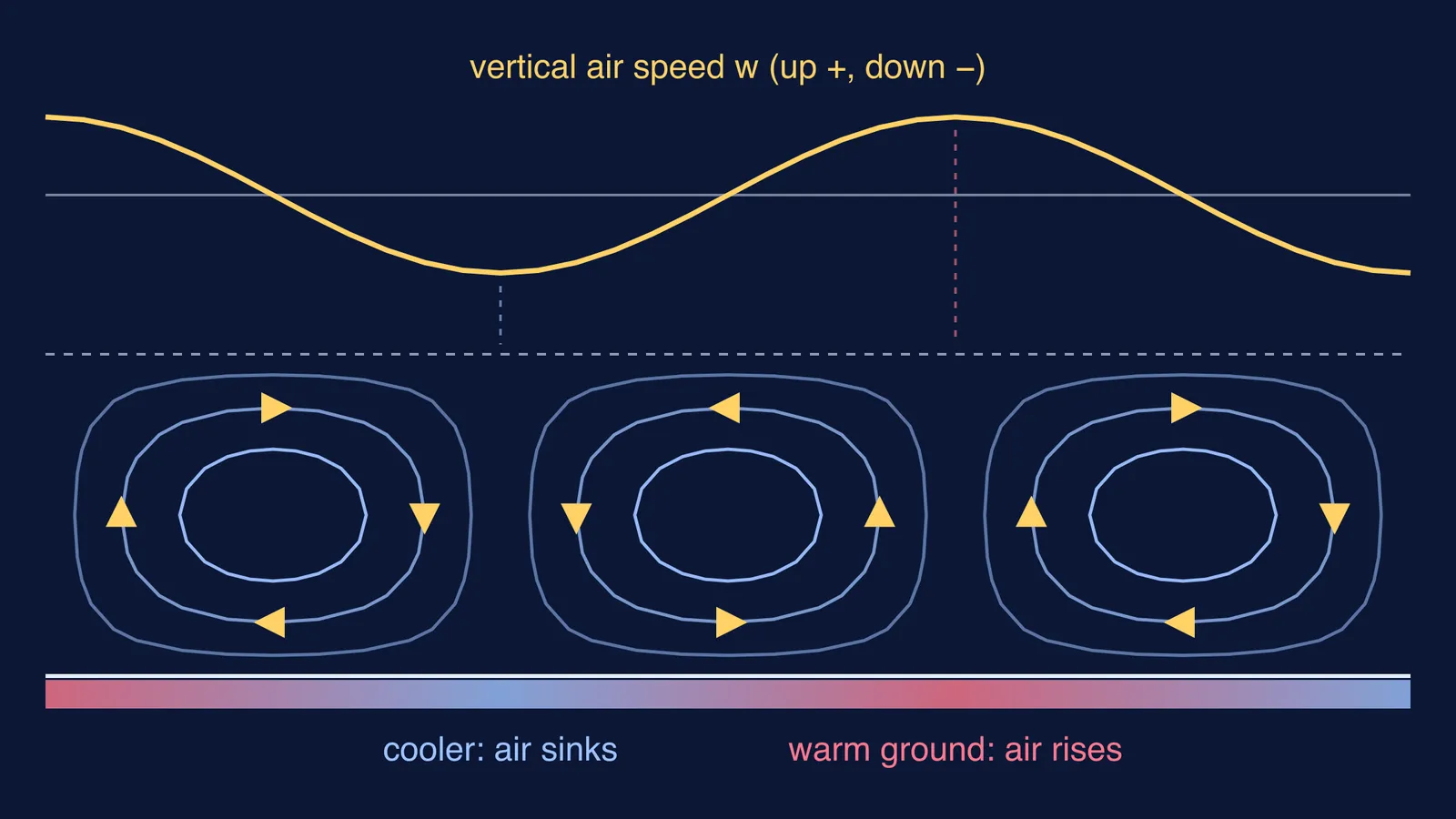
Rising warm air. On a sunny day the sun heats the ground unevenly, so warm air rises in some places and cooler air sinks in others (US National Weather Service training notes). The same notes say these convective currents can grow strong enough to build thunderstorms, which bring severe turbulence. A plane flying level through this pattern gets nudged up, then down, then up again, which is what the diagram at the top of this page shows. Our post on how convection currents form when you heat a tank builds the same loop in water.
Jet streams and wind shear. A jet stream is a core of strong horizontal winds found where there are large temperature differences between warm and cold air masses, and wind shear is a change in wind speed or direction over a short distance (NWS). Where fast air slides past slower air, the boundary breaks into swirling eddies, much as smooth pipe flow turns messy when fast enough (see the Reynolds number for laminar and turbulent flow). The NWS defines clear-air turbulence as turbulence not linked to cumulus-type clouds, at or above 15,000 feet, and says 75% of encounters with it are in clear air, which is why it can hit a plane in a cloudless blue sky. For why jet streams snake around the globe, read about Carl-Gustaf Rossby and the waves that steer the jet stream.
Air flowing over mountains. When wind of 25 knots or more blows across a mountain ridge, it can set up mountain waves that may stretch 100 miles or more downstream (NWS). The same source says the updraft and downdraft of such a wave can move an aircraft up or down by as much as 5,000 feet per minute.
Is turbulence dangerous?
For the aeroplane, rarely. For a person who is not buckled in, it can be. From 2009 to 2018, turbulence-related accidents made up more than a third of all accidents on US airlines, and most of them caused serious injuries but no damage to the aircraft (NTSB, 2021).
The FAA's table of serious turbulence injuries on US airlines lists 166 crew members and 40 passengers for 2009 to 2024 (FAA). The NTSB also found that flight attendants were the people most often injured; unlike passengers, they often have to be moving about. It found that being seated with the seat belt fastened is the most effective way to prevent a turbulence injury, and that about half of the accidents it studied happened during descent or approach.
Is turbulence getting worse?
At cruising height, it seems to be. Mark Prosser, Paul Williams and two colleagues analysed weather data from 1979 to 2020 and found that, at an average point over the North Atlantic, the yearly time spent in severe-or-greater clear-air turbulence rose by 55%, from 17.7 to 27.4 hours (Prosser et al., Geophysical Research Letters, 2023). The UK Met Office says climate change is intensifying jet streams through a growing temperature contrast between the poles and the equator, which leads to stronger wind shear high up (Met Office).
How can you tell what caused the bumps on your flight?
Next time you fly, ask three questions:
Were you near tall, puffy clouds, or low down on a hot afternoon? Think rising warm air.
Was the sky clear at cruising height when the jolts came? Think wind shear near a jet stream.
Were you crossing a mountain range on a windy day? Think mountain waves.
Worked example: an afternoon flight into Srinagar in summer gets bumpy as it descends towards the valley. Two causes fit. The plane is low, over ground heated by the afternoon sun (question 1), and it is threading between high ridges (question 3). It is also in descent, the phase where about half of US airline turbulence accidents from 2009 to 2018 happened, according to the NTSB report.
If a younger brother or sister is scared, try this script: "The air outside is moving up and down, like waves under a boat. Our job is to keep our belts on, and then it is just a bumpy ride." If fear of flying is stopping someone from travelling at all, talking to a doctor or counsellor can help.
Before your next window seat, explore the Fermi Simulation Lab, which has interactive simulations for the ideas that are easier to see than to read.


