

On this page
Have you ever wondered why a heatwave can stall over a continent for weeks, or why a storm system refuses to move? The answer lies high above the ground, in the giant, looping bends of the jet stream.
These massive atmospheric undulations are known as Rossby waves. Before the 1930s, building on the foundational work of Vilhelm Bjerknes and the physics of weather forecasting, meteorologists mapped weather by watching clouds and reading barometers, but they could not mathematically predict how large-scale systems would move. That changed thanks to Carl-Gustaf Rossby, a Swedish-American meteorologist who turned weather forecasting into an exact science.
What are Rossby waves in the jet stream?
The jet stream is a river of fast-moving air in the upper troposphere that flows from west to east. Driven by the temperature difference between the cold polar regions and the warmer equator, it serves as a boundary between these distinct air masses. However, it does not travel in a straight line. Instead, it meanders, forming enormous waves that can span entire continents and oceans.
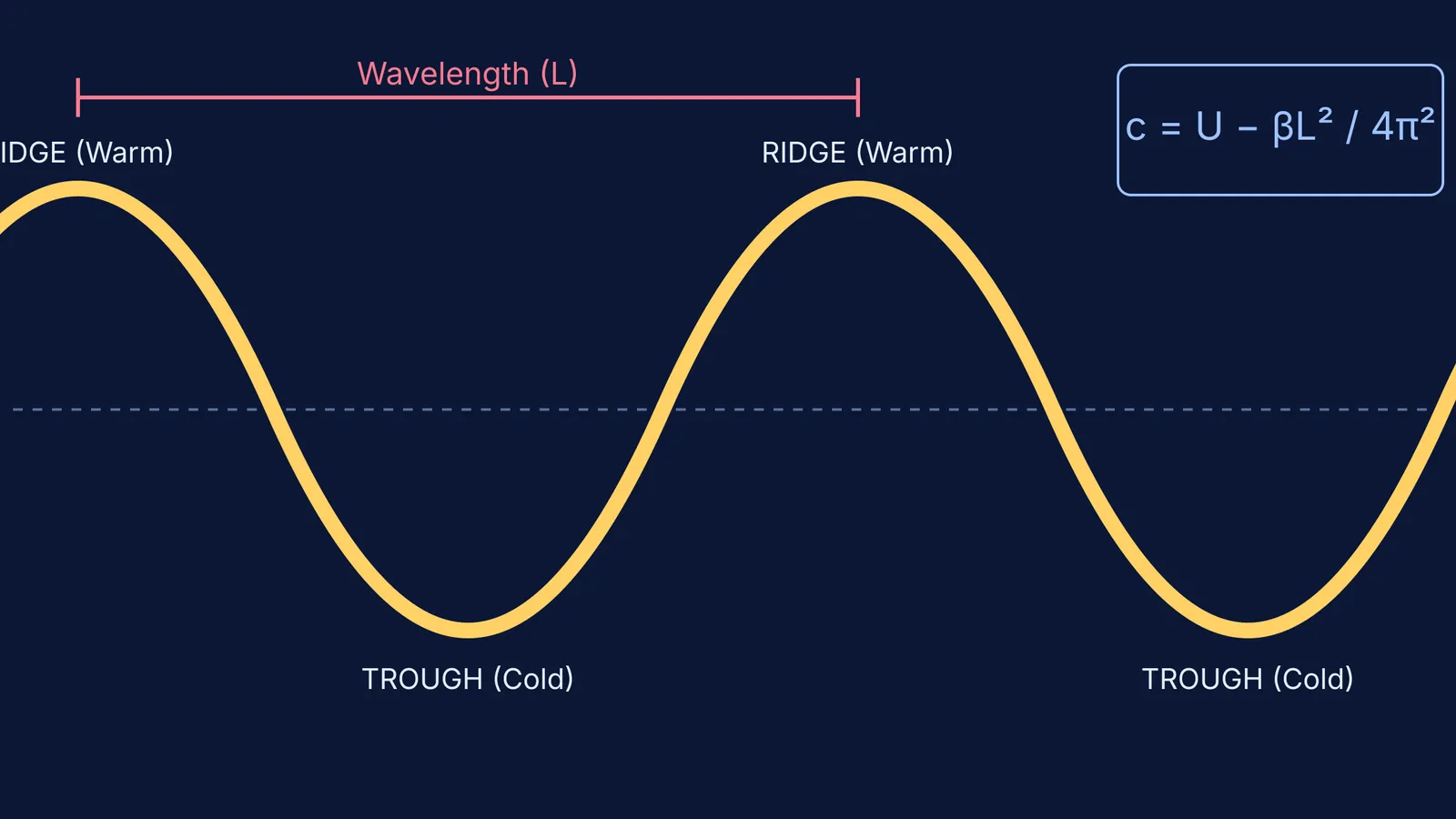
These bends are Rossby waves. When the jet stream bows northward toward the pole, it forms a "ridge," pulling warm surface air up with it. When it dips southward toward the equator, it forms a "trough," dragging cold polar air down. The movement of these ridges and troughs drives the high and low-pressure systems that create our daily weather.
How did Carl-Gustaf Rossby explain the waves?
In 1939, while leading a research group at the Massachusetts Institute of Technology, Rossby published a landmark paper in the Journal of Marine Research. He provided the first theoretical explanation for these giant waves by applying the conservation of absolute vorticity.
Rossby showed that the Earth's rotation (the Coriolis effect) acts as a restoring force. Because the Earth's spin affects the atmosphere differently at the equator than at the poles, air pushed north or south naturally curves back toward its original latitude. This continuous overcorrection creates the sweeping wave pattern. By proving this, Rossby laid the groundwork for the first computer-based weather forecasts, setting the stage for future pioneers like Syukuro Manabe and the first computer climate models.
How do you calculate the speed of a Rossby wave?
Rossby did not just describe the waves; he calculated them. He derived a simple formula to find the wave's phase speed (c), which is how fast the wave pattern itself moves over the ground:
c = U − βL² / 4π²
This equation is a perfect example of how physicists read a complex system. Here is how to break it down:
U is the speed of the westerly winds in the jet stream pushing the wave east.
β (beta) represents how much the Coriolis effect changes with latitude. As you move away from the equator, the rotational speed of the Earth's surface decreases, creating this varying effect.
L is the wavelength (the physical distance from one ridge to the next ridge).
The fraction βL² / 4π² represents the wave's natural tendency to travel westward (retrograde) against the prevailing wind. It reveals something profound: longer waves (larger L) have a much stronger tendency to move westward because of the L² term. If the eastward wind U perfectly matches this westward tendency, then c = 0. The wave becomes stationary.
When a Rossby wave stalls, the weather beneath it gets stuck. A 2026 study in Science Advances by Marianna Linz and Todd A. Mooring tested the theory of "quasiresonant amplification"—the idea that climate change is causing these waves to amplify and lock in place more often. Instead of confirming the theory, they found that waves were actually weaker under conditions thought to suit the theory, casting doubt on its value as a simple explanation for extreme events.
How can you learn the physics of rotation?
Visualising how the Coriolis effect pushes a massive volume of air across a spinning globe is notoriously difficult. If you are studying rotational mechanics or wave physics, having a clear mental model is half the battle. The Fermi Simulation Lab has interactive simulations for the ideas that are easier to see than to read, allowing you to manipulate variables like wavelength and wind speed to see how the system responds.
When physics throws a complex conservation law at you, a textbook answer is rarely enough. Fermi's AI tutor can work out what you already know and build a plan for the session, so you sit down to a clear next step. It holds a line of reasoning, drawing out the forces on a digital whiteboard until the concept clicks.
Whether it is the motion of a spinning top or a planetary wave steering the jet stream, every complex motion breaks down into fundamental forces. Rossby found the forces hidden in the wind, and in doing so, he taught us how to predict the sky.


