On this page
A disc spins on frictionless bearings. You heat it. Nothing pushes or brakes it, yet it ends up turning a little slower. This is a common exam question because it joins two chapters, thermal expansion and rotation, and it hides a sign that is easy to get backwards.
What happens to angular speed when a rotating disc is heated?
Start with what stays fixed. Angular momentum L = Iω is conserved when no net external torque acts on the system, as OpenStax University Physics, section 11.3 states. Heating a disc on a frictionless axle applies no torque about that axle, so Iω before equals Iω after.
Now what changes. For a uniform disc about its central axis, I = ½MR², per OpenStax section 10.5. Mass does not change on heating; the radius does. Linear expansion gives R' = R(1 + αΔT), so
I' = ½MR²(1 + αΔT)²
ΔI/I ≈ 2αΔT, ignoring the tiny (αΔT)² term
This is the same factor 2α that appears in area expansion, ΔA = 2αAΔT, in OpenStax University Physics volume 2, section 1.3. That is no accident: I depends on R², just as area does.
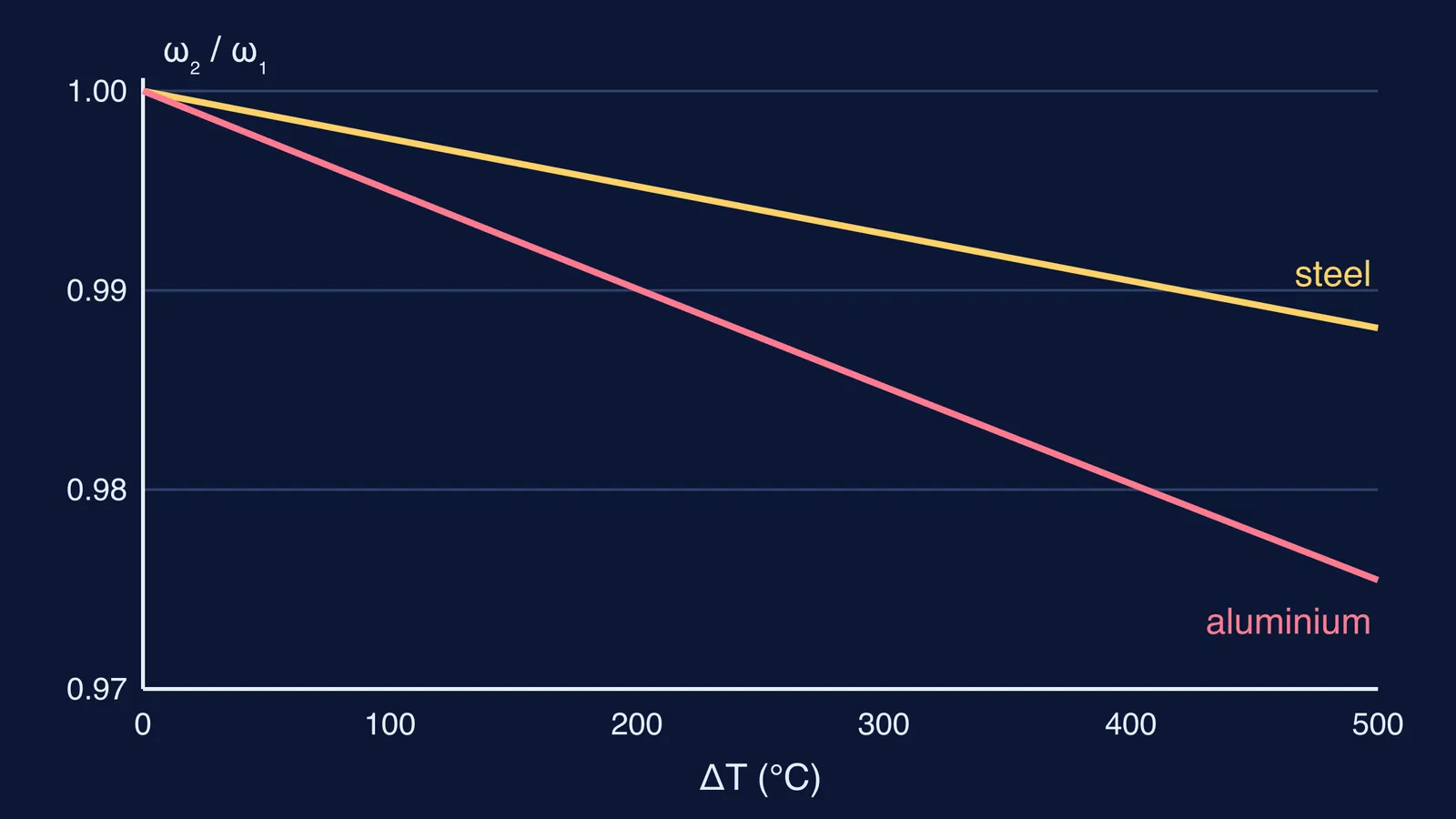
Since Iω is constant, ω' = ω / (1 + αΔT)², and the fractional change is Δω/ω ≈ −2αΔT. The minus sign is the whole answer: the disc slows down.
If you have seen why a spinning skater speeds up when they pull their arms in, this is the same law run in reverse; our post on the spinning skater and angular momentum conservation walks through that case.
How much does the rotational kinetic energy change?
Rotational kinetic energy is K = ½Iω², per OpenStax section 10.4. Write it in terms of the conserved quantity: K = L²/(2I). With L fixed and I rising, K must fall.
ΔK/K ≈ −ΔI/I = −2αΔT
So the kinetic energy drops by the same fraction as ω, not twice that fraction. The square on ω alone would give −4αΔT, but the rise in I gives back +2αΔT.
How much does a steel or aluminium disc slow down?
Take a uniform disc of mass 2 kg and radius 0.10 m spinning at 100 rad/s on frictionless bearings. It is heated by 100 °C. The linear expansion coefficients below come from Table 1.2 of OpenStax University Physics volume 2: steel 12×10⁻⁶ per °C, aluminium 25×10⁻⁶ per °C.
Moment of inertia before heating: I = ½ × 2 × (0.10)² = 0.010 kg m².
Angular momentum: L = 0.010 × 100 = 1.0 kg m²/s. This stays fixed.
Kinetic energy before: K = ½ × 0.010 × 100² = 50 J.
Steel: 2αΔT = 2 × 12×10⁻⁶ × 100 = 0.0024, so I rises by 0.24%. Exactly, ω' = 100 / (1.0012)² ≈ 99.76 rad/s. K' ≈ 49.88 J, a drop of about 0.12 J.
Aluminium: 2αΔT = 2 × 25×10⁻⁶ × 100 = 0.005, so I rises by 0.5%. ω' = 100 / (1.0025)² ≈ 99.50 rad/s. K' ≈ 49.75 J, a drop of about 0.25 J.
The changes are small, which is why the linear approximation 2αΔT works so well. And the material with the larger α slows more, roughly twice as much here, because aluminium's α is roughly twice steel's.
Where does the lost kinetic energy go?
As the disc expands, every bit of metal moves outward to a larger radius while keeping the same angular momentum about the axis. It is like the skater extending their arms instead of pulling them in. In OpenStax's skater example, pulling the arms in takes work and raises kinetic energy; extending them lowers it again. In the disc, the internal forces that hold each bit of metal on its circular path point inward, so they do negative work as the metal moves out. The lost energy stays in the disc as internal energy rather than vanishing.
Cooling works the other way. A cooled disc shrinks, I falls by about 2α|ΔT|, and ω rises by about the same fraction.
A 30-second exam checklist
Is there an external torque about the axis? If not, write Iω = constant first.
Which length sets I? For a disc or ring it is R, so use 2α, not 3α (volume) and not α.
Heating means ω goes down; cooling means ω goes up. Check the sign before you box the answer.
For energy, use K = L²/2I so you see at once that K moves opposite to I.
If the options are percentages, 2αΔT × 100 gives the answer directly.
The same expansion logic shows up in other questions: why a hole in a metal plate gets bigger on heating and why engineers heat a ring to fit it onto a rod.
If you keep losing marks on sign or factor slips in questions like this, the Fermi Problem Library has worked problems with a step-by-step solver that explains the reasoning rather than printing an answer. Try a version with a ring or a rod next, and predict the sign before you calculate.