

On this page
Blacksmiths and engineers have used the same trick for centuries: if a metal ring or tyre is too small to fit over a wooden wheel or a steel rod, they do not force it. They heat it.
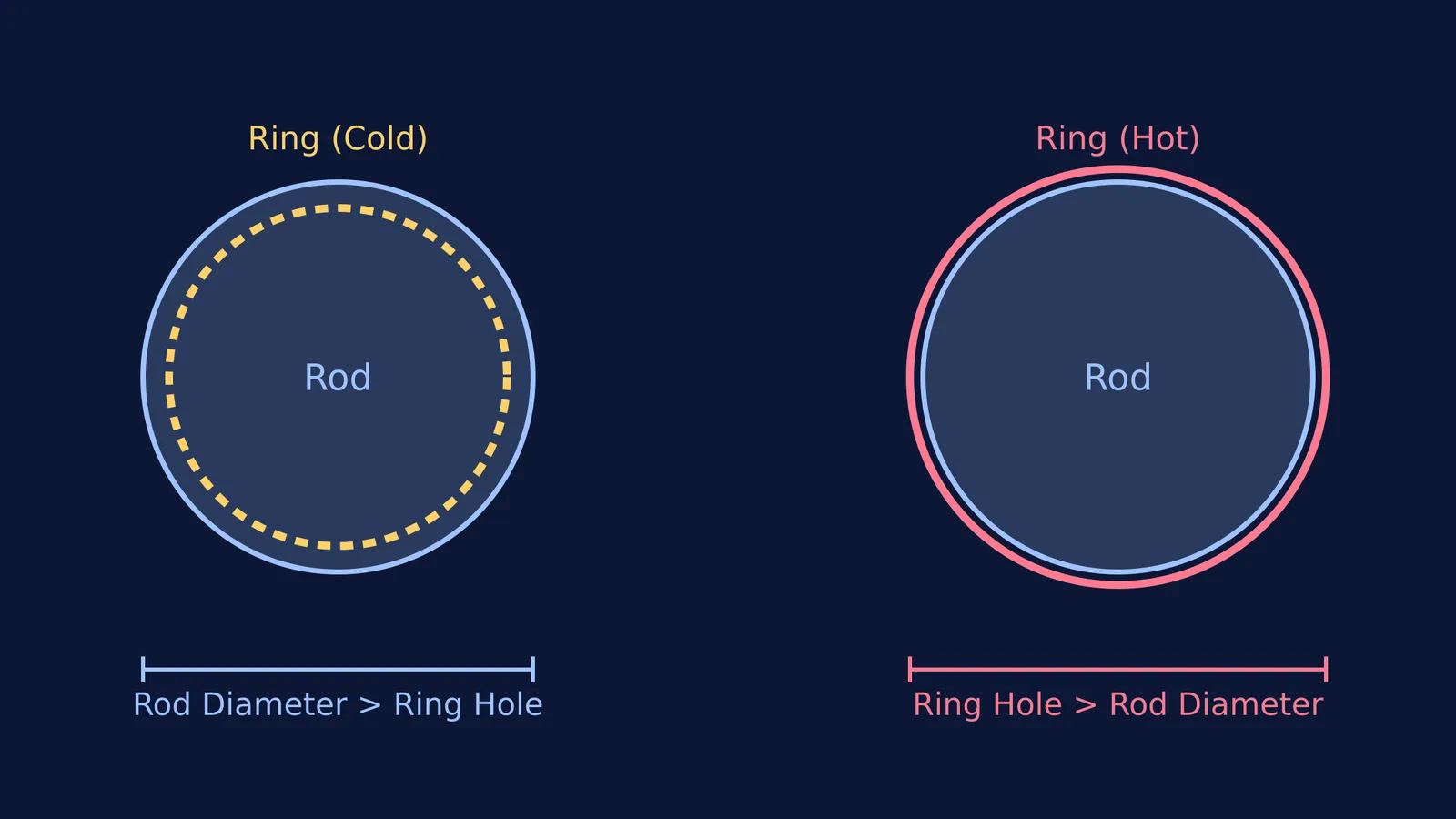
Thermal expansion solves the problem for you. When you heat a solid, the distance between its atoms increases. Because every dimension scales up by the same factor, a hole in a metal plate expands exactly as if it were filled with the same metal.
If you are stuck on similar physics numericals and cannot see the next step, the Fermi Problem Library has a step-by-step solver that explains the reasoning rather than printing an answer.
Why does a hole expand when heated?
It feels counter-intuitive that heating a ring makes its inner hole larger. You might think the heated metal would expand inward to fill the empty gap.
To see why the hole grows instead of shrinking, imagine drawing a circle on a solid metal plate and then heating the plate. The entire plate expands outward, so the circle you drew gets larger. If you cut that circle out to make a hole, heating the remaining plate still makes the hole expand at the exact same rate.
Every line you can draw on the object—its diameter, its circumference and its thickness—increases by the same percentage when the temperature rises. The empty space inside the ring expands precisely as if it were a solid disc of the same material.
This principle means we can treat the inner diameter of a hollow ring just like the length of a solid rod when calculating how much it will grow.
What temperature is needed to heat a ring so it slips onto a rod?
To find out exactly how hot the ring needs to be, we use the standard formula for linear thermal expansion, detailed by HyperPhysics:
ΔD = D₀αΔT
ΔD is the change in diameter you need to make the parts fit.
D₀ is the original inner diameter of the cold ring.
α (alpha) is the coefficient of linear expansion for the specific metal.
ΔT is the change in temperature required to reach the target size.
By rearranging this equation, we get the temperature rise you need:
ΔT = ΔD / (D₀α)
Worked example: The steel tyre and the wooden wheel
Consider a hypothetical physics problem to apply the HyperPhysics formula: a wooden wagon wheel has an outside diameter of 3750 mm. A steel tyre with an inside diameter of 3737 mm at an initial temperature of 20 °C must be shrunk-fit onto this wheel. To what minimum temperature must the steel tyre be heated so that it just slips over the wheel?
Identify the gap: The steel tyre must expand from an inner diameter of 3737 mm to 3750 mm.
ΔD = 3750 − 3737 = 13 mm.
Find the coefficient of expansion: For steel, the linear expansion coefficient α is 1.3 × 10⁻⁵ /°C.
Calculate the temperature rise (ΔT):
ΔT = 13 / (3737 × 1.3 × 10⁻⁵) ΔT = 13 / 0.048581 ΔT = 267.6 °C.
Add the starting temperature: The room is already at 20 °C.
Final temperature = 20 + 267.6 = 287.6 °C.
The steel tyre must be heated to approximately 288 °C. Once you slip it over the wooden wheel and let it cool, it contracts back toward its original size, gripping the wheel with immense force. This is called a shrink fit or an interference fit.
Common mistakes to avoid in expansion problems
When solving thermal expansion numericals in exams like JEE Main, JEE Advanced or NEET-UG, watch out for these common traps that can derail your calculation:
Forgetting the starting temperature: The formula ΔD = D₀αΔT only gives you the change in temperature. You must add this calculated value to the initial room temperature given in the problem to find the final temperature required.
Mixing up radius and diameter: The expansion formula works perfectly for both, but you must be consistent throughout the problem. Do not use the radius for the initial size D₀ and the diameter gap for the change ΔD.
Ignoring the clearance gap: Sometimes a problem asks for the ring to be a specific amount larger than the rod so it slides easily. In that case, add the requested clearance gap to the rod's target diameter before calculating your total ΔD.
You see the same physical principle of expansion at work in the pendulum clock losing time in summer, where a brass rod expands and consequently increases the period of the swing. The concept also loosely connects to how stretching a wire changes its resistance due to the corresponding length and area changes. In every case, knowing exactly how materials respond to physical changes is the essential key to finding the right solution.


