

On this page
Geomorphic Processes is Chapter 5 of the NCERT Class 11 textbook Fundamentals of Physical Geography in the current 2026-27 reprint, according to the book's contents page. Older editions numbered it Chapter 6, after a chapter on minerals and rocks that the current book no longer has.
In the CBSE Geography syllabus for 2026-27, the chapter sits in Unit III, Landforms, which carries 6 marks together with Chapter 6. It lists exogenic and endogenic processes, diastrophism, volcanism, weathering, landslides and soil formation.
What are endogenic and exogenic forces?
The NCERT chapter defines geomorphic processes as the endogenic and exogenic forces that put physical stress and chemical action on earth materials and so change the shape of the earth's surface.
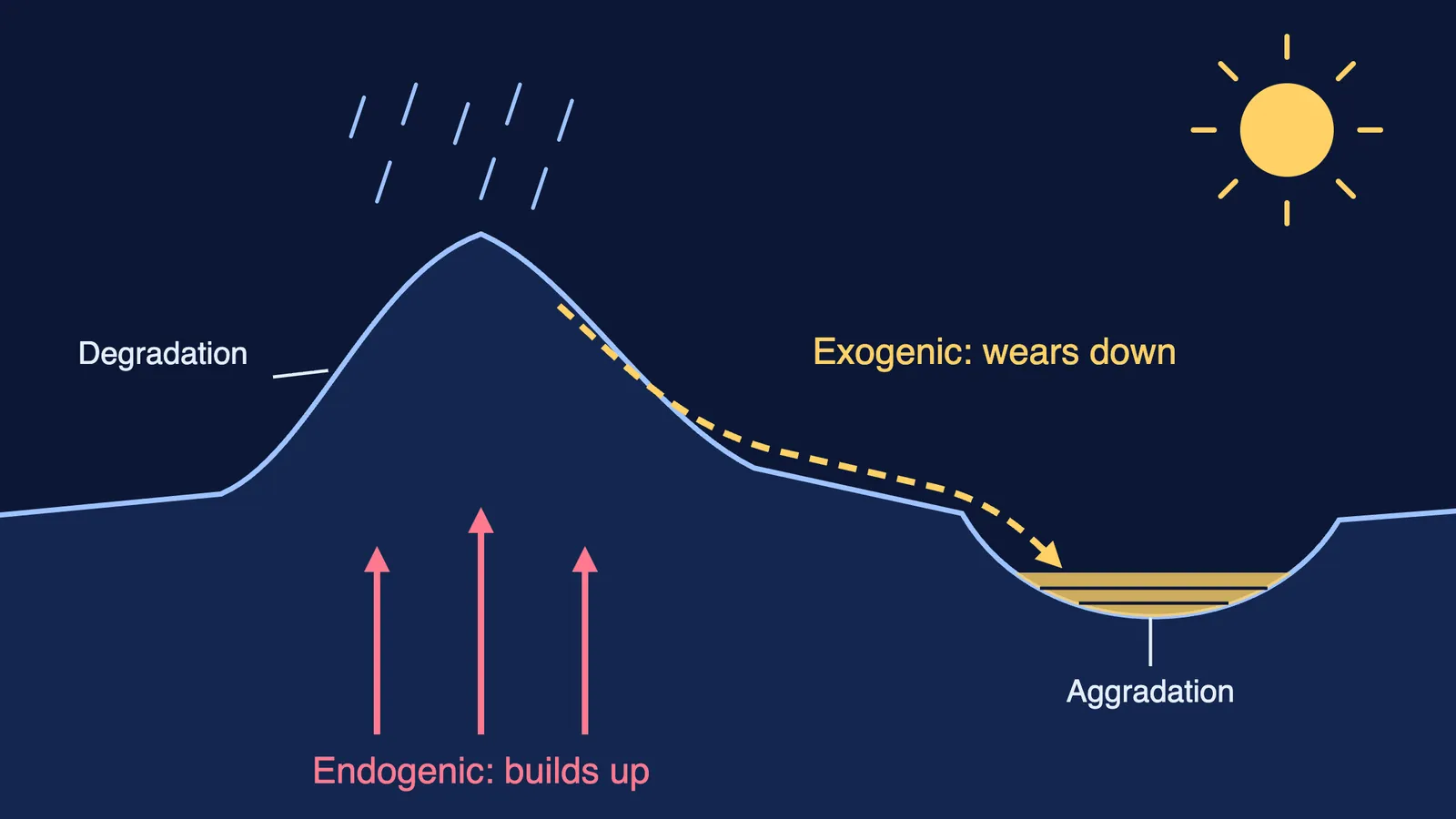
Endogenic forces come from inside the earth. NCERT names radioactivity, rotational and tidal friction, and primordial heat left from the earth's origin as the main sources of this energy. They are mainly land-building forces.
Exogenic forces take their energy from the atmosphere, ultimately the sun, and from slopes created by tectonic movement. They are mainly land-wearing forces.
Exogenic processes wear down high ground (degradation) and fill basins (aggradation), while endogenic forces keep raising the surface, so relief stays uneven.
Diastrophism covers orogeny (mountain building by severe folding along long, narrow belts), epeirogeny (broad uplift or bending of large areas of crust, which builds continents), earthquakes and plate tectonics. Volcanism is the movement of molten rock onto or towards the surface. For background, revise seismic waves and volcanoes from Interior of the Earth and plate movements from Distribution of oceans and continents.
Exogenic processes are weathering, mass wasting, erosion and deposition. NCERT covers them all under one general term, denudation (to strip off or uncover), and lists weathering, mass wasting, erosion and transportation within it.
What are the three types of weathering?
NCERT describes weathering as the mechanical breaking and chemical decay of rocks by the elements of weather and climate. Little or no material moves, so it happens in place (in situ). The three groups are:
Chemical: solution, carbonation, hydration, oxidation and reduction. Water and air, helped by heat, drive these reactions, and decaying plants and animals add carbon dioxide underground.
Physical or mechanical: applied forces such as overburden pressure, expansion from temperature change or crystal growth, and repeated wetting and drying. Each cycle is tiny, but repetition tires the rock until it breaks.
Biological: burrowing earthworms, termites and rodents expose fresh surfaces, plant roots press rocks apart, and decaying matter makes acids.
One process rarely works alone; often one dominates. Exfoliation, the peeling of curved sheets that leaves rounded rock surfaces, is a result, not a process.
Weathering prepares the ground for soil, erosion and mass movement, and can concentrate ores of iron, manganese, aluminium and copper. If the chemistry of oxidation or hydration feels vague, the Fermi Concept Library has a lesson for every concept in chemistry.
How are mass movements different from erosion?
In a mass movement, gravity moves debris downslope directly; no agent such as water, ice or wind carries it, so NCERT does not count it as erosion. Weathering helps mass movement but is not required. In erosion, agents such as running water, groundwater, glaciers, wind and waves pick up and carry debris. Deposition follows when they slow down on gentler slopes.
NCERT describes landslides as rapid, visible movements of fairly dry material, and describes five types: slump (sliding with a backward rotation), debris slide, debris fall, rockslide and rock fall.
For India, NCERT links frequent Himalayan landslides to active tectonics, mostly sedimentary rocks and loose deposits, and steep slopes. The relatively stable, hard-rock Western Ghats and Nilgiris still get them because of near-vertical cliffs and heavy rain in short bursts.
How does soil form, and what are the five factors?
Soil formation (pedogenesis) starts with the weathered layer. Bacteria, mosses and lichens colonise it, humus builds, plants follow, and roots and burrowers make it porous.
NCERT names five factors: parent material, topography, climate, biological activity and time. It calls parent material and topography passive controls and climate an active one. Learn one example each: thin soils on steep slopes; salt hardpans in dry climates; peat in the tundra, where slow bacteria let organic matter pile up; Rhizobium fixing nitrogen in legume roots; and young soils on fresh alluvium.
How should you revise this chapter?
Classify each scene with the three-question test.
Boulders crash onto a ghat road after heavy rain: rock fall, a mass movement.
A river drops silt where it reaches flat land: deposition after erosion.
A granite hill has rounded, peeling sheets: exfoliation, a result of weathering.
A tree root splits an old wall: biological weathering.
For the long question on the earth as a playfield of two opposing groups of processes, use four parts: define both forces, give their energy sources, name two processes each, and end with why relief stays uneven. If you are not sure where to begin, Fermi's AI tutor works out what you already know and builds a plan for the session.
Next, read Origin and evolution of the Earth to see where the crust these forces shape came from.


