On this page
The question asks how far you travel from a point, in a given slanted direction, before you hit a line. The perpendicular-distance formula answers a different question, and the NCERT Class 11 chapter on straight lines asks both kinds (NCERT Class 11 Mathematics, Chapter 9: Straight Lines).
What does distance along a given direction mean?
It is the length of the segment from the point to the line, measured along the given direction. NCERT's Example 12 sets out the method: to find the distance of a line from a point along another line, find where the two lines meet, then measure the distance between the point and that meeting point (NCERT Chapter 9, Example 12).
The parametric form does the same job in one equation.
How does the parametric (distance) form work?
Take the line through P(x1, y1) at angle θ to the positive x-axis. Every point on it can be written as x = x1 + r cos θ, y = y1 + r sin θ. Because (cos θ, sin θ) has length 1, the number r is the signed distance from P: positive one way along the line, negative the other.
The recipe:
Find cos θ and sin θ from the direction. If you are given a slope m = tan θ, use cos θ = 1/√(1 + m²) and sin θ = m/√(1 + m²).
Write the general point (x1 + r cos θ, y1 + r sin θ).
Substitute it into the other line, ax + by + c = 0, and solve for r.
The distance is |r|.
Steps 2 and 3 together give one formula: r = −(ax1 + by1 + c) / (a cos θ + b sin θ). If the bottom is zero, your direction is parallel to the line and you never reach it.
Worked example: NCERT Miscellaneous Exercise, Question 14
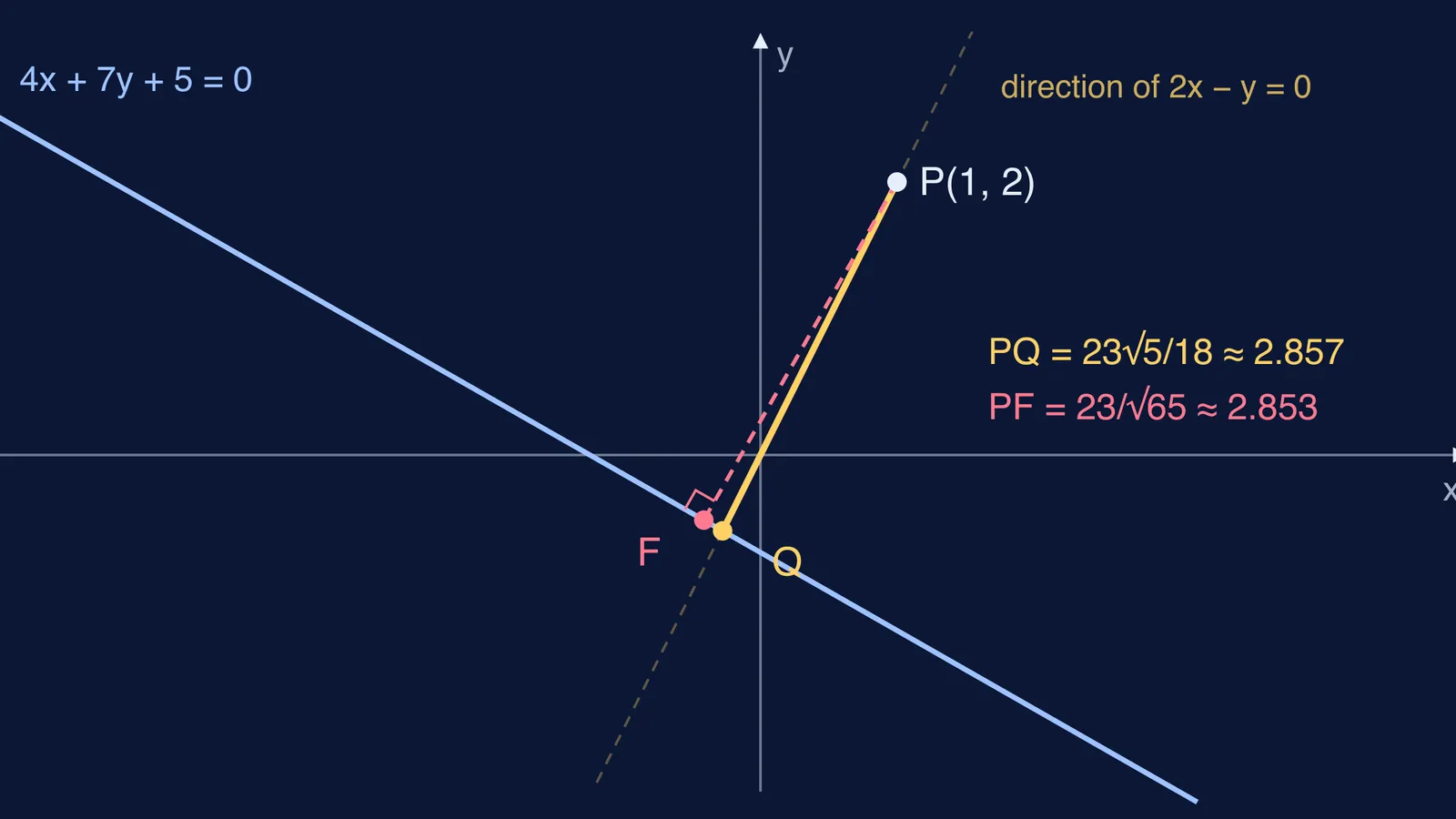
The question: find the distance of the line 4x + 7y + 5 = 0 from the point (1, 2) along the line 2x − y = 0 (NCERT Chapter 9, Miscellaneous Exercise).
Direction. The line 2x − y = 0 has slope 2, so tan θ = 2, cos θ = 1/√5 and sin θ = 2/√5. It passes through (1, 2), so you are moving along it.
General point: (1 + r/√5, 2 + 2r/√5).
Substitute: 4(1 + r/√5) + 7(2 + 2r/√5) + 5 = 0, which simplifies to 23 + 18r/√5 = 0.
Solve: r = −23√5/18. The distance is 23√5/18, about 2.857 units.
The minus sign is information, not an error. It tells you the line lies on the side of P you reach by moving towards smaller x, so the meeting point is (1 − 23/18, 2 − 46/18) = (−5/18, −5/9). Substitute it into both lines to check.
What is the common trap?
A common slip is using the direction numbers straight from the slope, (1, 2), instead of the unit vector (1/√5, 2/√5). The parameter is then not a distance: you get t = −23/18 and are wrong by a factor of √5.
Two more traps sit close behind:
Reaching for the perpendicular formula. NCERT's formula |ax1 + by1 + c|/√(a² + b²) gives the perpendicular distance (NCERT Chapter 9, Section 9.4). Here that is 23/√65, about 2.853, almost the same as 2.857. In a multiple-choice question both could appear as options.
Reporting r with its sign. A distance is |r|. Keep the sign only to locate the meeting point.
If your r does not match the book and you cannot see why, the Fermi Problem Library has worked problems with a step-by-step solver that explains the reasoning rather than printing an answer, so you can find the step that went wrong.
How should you practise this?
Redo Example 12 and Question 14 both ways: intersection first, then the parametric form. Matching answers confirm your setup.
Try Question 15 from the same exercise, which runs the idea backwards: find the direction of a line through (−1, 2) that meets x + y = 4 at a distance of 3 units (NCERT Chapter 9, Miscellaneous Exercise). Here r is known and θ is the unknown.
If the perpendicular formula still feels shaky, revise it first with our guide to the perpendicular distance from a point to a line.
The same idea carries into 3D, where a unit direction vector lets you find points at a fixed distance along a 3D line.
If getting cos θ and sin θ from a slope is the weak step, the Fermi Concept Library gives every concept in mathematics its own lesson.
Before your next test, redo Question 14 on a blank sheet and check it against 23√5/18.