

On this page
Finding points at a set distance along a line is a frequent question in JEE mathematics and standard 3D geometry tests. While you can solve it by plugging unknown coordinates into the three-dimensional distance formula and solving the resulting equations, the algebra quickly gets heavy. You end up with a messy quadratic equation that is prone to calculation errors under exam pressure. There is a much faster, vector-based way that completely bypasses the quadratic equation.
How do you find points on a 3D line at a given distance?
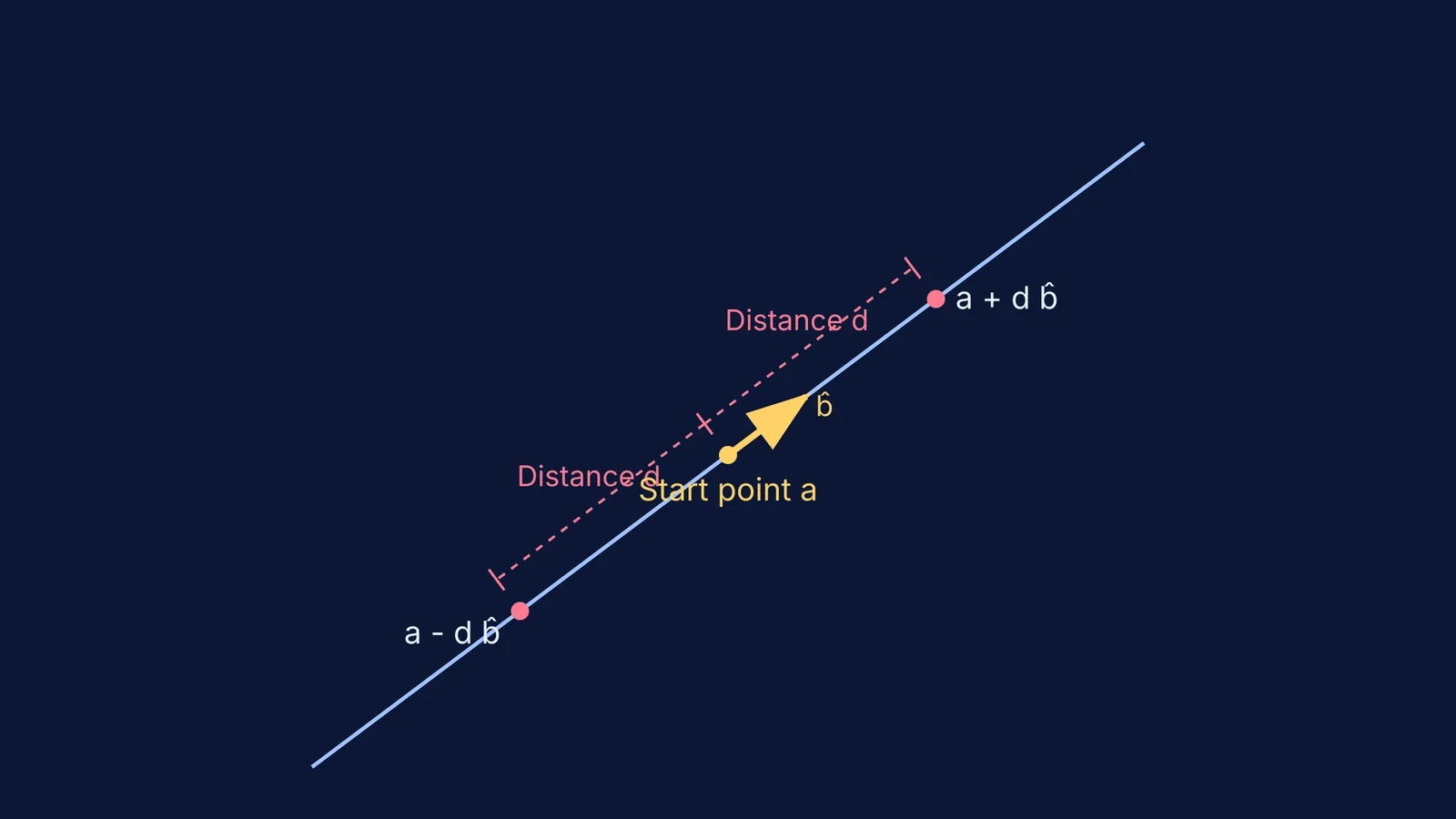
Suppose you have a line passing through a starting point A, which has a position vector a, and you need to find the specific points on this line that are exactly d units away from A.
The most efficient method is to write the line's equation using a unit vector. According to Wolfram MathWorld, a unit vector has a length of exactly 1. If the line's direction is given by an ordinary vector b, you must first convert it into a unit direction vector b̂. You do this by calculating the magnitude of the vector b and then dividing the vector by that magnitude.
Once you have established b̂, the two points at distance d are located at: r₁ = a + d b̂ r₂ = a - d b̂
The positive sign gives the point located d units forward along the line's direction, and the negative sign gives the corresponding point d units backward along the same line.
Why does the unit vector method work?
The general vector equation of a line is typically written as r = a + λb, where λ is a scalar parameter. This equation tells you to start at your known point a and take λ steps of vector b to reach another point on the line.
If b is an ordinary vector, its physical length could be anything. Taking 5 steps of a vector that is 3 units long puts you 15 units away from your starting position. This means the parameter λ does not directly represent the physical distance. But if you deliberately use the unit vector b̂, each step you take is exactly 1 unit long. Taking d steps of a unit vector guarantees you have travelled a distance of exactly d. This direct link between the parameter and the physical distance is exactly why the unit vector simplifies 3D geometry problems, much like the Section formula in 3D: dividing a segment internally and externally simplifies finding dividing points without complicated coordinate algebra.
What happens if you use the Cartesian distance formula instead?
To understand why the vector method is preferred, consider the alternative Cartesian approach. If a line passes through (x₁, y₁, z₁) with direction ratios (p, q, r), any point on the line can be written as (x₁ + λp, y₁ + λq, z₁ + λr). To find points at distance d, you would substitute these coordinates into the distance formula: d² = (λp)² + (λq)² + (λr)² d² = λ²(p² + q² + r²)
You then solve this quadratic equation for λ. While this works perfectly well, it forces you to square terms, factor out λ², and then take a square root. The vector method builds the (p² + q² + r²) division directly into the unit vector from the start, making the final step a simple addition.
Worked example: finding the points
Let us find the points on the line r = (î + 2ĵ + 3k̂) + λ(2î - ĵ + 2k̂) that are at a distance of 6 units from the starting point (1, 2, 3).
Identify the starting point and direction.
The starting point is a = î + 2ĵ + 3k̂. The direction vector is b = 2î - ĵ + 2k̂.
Find the unit direction vector b̂.
First, find the magnitude of b: |b| = √(2² + (-1)² + 2²) = √(4 + 1 + 4) = √9 = 3. Divide b by its magnitude to get the unit vector: b̂ = (1/3)(2î - ĵ + 2k̂).
Apply the distance formula r = a ± d b̂.
With d = 6, we multiply the unit vector by 6: d b̂ = 6 × (1/3)(2î - ĵ + 2k̂) = 2(2î - ĵ + 2k̂) = 4î - 2ĵ + 4k̂.
Calculate the two points.
Add d b̂ for the forward point: r₁ = (î + 2ĵ + 3k̂) + (4î - 2ĵ + 4k̂) = 5î + 0ĵ + 7k̂. Subtract d b̂ for the backward point: r₂ = (î + 2ĵ + 3k̂) - (4î - 2ĵ + 4k̂) = -3î + 4ĵ - 1k̂. The points are (5, 0, 7) and (-3, 4, -1).
How do you check your answer?
If you have time in the exam, you can verify these coordinates using the standard 3D distance formula to ensure they are exactly 6 units from (1, 2, 3).
For (5, 0, 7):
Distance = √((5 - 1)² + (0 - 2)² + (7 - 3)²) = √(16 + 4 + 16) = √36 = 6.
For (-3, 4, -1):
Distance = √((-3 - 1)² + (4 - 2)² + (-1 - 3)²) = √(16 + 4 + 16) = √36 = 6.
Both points are correct. This technique of translating physical movement into vector operations is just as useful here as it is when determining velocity and acceleration vectors from r(t) in kinematics.
If you find yourself forgetting where to apply unit vectors, the Fermi Concept Library has every concept in physics, chemistry, biology, mathematics and computing, each with its own lesson and its place in the map.


