

On this page
Directing is Unit 7 of Class 12 Business Studies and it is the chapter about people. In the CBSE Business Studies curriculum for 2026-27, it sits in Part A with Staffing and Controlling, and those three units share 20 of the 80 theory marks.
What is directing in Class 12 Business Studies?
The NCERT Business Studies Part 1 textbook, Chapter 7 describes directing as instructing, guiding, counselling, motivating and leading people so the organisation reaches its goals. It initiates action, happens at every level, continues throughout the organisation's life and flows from top to bottom.
The textbook names four elements of directing:
Supervision: overseeing subordinates' work and giving instructions so that resources are used well and targets are met.
Motivation: stimulating people to act towards the goal.
Leadership: influencing people to work willingly.
Communication: passing information and understanding from sender to receiver.
What exactly does the 2026-27 syllabus ask for?
Go by the official CBSE curriculum, not an old guidebook. For Directing it lists: concept and importance, elements of directing, motivation (concept, Maslow's hierarchy of needs, financial and non-financial incentives), leadership (concept, and the authoritative, democratic and laissez-faire styles) and communication (concept, formal and informal communication, barriers to effective communication and how to overcome them).
Two things to notice. Supervision is not a separate line in the syllabus; it is covered under "elements of directing". And topics you may find in the NCERT chapter but not in that list, such as the principles of directing, are not named in the 2026-27 curriculum, so give them less time than the four elements.
What is Maslow's hierarchy of needs?
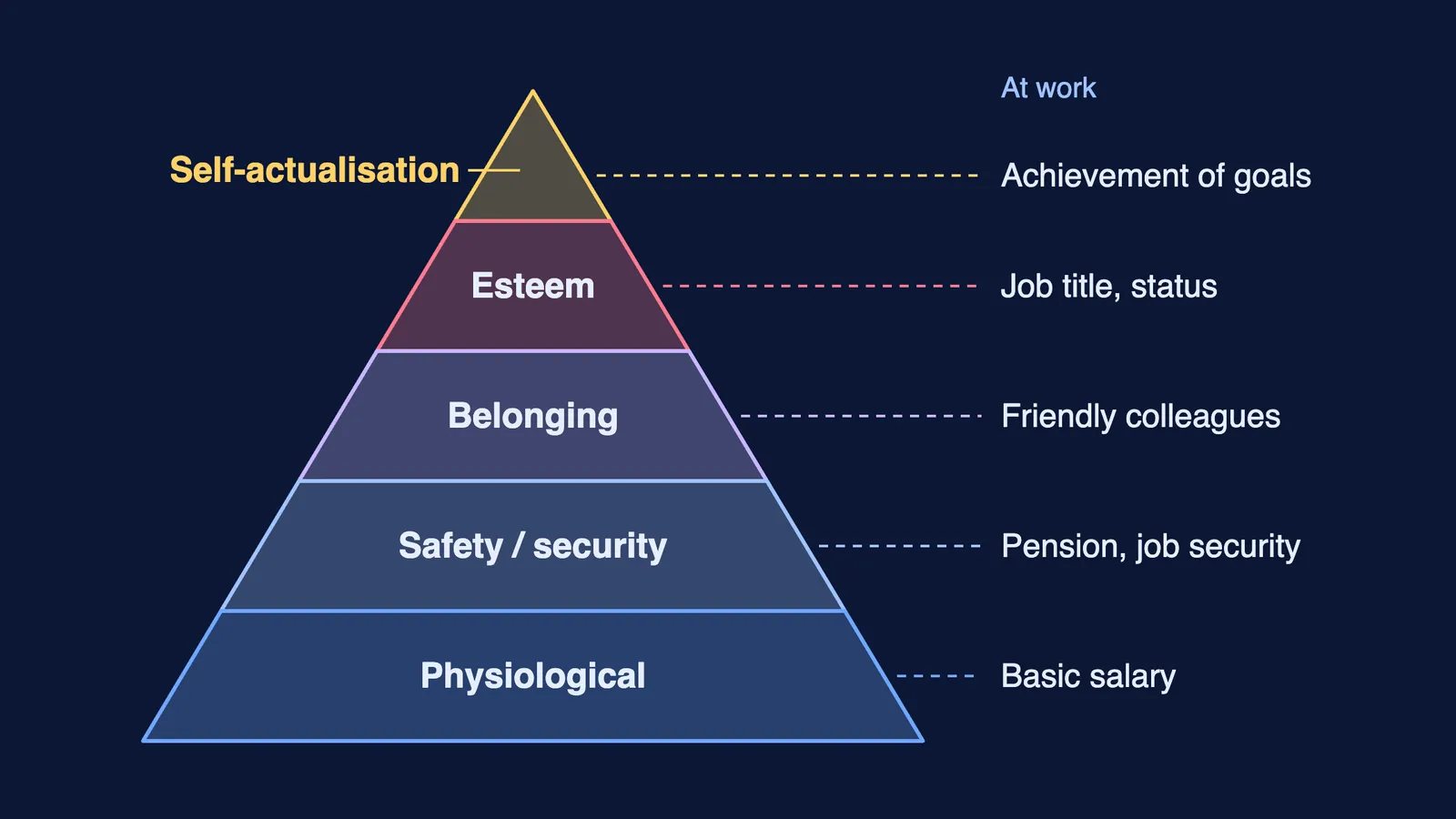
Abraham Maslow set out his theory in a 1943 paper, A Theory of Human Motivation, in Psychological Review. The NCERT chapter teaches it as five needs in a fixed order, from the base up:
Basic physiological needs, met at work by basic salary.
Safety or security needs, such as job security, stable income and a pension.
Affiliation or belonging needs: friendship and acceptance among colleagues.
Esteem needs: self-respect, status, recognition.
Self-actualisation: growth, self-fulfilment and reaching your full potential.
Learn its assumptions too. People act to meet needs; a need that is already satisfied no longer motivates; and a person moves up only when the lower need is met. NCERT notes the order and classification have been criticised.
If you take Psychology too, our post on motives and Maslow in Class 11 Psychology shows the same theory from the other side.
What are the three leadership styles?
The NCERT chapter classifies styles by how a leader uses authority:
Autocratic (authoritative): the leader gives orders and expects obedience; communication is one-way. It helps where quick decisions and on-time output matter.
Democratic (participative): the leader decides in consultation with subordinates and encourages them to take part.
Laissez-faire (free-rein): the leader uses power only when essential; the group sets its own objectives and solves its own problems, and the leader supports and supplies information.
The textbook adds that a leader may mix styles depending on the situation.
What are the barriers to communication?
NCERT groups them into four kinds:
Semantic: badly expressed messages, words with several meanings, faulty translation, unclarified assumptions, technical jargon, body language that contradicts the words.
Psychological: judging a message before it is finished, not paying attention, loss of detail as a message passes through many people, distrust.
Organisational: unsupportive policy, rigid rules, the status gap between boss and worker, too many levels, missing facilities such as meetings or suggestion boxes.
Personal: a superior's fear of losing authority or lack of confidence in subordinates, subordinates unwilling to speak up, no reward for good suggestions.
Remedies include clarifying the idea first, matching the message to the receiver, careful language and getting feedback.
How do you answer a case question on directing?
Use four steps:
Underline the trigger words. "Orders", "no discussion" point to autocratic; "consulted the team" to democratic; "wanted a promotion" to esteem; "did not understand the word" to a semantic barrier.
Name the concept exactly as the syllabus does.
Quote the line from the case as evidence.
Add one sentence of explanation in your own words.
Worked example: a factory manager writes a notice in English for workers who mostly read Hindi, and the translation says something different. That is a semantic barrier (faulty translation), shown by the line about the notice, fixed by checking understanding through feedback.
For that link, read our notes on Fayol, Taylor and the principles of management, and practise case spotting with how to ask AI which management principle a case shows. If you also take physics or maths, Fermi's AI tutor can work out what you already know and build a plan for the session.
Tonight, write the four elements, five needs, three styles and four barrier groups from memory, then check.


