On this page
A diamond does not make light. It traps it. In a well-cut stone, light enters through the top, usually bounces off the sloping back facets twice, and comes back out through the top towards your eye. The physics is total internal reflection, and the deciding number is the critical angle.
What is the critical angle of diamond?
When light passes from a denser medium into air, it bends away from the normal, as explained in our post on when light bends towards or away from the normal. Past a certain angle the refracted ray would have to bend beyond 90°, so all the light reflects back inside instead. That angle of incidence is the critical angle C, and for a material in air sin C = 1/n.
This happens only when light travels inside the optically denser medium, as this gemmology textbook chapter on brilliance notes. For diamond, with n = 2.417, it gives the critical angle as the inverse sine of 1/2.417, about 24°26', or 24.4°.
For comparison, SCHOTT N-BK7, a common optical glass, has a listed refractive index (nd) of 1.5168 (RefractiveIndex.INFO, from SCHOTT's catalogue). That gives sin C = 1/1.5168 = 0.659, so C is about 41.2°.
How does the cut trap light inside a diamond?
A high refractive index is not enough: the facets must be angled so light meets them beyond the critical angle. In 1919, Marcel Tolkowsky worked through the optics in his book Diamond Design, using n = 2.417 and a critical angle of 24°26'. He noted that with parallel faces, "all the light passing in by the front of a gem passes out again by the back without any reflection". His proposed round brilliant has a pavilion (back) angle of 40°45', a crown (top) angle of 34°30' and a table 53% of the diameter.
The International Gem Society explains that pavilion facets cut too shallow or too steep let light leak out of the bottom or sides, which gemmologists call "windowing" or "extinction".
How does one ray travel through a brilliant cut?
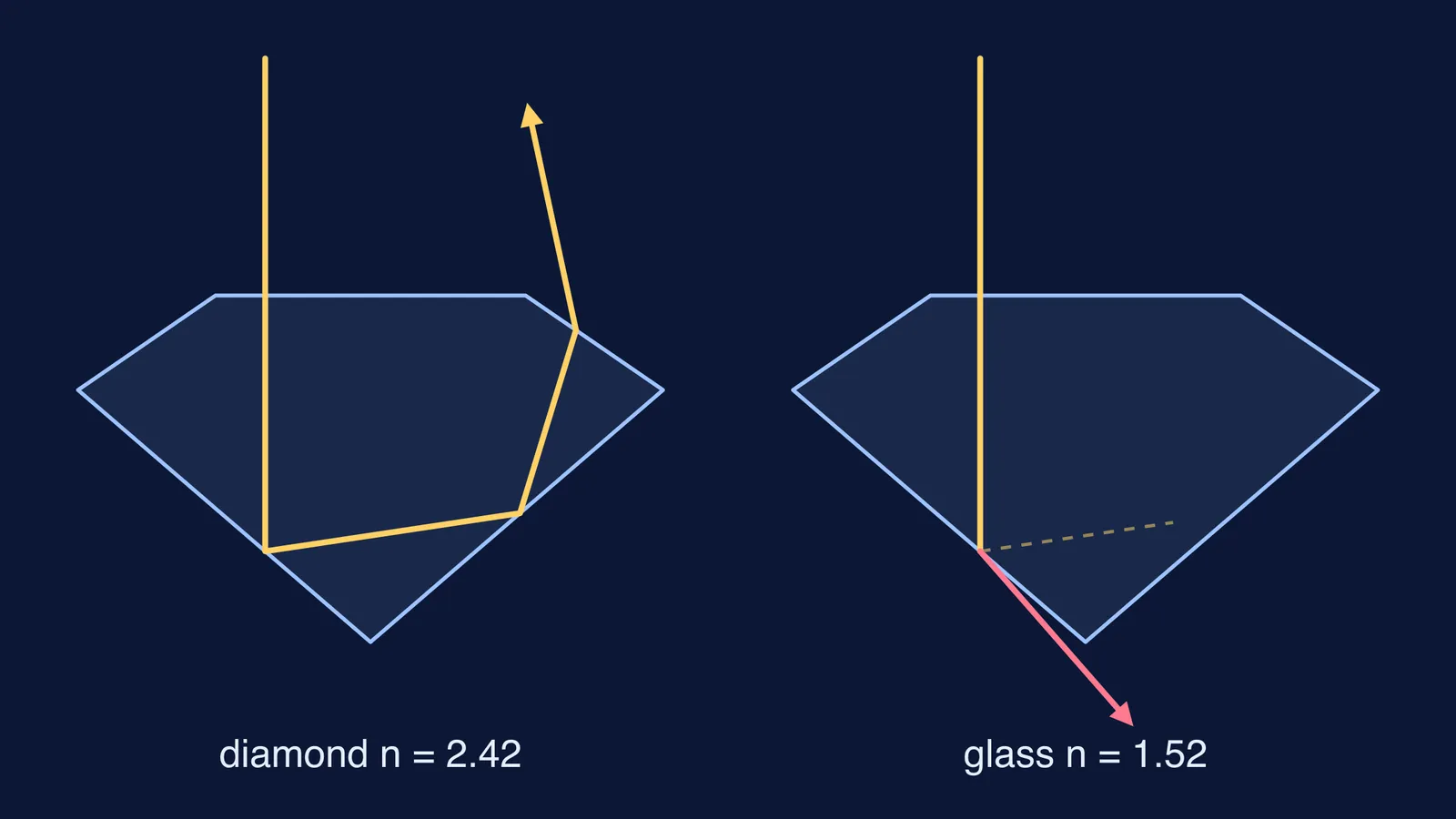
Take a ray falling straight down into Tolkowsky's brilliant. In Diamond Design he finds it is reflected twice, then travels at 17° to the vertical.
The ray enters the table at 0° incidence, so it does not bend.
It meets a pavilion facet tilted 40.75° from horizontal. The facet's normal is tilted 40.75° from vertical, so the angle of incidence is 40.75°. That is more than 24.4°, so the ray is totally reflected.
The reflected ray now heads across the stone, 8.5° above horizontal (90° minus 2 × 40.75°). It meets the opposite pavilion facet at 180° minus 3 × 40.75° = 57.75°. Still more than 24.4°: reflected again.
The ray now travels upwards, 17° from vertical (180° minus 4 × 40.75°). In the hero diagram it reaches a crown facet tilted 34.5°, so it strikes at 34.5° minus 17° = 17.5°. That is below 24.4°, so it leaves. Snell's law gives sin r = 2.417 × sin 17.5° = 0.727, so r is about 46.6°, and the ray heads back up towards the viewer.
Two total internal reflections, then out through the top: that is the sparkle.
Why does glass not sparkle like diamond?
Run step 2 with N-BK7 glass, whose critical angle is 41.2° from its catalogue refractive index. The ray meets the pavilion at 40.75°, half a degree short of that, so it is not totally reflected: sin r = 1.5168 × sin 40.75° = 0.990, giving r of about 82°. Part of the light escapes through the back; a partial reflection stays inside, but every such bounce loses light.
Diamond clears its critical angle by more than 16° at that facet; glass misses by half a degree.
Where do the rainbow flashes come from?
The coloured flashes, called fire, come from dispersion: the International Gem Society notes that blue light bends more than red in a gem, so colours separate as light leaves the crown. The critical angle also depends on colour, as we show in why the critical angle differs for different colours.
How do you solve critical angle problems without slipping?
Draw the normal at each surface before measuring any angle.
Check that the ray is inside the denser medium; if not, total internal reflection is impossible.
Find C from sin C = 1/n (or n2/n1 for two media).
Compare the angle of incidence with C at every surface the ray meets, not just the first.
For a vertical ray on a tilted face, the angle of incidence equals the tilt of the face.
For more practice, including optical fibres, see our post on total internal reflection and critical angle problems. If ray paths are hard to picture, the Fermi Simulation Lab has interactive simulations for ideas that are easier to see than to read. When you get stuck midway through a problem like this, the Fermi Problem Library has a step-by-step solver that explains the reasoning rather than printing an answer.