On this page
Below about 200 metres there is rarely much sunlight in the sea, and below 1,000 metres sunlight does not reach at all, according to NOAA's National Ocean Service. Below about 200 metres the water averages about 4°C, food is scarce and the pressure is enormous (NOAA Ocean Exploration). Yet the deep sea is full of animals, and their survival comes down to four ideas: soft bodies, their own light, big mouths and slow lives.
How do deep sea animals survive the pressure?
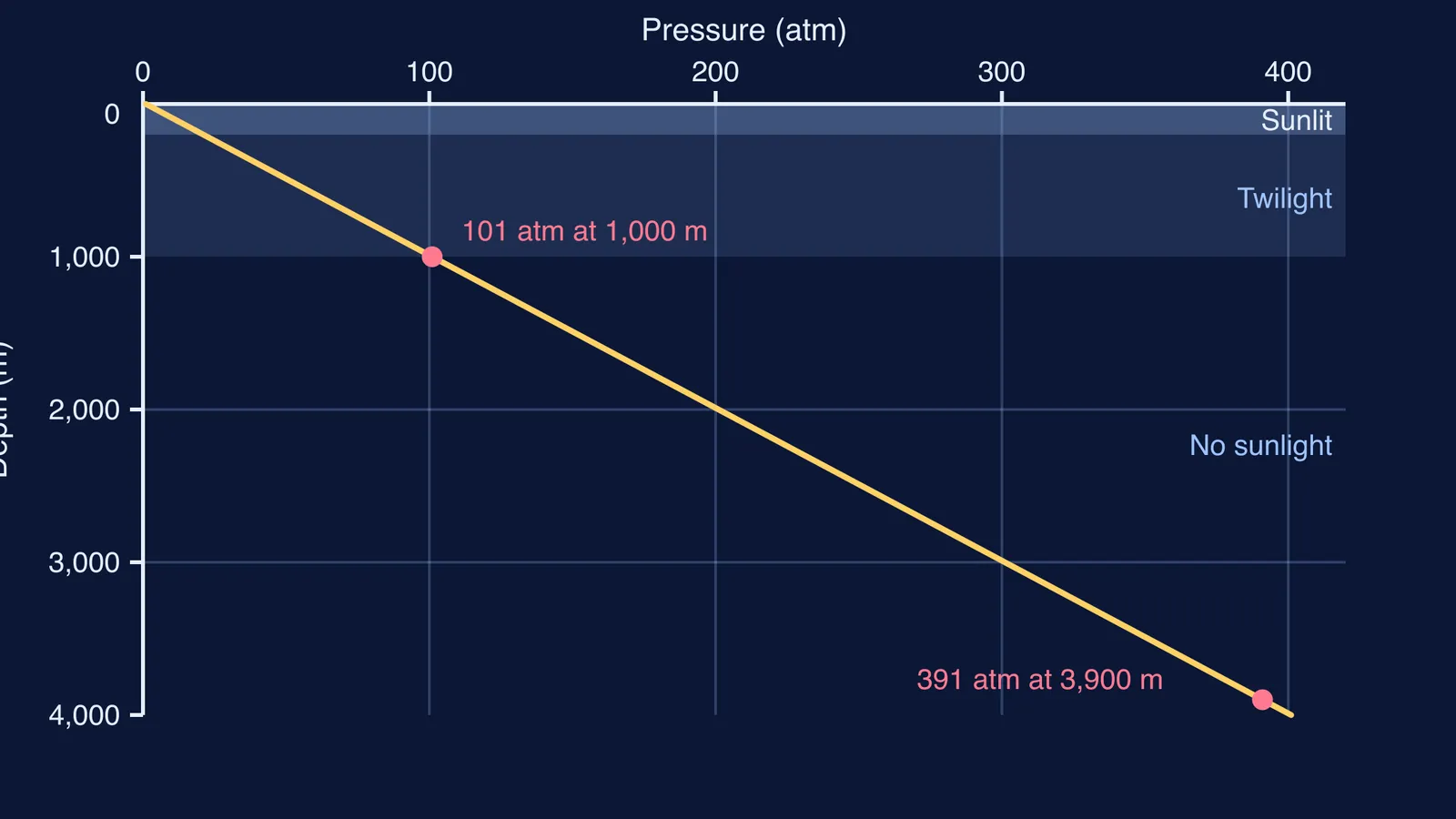
Pressure in the ocean increases about one atmosphere for every 10 metres of depth, says NOAA Ocean Exploration.
The answer is not armour. The same NOAA page explains that most deep-sea animals are largely water, water is incompressible, and without gas-filled spaces such as lungs or swim bladders they are less affected by pressure than we imagine. Some species migrate 1,000 metres up and down every day, a range of about 100 atmospheres, with no harmful effects. A gas-filled organ is a liability at depth; our post on how a swim bladder adjusts buoyancy shows why gas behaves so differently from water.
Worked example: check the 10-metre rule yourself
Pressure under a column of liquid is P = ρgh. Take the density of water as 1,000 kg/m³ and g as 9.8 m/s².
For h = 10 m: P = 1,000 × 9.8 × 10 = 98,000 Pa.
One atmosphere is 101,325 Pa, so 10 m of water adds about 0.97 atm. Seawater is slightly denser, which brings it close to the 1 atm rule.
At 3,900 m: 3,900 ÷ 10 = 390 atm from the water, plus 1 atm from the air, so about 391 atm.
That is about 39.6 million Pa: roughly the weight of 400 kg on every square centimetre.
Why do so many deep sea animals glow?
Bioluminescence is light produced by a living thing through a chemical reaction between an enzyme and a substrate (NOAA Ocean Exploration). NOAA says it may help animals find food, reproduce and defend themselves, though scientists still do not know its main purpose.
In a 2017 study in Scientific Reports, Séverine Martini and Steven Haddock went through 17 years of video from remotely operated vehicles off California, from the surface down to 3,900 metres, and classified more than 350,000 observations of animals (Martini and Haddock, 2017). They found that 76% of the observed individuals could produce light, and the share was remarkably uniform with depth.
The deep-sea anglerfish is the famous example. Its glowing lure is lit by bacteria living inside it, and a 2019 study in eLife found that most of the anglerfish species surveyed, across six genera, shared one species of glowing bacterium, which they appear to pick up from the surrounding seawater rather than inherit (Baker and colleagues, 2019).
Why do deep sea fish have such big mouths?
Without sunlight there is no photosynthesis, so most deep-sea food has to sink from above as marine snow: dead plants and animals, faecal matter, sand and dust, with some flakes falling for weeks (NOAA Ocean Service). Meals are rare, so wasting one is costly.
The pelican eel has massive jaws and eats mainly crustaceans, plus fishes and cephalopods, at depths of 500 to 3,000 metres (Australian Museum).
The black swallower has a stomach that stretches until it is see-through, and it could swallow prey more than twice its length and 10 times its mass (Australian Geographic).
Sunlight is not the only fuel, though. Around hydrothermal vents and cold seeps, communities run on chemosynthesis instead of photosynthesis (NOAA Ocean Exploration). Read about the 1977 Alvin dive that found deep-sea vents and how chemosynthetic bacteria differ from photosynthetic ones.
Why are deep sea animals so slow?
In several important animal groups, metabolic rates decline strongly with depth, though not in all. A review by Brad Seibel and Jeffrey Drazen concluded that low metabolic rates in the deep sea do not come from shortages of food or oxygen, or from temperature or pressure (Seibel and Drazen, 2007). Their explanation is about light. In well-lit water, visual predators face strong selection for fast, powerful swimming. Where darkness limits hunting by sight, that selection relaxes, so animals can save energy.
How do you write a deep sea adaptation answer?
In a school exam answer, use a four-link chain for each adaptation:
Condition: name the habitat feature (no sunlight below 1,000 m).
Problem: say what it causes (no photosynthesis, so little food).
Adaptation: name the trait (huge jaws and a stretchy stomach).
Example: give one animal (the black swallower).
If one link feels shaky, such as why gas compresses but water does not, the Fermi Concept Library covers every concept in physics, chemistry and biology, each with its own lesson and its place in the map. To practise numericals like the 3,900-metre example, the Fermi Problem Library has worked problems with a step-by-step solver that explains the reasoning rather than printing an answer.
Next time you see a strange deep-sea fish, ask which of the four links it shows.