

On this page
Before 1977, marine biologists assumed that the deep ocean floor was a barren desert, devoid of significant life. That assumption shattered in February 1977, when a team of scientists aboard the submersible *Alvin* made one of the most surprising discoveries in the history of biology.
How did the 1977 Alvin expedition discover hydrothermal vents?
The expedition to the Galápagos Rift, an undersea mountain range in the Pacific Ocean, was primarily a geological mission. Oceanographer Jack Corliss of Oregon State University led the science team, working alongside researchers like Richard von Herzen and Robert Ballard, who analyzed photographs from the support vessel *Knorr*. On the first discovery dive, Corliss was accompanied by geologist Tjeerd van Andel and pilot Jack Donnelly. They descended to a depth of approximately 2,500 metres (8,000 feet) to study the spreading seafloor. The broader team of thirty marine geologists, geochemists, and geophysicists were looking for volcanic activity and heat flow, not life.
As *Alvin* moved along the pitch-black ocean floor, the team noticed shimmering water mixing with the cold deep-sea environment, indicating warm fluid rising from cracks in the rock. They had found the first known active hydrothermal vents. The most shocking revelation, however, was what surrounded these warm springs.
What animals live at hydrothermal vents?
Instead of a lifeless expanse of rock, Corliss and his colleagues found a dense, thriving ecosystem completely alien to science. The community included several species previously unknown:
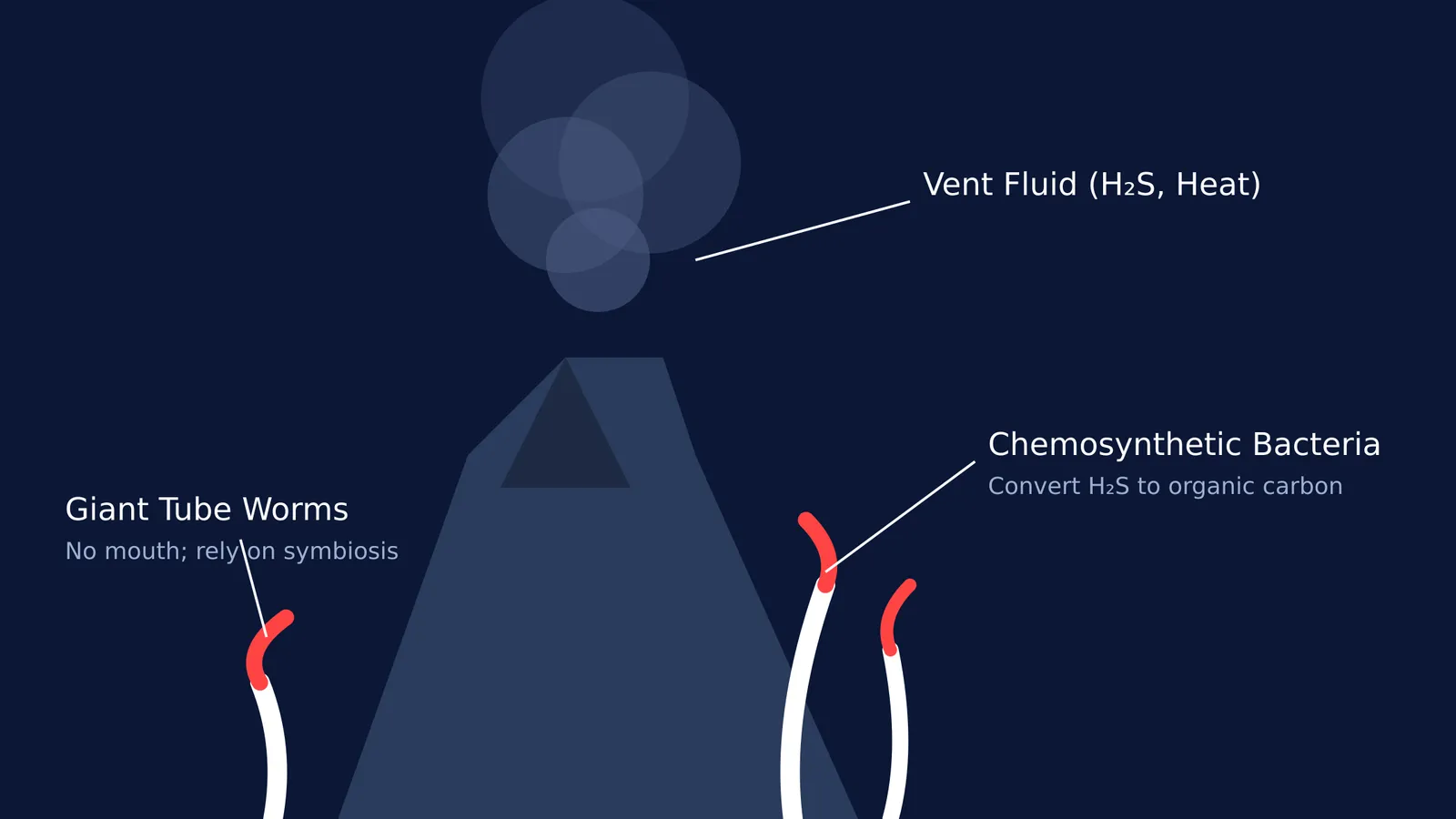
Giant tube worms: Later named *Riftia pachyptila*, these human-sized worms possessed bright red heads but lacked mouths and digestive tracts. They live inside strong, protective chitin tubes that they secrete themselves.
Deep-sea clams: Foot-long white clams that were far larger than any previously known deep-sea bivalves.
Unique shrimp: Species with primitive structures designed to detect heat radiation rather than light, allowing them to navigate the dark environment near the vents.
These organisms lived in total darkness, isolated from the sun-driven food webs that govern almost all other life on Earth.
How do giant tube worms survive without a mouth?
The giant tube worms (*Riftia pachyptila*) found at the vents presented a unique biological puzzle. They can grow to spectacular lengths of more than two metres_dans_leur_habitat_(Ifremer_00569-68102).jpg), yet they possess no mouth, no digestive tract and no anus.
Instead of eating in the traditional sense, these worms live in a symbiotic relationship with chemosynthetic bacteria. The worm's body contains a large sac called a trophosome, which houses these bacteria. The worm uses its bright red, plume-like gills to absorb hydrogen sulfide and oxygen from the water, transporting these chemicals through its blood directly to the bacteria in the trophosome. The bacteria then convert these chemicals into organic carbon, feeding both themselves and the host worm. The host provides shelter, while the microbes provide food.
Why was the discovery of hydrothermal vents important?
The animals at the Galápagos Rift survived through a process called chemosynthesis. Instead of relying on plants that use sunlight for photosynthesis, the base of this food web consisted of vast communities of bacteria that converted dissolved chemicals—primarily hydrogen sulfide erupting from the vents—into usable energy.
This discovery proved that life could thrive in extreme environments using chemical energy, which shifted scientific thinking about where life could exist in the universe. It turned our understanding of life on Earth upside down by showing that entire ecosystems could exist fueled solely by the Earth's internal heat.
Following the expedition, Corliss himself shifted his research focus. In 1981, he co-authored a landmark paper with John Baross and Sarah Hoffman proposing that the first life on Earth might have originated in deep-sea hydrothermal vents rather than in a sunlit surface pool. He later moved to Budapest to continue modeling these evolutionary systems using cellular automata. This hypothesis added a compelling new chapter to the history of evolutionary thought, contrasting with earlier models proposed by scientists like Alexander Oparin and the primordial soup theory of life.
Furthermore, the geological aspects of the discovery provided direct, visible evidence for tectonic plate movement, building on the foundational work of Harry Hess and the idea of seafloor spreading.
If you are studying biology and ecology, understanding how energy flows through different ecosystems is crucial. You can explore these metabolic pathways in the Concept Library, or use Fermi's AI tutor to break down the chemistry of hydrogen sulfide oxidation step by step, as it writes on a board and draws the figures alongside you.


