
On this page
Controlling is the last unit of Part A in Class 12 Business Studies, and it rests on one idea: a manager sets a target, checks what actually happened, and fixes the gap. Here is what the current syllabus asks for, the five steps with a worked example, and how controlling links back to planning.
What does the CBSE syllabus include for Controlling?
The CBSE Business Studies curriculum for 2026-27 lists three things under Unit 8: the concept and importance of controlling, the relationship between planning and controlling, and the steps in the process of control. In the same document, Staffing, Directing and Controlling together carry 20 of the 80 theory marks.
Two points need care. First, the NCERT chapter on Controlling still names techniques of managerial control (budgetary control, ratio analysis, PERT and CPM and others) in its key terms, summary and exercises, but the curriculum does not list them and the chapter no longer explains them. Treat them as outside this year's syllabus unless your teacher says otherwise. Second, the textbook also discusses limitations of controlling, which the curriculum does not name; read them once, because they help answers on importance.
What is controlling in management?
In the NCERT textbook's terms, controlling means making sure the work in an organisation is done according to plan, and that resources are used effectively and efficiently to reach set goals (NCERT, Chapter 8). It is goal-oriented and pervasive: managers at top, middle and lower levels all do it, in a school or hospital as much as in a company. It is not merely the last function: what it finds feeds the next round of planning.
The chapter lists its importance as follows:
it keeps the organisation moving towards its goals
it tests whether the standards were accurate
it cuts waste of resources
it motivates employees, who know in advance how they will be judged
it builds order and discipline
it helps coordination, since every department works to agreed standards
What are the steps in the process of controlling?
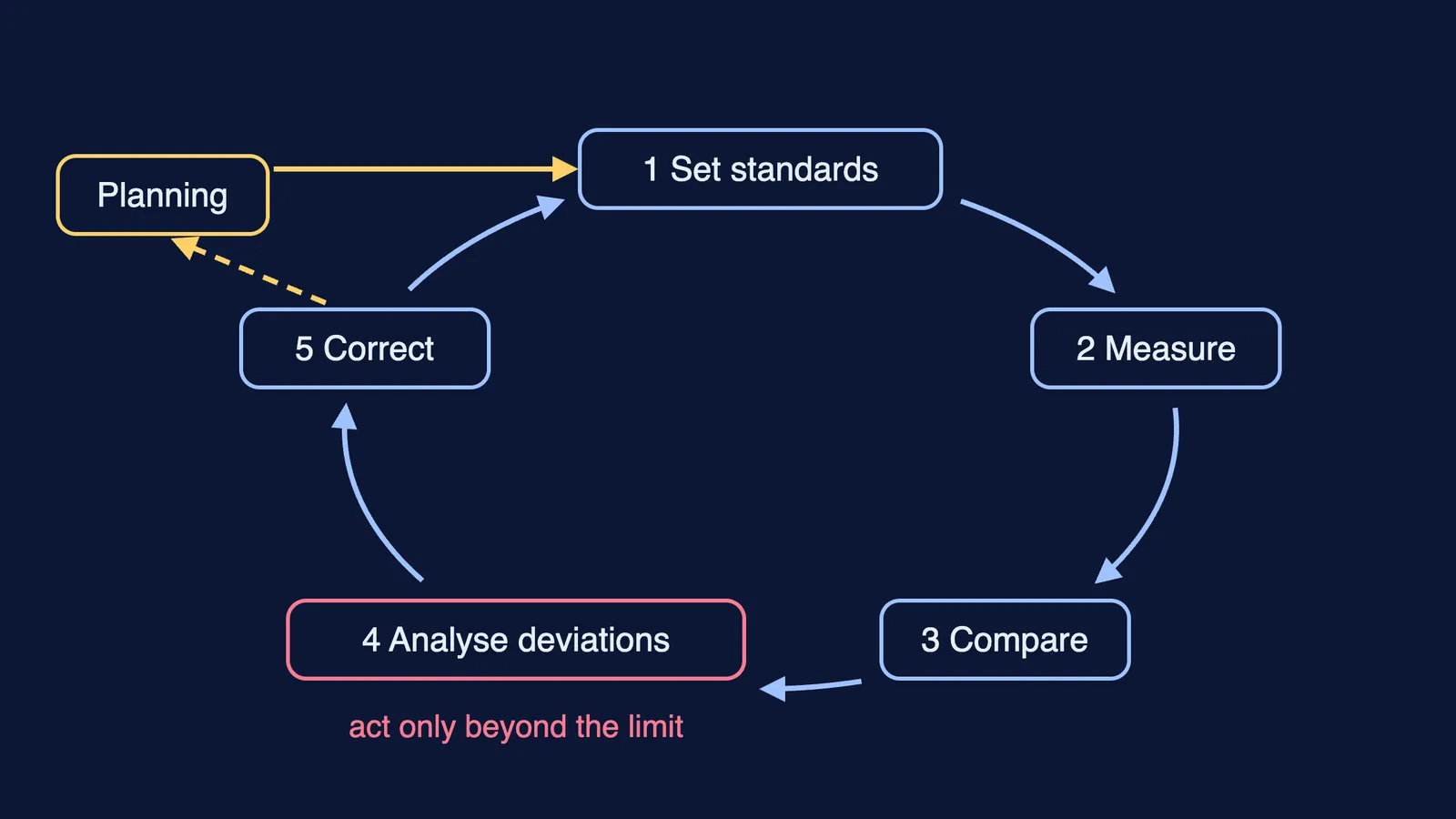
The chapter gives five steps (NCERT, Chapter 8):
Setting performance standards
Measuring actual performance
Comparing actual performance with standards
Analysing deviations
Taking corrective action
A worked example, with made-up numbers: suppose a bakery in Pune plans to sell 1,000 loaves a day and decides that wastage up to 2 per cent is acceptable.
Standard: 1,000 loaves sold daily, wastage no more than 20 loaves. A number makes later comparison easy; "good quality" alone would not.
Measure: the manager counts unsold loaves each evening and checks sample loaves during baking, not only at the end of the day.
Compare: on Monday 26 loaves were wasted, a deviation of 6 loaves over the limit.
Analyse: is 6 loaves significant? The bakery agreed small misses go to the shift supervisor; only bigger gaps reach the owner. The cause turns out to be an oven running hot.
Correct: repair the oven and retrain the night shift. If wastage stays high because demand has fallen, the standard itself may need revising.
Step 4 is where two exam terms live. Critical point control means watching the key result areas where a slip hurts the whole business, rather than checking everything. Management by exception means only deviations beyond the agreed limit go to senior managers, which saves their time and leaves routine problems to subordinates. The curriculum does not name either; the NCERT chapter teaches both inside Step 4, so learn them there.
How are planning and controlling related?
The textbook calls planning and controlling inseparable: planning supplies the standards, and controlling checks whether events follow the plan (NCERT, Chapter 8). Without a plan there is nothing to control against; without control, a plan has no way to be kept on track.
A common question asks whether planning only looks ahead and controlling only looks back. The textbook's answer is that this is only partly true. Plans are built on past experience, and the fixes that controlling makes are meant to improve what happens next, so both look backward and forward. Say so, and add that good plans make control easier while control feeds better plans.
How should you write a board answer on controlling?
For "steps of controlling", name all five in order, then one or two lines each. In case studies, quote the line that matches each step.
For management by exception, give the rule (only significant deviations reach management) and one benefit, such as saving managers' time.
For "planning looks ahead, controlling looks back", say "partly true" and explain both directions.
You can also run the same loop on your own revision: set a weekly target, check it on Sunday, find the cause of any gap and adjust next week's plan. If you study maths alongside commerce, Fermi's AI tutor can work out what you already know and build a plan for the session.
For the units that come before this one, see our guide to Fayol's and Taylor's principles of management and a method to check which management principle a case shows. Part B starts with financial management and capital structure.